
Healthcare Marketing for Doctors, Clinics, Hospitals & Labs
Healthcare marketing cannot follow one playbook for every organization. An independent specialist needs patients to understand the doctor, qualifications, consultation options and practice location. A growing clinic needs patients to find the correct service and book at the right branch. A hospital has multiple service lines and decision-makers. A laboratory needs accurate test and location information. Each deserves a different digital marketing structure.

Find Marketing Support for Your Healthcare Organization
DigiTaTop Agency supports doctors, medical specialists, clinics, hospitals, diagnostic laboratories and healthcare organizations through healthcare SEO, AI-search optimization, Google Ads and PPC, website design, branding, social media management and marketing strategy. Our medical practice marketing starts with your organization, available services and enquiry capacity. Explore medical marketing for doctors for an individual clinician, or medical clinic marketing for a practice, team or clinic group.
Conceptual healthcare marketing workspace. It does not depict a DigiTaTop office or client project.
Choose the type of organization you represent to see the priorities, verification requirements and most relevant next steps. A medical specialty can sit within more than one organization type.
What to explore first: Professional visibility, consultation enquiries and the right practice location
What to explore first: Service, practitioner and branch information with clearer appointment pathways
What to explore first: Department and service-line visibility across locations and teams
What to explore first: Test availability, location discovery and accurate patient information
What to explore first: Specialty-specific content, patient questions and advertising eligibility
How Our Approach Changes by Healthcare Audience
Our approach changes with the structure of the healthcare provider. The following groups share some marketing needs, but differ in what matters most to patients, how services are organized and what must be verified before a campaign or page goes live.
Doctors & Medical Specialists
Digital marketing for doctors, physicians and private consultants begins with a clear professional identity. Potential patients may search for a doctor’s name, a specialty, an available consultation or a specific service in their city. Those journeys need accurate information about the doctor’s qualifications, practice locations, professional role, offered services and contact process.
Physician marketing services and medical practice marketing are most useful when they connect a verified doctor biography, focused consultation and service pages, consistent local business information, accessible appointment enquiries and patient education reviewed by a qualified medical professional. Search and advertising work should reflect what the individual doctor actually offers and where consultations are available.
For a single specialist comparing a healthcare marketing agency for doctors, the right first investment might be fixing the practice website and high-intent search visibility. It might also be a defined paid campaign where the service is eligible to advertise and the appointment process is ready. The decision depends on evidence, not on a default package.
For doctor-led practices, the first priorities often connect healthcare SEO, website design for doctors and eligible Google Ads for doctors with accurate professional information and local discovery.
Medical Clinics & Private Practices
A clinic is more than the sum of its doctors. Patients need to understand available treatments, practitioner options, locations, operating information, insurance arrangements where applicable, and the next step to request an appointment. Small private practices and multi-specialty clinics have different information needs and budgets.
Medical clinic marketing and private practice marketing should map services to the people and locations delivering them. A service page for a procedure should not imply that every branch offers it; a specialist’s profile should not list an outdated clinic affiliation. For multi-location clinics, consistent navigation and localized service details are essential.
DigiTaTop can help a clinic assess the structure of its service pages, organic visibility, paid campaign landing pages, clinic branding and content approval workflow. Where relevant, a local SEO approach connects Google Business Profiles, verified clinic details and useful service-location pages.
For a clinic, relevant starting points can include medical SEO, clinic website design and social media management, chosen around service availability and appointment handling.
Hospitals & Healthcare Groups
Hospital marketing works across departments, service lines, locations, clinical teams and often several approval levels. A patient looking for a specialist clinic has a different task from a healthcare professional or institutional partner evaluating the hospital group.
Hospital digital marketing needs an information architecture that makes departments, treatments, specialists, hospital locations and practical contact pathways easy to distinguish. Content governance is particularly important when many teams contribute information. Campaigns require defined service-line ownership and clear destinations; broad messages that send every visitor to the homepage usually offer too little direction.
For hospital groups, our strategic work can assess which service lines need visibility, how audiences search, how the website connects departments and clinicians, which channels fit the priorities, and which enquiry or referral actions can be measured responsibly. Scale should follow the organization’s actual service inventory and operational capacity.
Hospitals may start with a healthcare marketing strategy to prioritize departments and service lines, supported by healthcare website development and scoped PPC management.
Medical Laboratories & Diagnostic Centers
A laboratory or imaging center must make its offerings practical to understand: what tests or examinations are available, where they are available, whether preparation or referral information applies, and how a person can get in touch. Accuracy matters more than generic promotional claims.
Medical laboratory marketing and diagnostic center marketing may prioritize test and imaging service pages, branch-level information, Google Business Profile visibility, patient-friendly explanations and appointment or enquiry routing. Individual services need appropriate language; marketing copy must not imply that a test diagnoses a condition on its own or that a particular clinical outcome is guaranteed.
For a multi-branch diagnostic provider, the website should distinguish locations and service availability. Search and paid advertising plans should also consider service eligibility, local regulations and the provider’s ability to fulfill enquiries. Clinical or laboratory professionals must approve medically substantive claims.
For diagnostic providers, healthcare SEO and website architecture can connect actual tests and services to the branches that offer them, with promotion only where appropriate.
Medical Specialties & Specialty Practices
A specialty is a clinical focus, not a separate type of healthcare organization. It cuts across doctors, clinics and hospitals. The right marketing approach depends on the actual specialty, patient research journey, treatment eligibility, local service availability and required clinical review.
For example, dental marketing often needs strong local service pages and clear differentiation between consultation types; ophthalmology marketing may need accurate surgeon profiles and information about clinical assessment pathways; fertility clinics require especially careful sensitive-topic communication and advertising-policy checks. Dermatology, cosmetic and surgical specialties may require additional substantiation and patient-image permissions. These are planning considerations, not claims that every service can be advertised in every market.
Medical specialties have different patient questions, treatment pathways, evidence requirements, advertising restrictions and local search patterns. DigiTaTop considers these differences whether the provider is a solo doctor, specialty clinic or hospital department. The organization type and its clinical focus both shape the marketing approach.
A specialty-led strategy may combine medical SEO, physician branding and an approved marketing strategy tailored to the actual specialty, service and target market.
How Priorities Differ Across Medical Specialties
Ophthalmology
Patient or buyer questions: Named eye surgeons, consultations, treatment eligibility
Marketing information to verify: Doctor credentials, services and locations
Dentistry
Patient or buyer questions: Local dental services, practice access, treatment choices
Marketing information to verify: Actual treatments, dental team and appointment routes
IVF & Fertility
Patient or buyer questions: Treatment pathway, clinic credentials and sensitive choices
Marketing information to verify: Clinical claims, advertising policy and careful language
Dermatology
Patient or buyer questions: Medical consultation versus aesthetic-service intent
Marketing information to verify: Treatment category, practitioner role and image permissions
Cosmetic Surgery
Patient or buyer questions: Qualifications, procedure suitability and patient expectations
Marketing information to verify: Claim substantiation, surgeon role and creative consent
Private Medical Consultants
Patient or buyer questions: Named-consultant searches, referrals and availability
Marketing information to verify: Affiliations, consultation locations and contact options
These are examples of the questions that may shape a brief, not claims about campaigns DigiTaTop has completed or a guarantee that any procedure may be advertised.
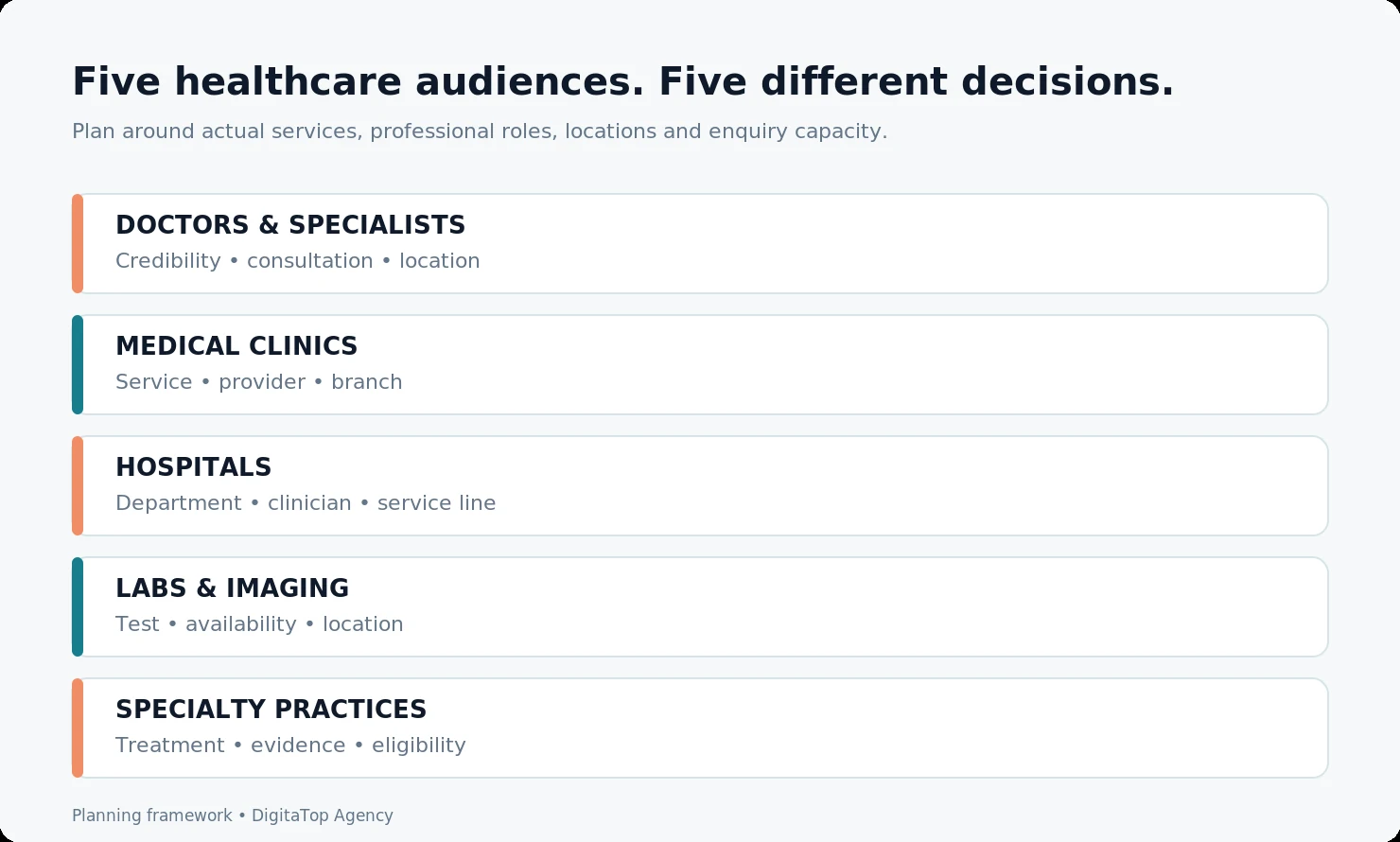
How Healthcare Marketing Changes by Organization
Individual doctor or specialist
What audiences need first: Identity, credentials, consultation options and location
Digital priority to assess: Doctor profile, service visibility, enquiry path
What must be verified: Clinical role, qualifications, offered services, availability
Clinic or private practice
What audiences need first: Treatments, providers, branch and booking details
Digital priority to assess: Service–provider–location architecture, local SEO
What must be verified: Which branch and clinician offer each service
Hospital or healthcare group
What audiences need first: Departments, specialists, facilities and coordinated service lines
Digital priority to assess: Multi-level architecture and service-line campaigns
What must be verified: Department ownership, service details and approvals
Laboratory or imaging center
What audiences need first: Test availability, preparation guidance, branches and contact
Digital priority to assess: Location-specific service discovery and calls
What must be verified: Available tests, equipment claims, referral rules
Specialty practice
What audiences need first: Relevant treatment information and practitioner expertise
Digital priority to assess: Specialty content, compliant promotion and conversion
What must be verified: Clinical claims, permissions, policy eligibility
There is no universal winner between SEO, PPC, AI-search optimization, website redesign and social media management. The best starting point is the constraint most likely to prevent a relevant person from finding accurate information and making a useful enquiry.
Example: Choosing a First Priority
Consider an illustrative multi-location clinic that receives relevant searches but routes every visitor to a general contact page. Before increasing ad spend, a useful assessment would check service availability by branch, the accuracy of practitioner affiliations, mobile appointment paths and whether enquiry events are recorded correctly. The first decision may be to improve location-specific pages and contact routing, not to buy more clicks. This illustrates the type of decision framework, not a published client project or result.
Choose the Right Marketing Starting Point
Your services are hard to find in Google or Bing
Start by assessing crawlability, indexing, search intent, service-page content, location signals and internal links. For providers with several branches or specialties, clarify which services belong to which locations before building more pages. Healthcare SEO services can address technical and content foundations, while local visibility work supports location-based discovery.
People find you but do not enquire
Review mobile navigation, whether the page answers common service questions, professional credibility information, accessibility and contact routes. If visitors cannot locate the correct practitioner or branch, more traffic may not solve the problem. Explore healthcare website design and a practical marketing strategy review.
You need controlled promotion for an eligible service
Paid campaigns can support a defined service and geography when claims and targeting comply with relevant platform and market rules. Search ads, landing pages, media budgets and lead-quality measurement must work together. Explore healthcare PPC and Google Ads management.
Your organization is difficult to understand consistently
An unclear name, inconsistent descriptions of services or disconnected brand assets can undermine trust across the website, business listings and campaigns. A healthcare branding engagement can help align positioning and communication. Relevant content should also make clinical relationships clear and distinguish actual services from marketing promises.
You want better visibility across AI-assisted discovery
Accurate, accessible information about organizations, professionals, specialties, services and locations helps people and search systems understand relationships. Healthcare GEO and AI-search optimization can assess entity consistency, answer clarity and observable mentions or citations. No agency can guarantee inclusion in third-party AI responses.
Your social content lacks a clear purpose
A doctor’s professional communication needs different content priorities from a hospital’s public information or a clinic’s appointment-awareness campaigns. A workable social plan defines formats, review responsibilities, platform choices and appropriate measurement. Explore healthcare social media management.
How DigiTaTop Plans an Engagement
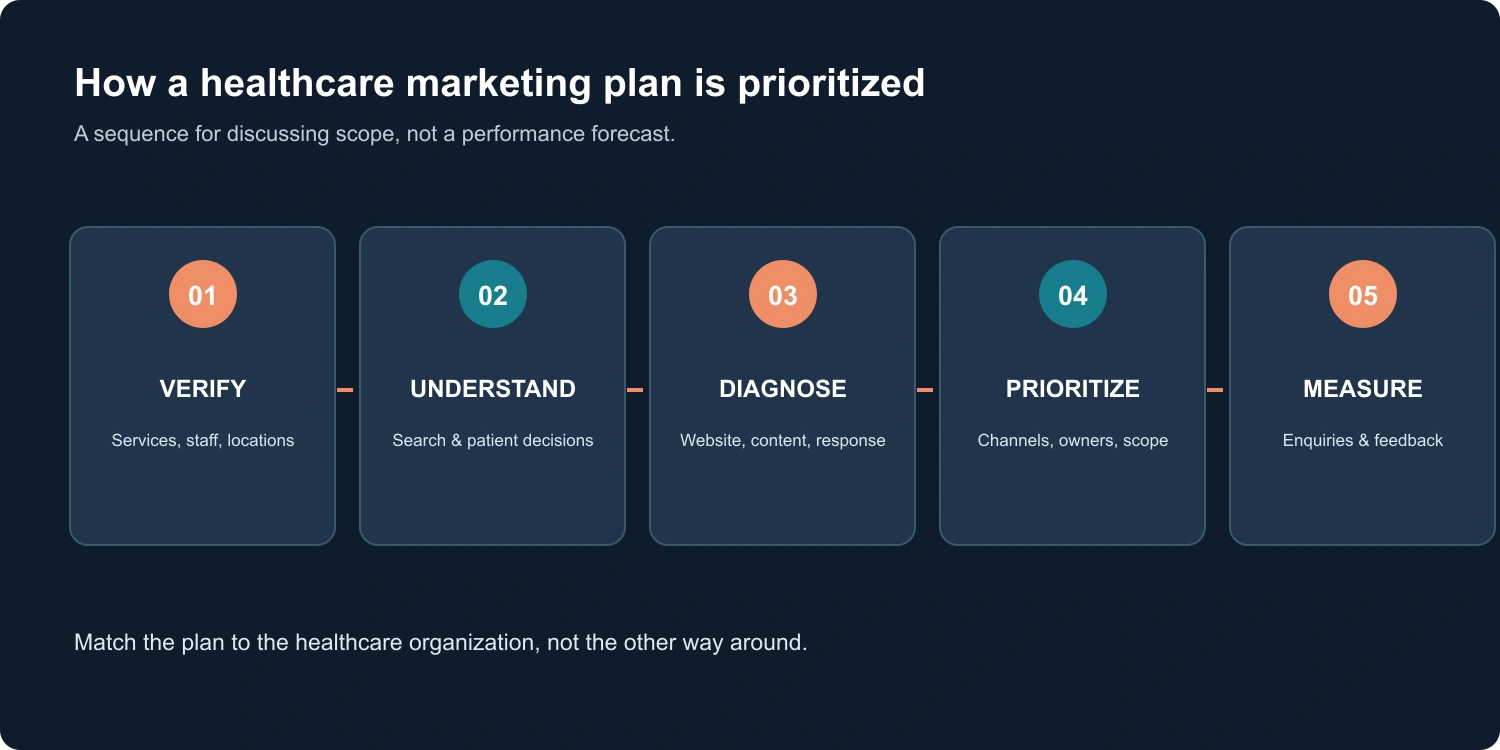
The starting point is an evidence-led discussion, not a commitment to every channel. We use the same core questions, then adapt the work to the healthcare organization.
1. Clarify the healthcare business. Confirm organization type, actual services, professional roles, locations, primary markets and what constitutes a suitable enquiry.
2. Review the discovery and decision journey. Look at how a patient or healthcare buyer finds the organization, evaluates relevant information, selects a practitioner or location and makes contact.
3. Identify constraints and approvals. Separate technical website problems from unclear messaging, low-fit traffic, inconsistent business information and operational follow-up. Assign review of medical claims to the appropriate qualified owner.
4. Choose priorities and scope. Agree the pages, campaigns, creative work, budget boundaries, owners and milestones that address those constraints first. A small doctor-led practice and a multi-branch hospital group need different delivery structures.
5. Measure the right outcomes. Define reported visibility and activity separately from genuine enquiries, appointment requests and confirmed bookings. Record limitations in attribution and privacy-sensitive measurement so reports support decisions rather than overstate results.
This is a practical planning framework. Actual services, deliverable quantities, prices and schedules depend on the agreed proposal. See the healthcare marketing process and compare marketing packages.
Healthcare Marketing in the United States and United Kingdom
DigiTaTop works from Dokki, Giza, Egypt, with healthcare marketing services positioned for organizations in the United States and United Kingdom as well as other agreed markets. Working remotely across markets does not mean the agency has physical offices there or can certify healthcare advertising compliance.
In either market, a campaign should verify practitioner and service information, review medical claims and keep patient information out of ordinary marketing workflows where it does not belong. US and UK rules, platform restrictions, and terminology differ. UK private consultants, US physicians, and multi-location clinic groups should not receive identical copy or targeting simply because they operate in healthcare.
Clinically substantive content needs an agreed division between marketing editing and qualified medical approval. This responsibility must be clear within each engagement, especially for treatment information, diagnosis-related explanations and patient-facing claims.
What Should a Healthcare Organization Ask Before Hiring an Agency?
A useful agency conversation should make the operating model visible. Ask who owns the website and advertising accounts; how a service or branch is verified; which assets and deliverables are included; who approves medical claims; how sensitive patient information is handled; and how enquiries will be reported without confusing them with confirmed patients.
Request scope details relevant to your size. One doctor’s website and local visibility program may be much more focused than a regional hospital group’s information architecture and paid media governance. A proposal should reflect that difference in responsibilities, review periods and cost.
DigiTaTop provides a range of healthcare digital marketing services, but every organization does not need all of them. The first useful step is to discuss which objective, bottleneck and audience deserve priority.
Frequently Asked Questions
Does DigiTaTop work with individual doctors or only large healthcare organizations?
DigiTaTop’s services are positioned for both individual doctors and specialists and larger organizations. A doctor-focused scope may center on professional visibility, an accurate website, local searches and qualified consultation enquiries, while a group engagement can include service-line, department and branch-level coordination.
What is the difference between marketing for a doctor and marketing for a clinic?
Doctor marketing emphasizes the named practitioner’s verified qualifications, specialties, consultation services and locations. Clinic marketing must also explain the organization, its services, practitioner roster, location availability and appointment process. Many projects need both perspectives connected without creating inconsistent or duplicate information.
Can you support hospitals and multi-location healthcare groups?
Yes, a proposed scope can cover healthcare groups and hospitals, including department or service-line architecture, location pages, branding consistency and suitable reporting structures. The exact locations, systems, reviewers, campaigns and management limits are agreed for each engagement.
Do you help medical laboratories and diagnostic imaging centers?
DigiTaTop can scope work for laboratories and diagnostic centers, focusing on accurate test or imaging service content, branch discovery, website structure, local visibility and contact paths. Medical claims, available equipment and patient preparation instructions require approval by an appropriate professional.
Do different medical specialties need different marketing strategies?
Yes. Searches, patient questions, advertising eligibility, claims standards and booking journeys vary between specialties. A fertility practice, an ophthalmologist and a dental group should not receive identical targeting or content structures. The plan should be based on verified services and relevant market rules.
Which service should a new medical practice start with?
Start with the main constraint: whether potential patients can find accurate service information, trust the website, understand the practitioner and contact the practice. Some new practices first need brand and website foundations; others may prioritize local SEO or narrowly scoped paid search. A discovery review determines the sequence.
Can SEO and AI-search optimization work together for healthcare providers?
Yes. Clear service content, accessible pages, consistent organization details and trustworthy sources can support conventional search and AI-assisted discovery. GEO adds structured observations and answer-focused improvement work, but neither SEO nor GEO guarantees a particular search position, AI citation or patient volume.
How can we discuss a project without sharing patient information?
Share your organization type, website URL, services, target locations, marketing objectives and business-level performance where appropriate. Do not send patient records, symptoms or medical histories through general website forms or messaging channels. Any sensitive-data processing needs separate review and suitable safeguards.
Find the Right Starting Point for Your Organization
Whether you represent an individual physician, private clinic, hospital, laboratory or specialty group, a better marketing plan begins with accurate services, a clear audience and a defined next action. DigiTaTop can help assess what is already working, what is blocking discovery or enquiries and which services are worth prioritizing.