
Our Healthcare Content & Medical Editorial Standards
Healthcare content influences decisions about doctors, services, investigations and treatment. It therefore needs more than fluent writing or a list of keywords. It needs a clear purpose, dependable sources, accurate descriptions of the services offered, accountable review and a way to correct information when circumstances change.

What Is a Medical Editorial Standard?
At DigitaTop Agency, our medical editorial standard describes how healthcare marketing content should be researched, prepared, reviewed and maintained for doctors, medical specialists, clinics, hospitals, diagnostic centres and healthcare organisations. We connect these editorial requirements with medical SEO, accessible website content and responsible presentation in search and AI-assisted discovery.
We are a healthcare marketing agency, not a medical authority or a substitute for a clinician. The healthcare organisation retains responsibility for the accuracy of its clinical claims and appoints an appropriately qualified professional to review medically substantive material before publication. DigiTaTop coordinates the editorial, digital and technical work defined in the agreed scope.
Illustrative research workspace. It does not depict DigiTaTop premises, staff or a client project.
A medical editorial standard is a set of rules for producing health-related information that people can understand and evaluate. It defines where facts come from, what requires expert judgement, who approves publication and how updates or corrections are handled. It applies to more than blog articles: treatment pages, doctor profiles, social posts, advertisements, location pages, FAQs and AI-search-ready answers can all communicate medically meaningful information.
For a private consultant, a small factual error in a profile may misstate qualifications or practice location. For an IVF clinic, a simplified success-rate claim may conceal important eligibility differences. For a laboratory, incorrect preparation instructions can cause practical problems for patients. The publication process should recognise those different risks rather than treat all website text as equally routine.
Our content approach keeps four questions visible throughout a project: Is it accurate? Is it supported? Is it understandable? Is it approved by the right person? Search visibility and conversions matter, but they do not override these requirements.
A Five-Stage Healthcare Editorial Workflow
A useful editorial process makes responsibility explicit at every stage. Our proposed workflow has five connected stages: Scope → Source → Review → Publish → Maintain.
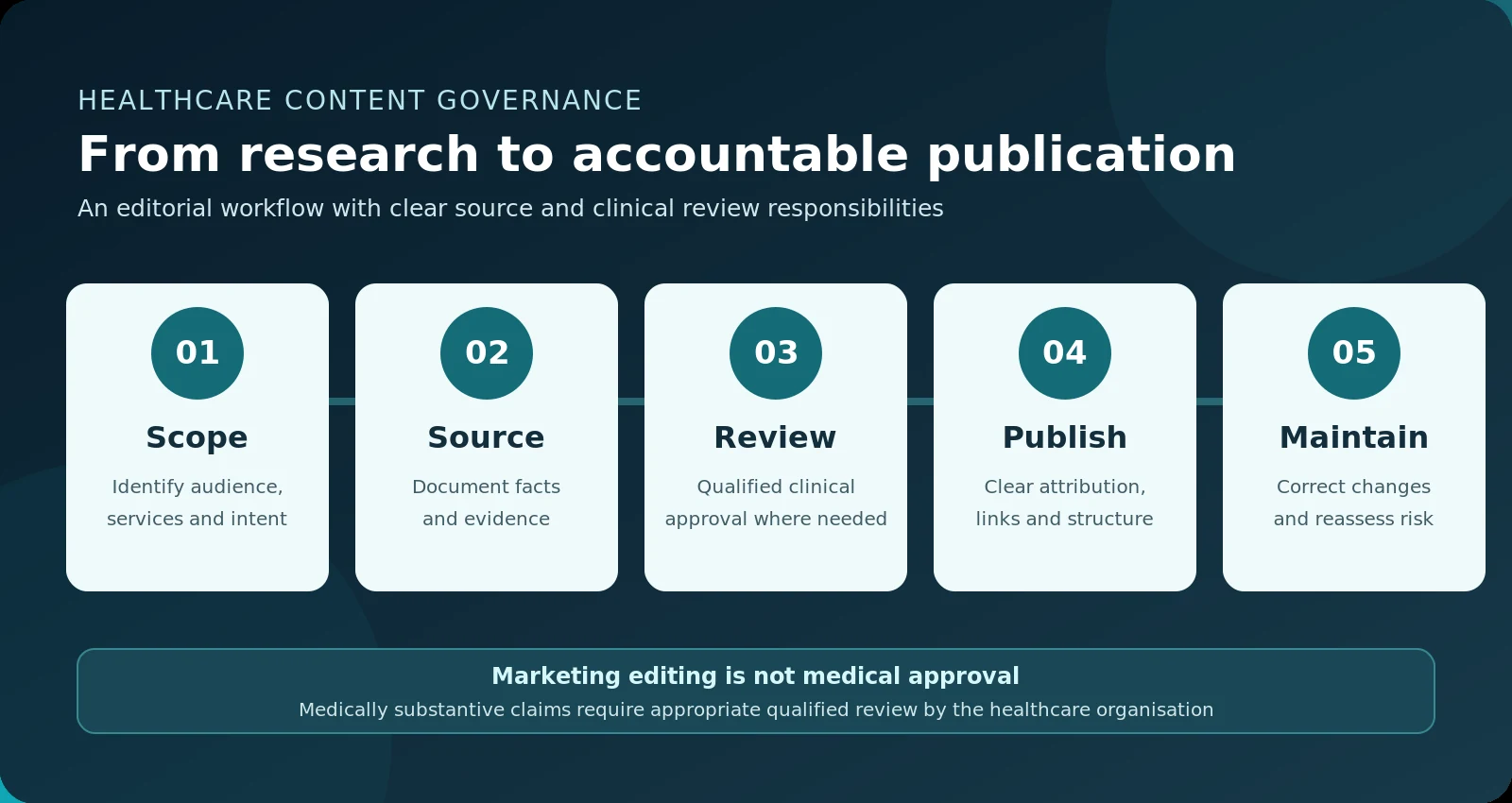
1. Scope the service, audience and information need
We begin by identifying what the page is intended to help someone do. A doctor-profile page should establish the practitioner’s verified role, expertise, affiliations and contact path. A service page should explain the actual service, its intended audience, location availability, relevant limitations and next step. A patient-education article should answer a real question without implying that general information is a personal diagnosis.
Before drafting, we request an approved inventory of services and providers, locations, target countries, language variants and relevant decision points. Content briefs distinguish commercial, educational and practical intents so one page does not try to answer incompatible questions.
2. Source facts and identify uncertainty
Medical claims require evidence appropriate to the claim. Sources may include recognised clinical guidelines, official professional bodies, public health authorities, reputable research publications and verified client-owned information. A supplier page, a single study, an online forum or a competing clinic’s marketing text is not automatically enough to support a treatment claim.
The research record should note the source title, organisation or author, link, publication or update date when available, and which statement it supports. We distinguish established guidance, emerging evidence, client-specific service facts and marketing positioning. Where there is legitimate uncertainty, the wording should show it rather than disguise it as certainty.
3. Route medically substantive material to qualified review
DigiTaTop can prepare the content structure and editorial draft, but medically substantive sections need approval by a suitable client-designated clinician or qualified subject-matter professional. The reviewer should be relevant to the specialty, and the organisation should verify the reviewer’s credentials and authority to approve that information.
Review responsibilities may include diagnoses or treatment explanations, risks and benefits, patient preparation, clinical indications, equipment claims, comparison language and time-sensitive medical guidance. A marketing editor can improve clarity and consistency; that is not the same as clinical sign-off. If required review or supporting evidence is missing, the claim should not be published as a verified medical fact.
4. Publish with clear attribution and useful page structure
An approved page should make it easy for readers to identify the responsible organisation, understand what the material covers and move to an appropriate next step. Where editorial and clinical roles are relevant, author and reviewer information should be accurate and visibly attributed. We do not invent doctor bylines, qualifications, institutional affiliations or publication dates.
Publication checks can include headings, accessibility, mobile readability, descriptive internal links, visible source references where helpful, current contact information, metadata, and relevant structured data that accurately reflects the page. An FAQ is useful only when the answer helps a reader; adding schema does not turn unsupported advice into trustworthy information.
5. Maintain, correct and retire outdated information
Medical services, staff, clinic locations, guidelines and platform policies can change. Content maintenance starts with identifying which facts are most likely to age. We recommend an agreed review owner, a documented correction route and periodic checks based on subject risk, not an arbitrary claim that every page is reviewed daily.
A high-impact change, such as a clinician leaving the practice, a service becoming unavailable or a material clinical recommendation changing, should trigger a specific review. Substantive corrections may require new clinical approval. A change log should record what changed and when; a cosmetic edit should not be used to imply a thorough new medical review.
How We Evaluate Medical Sources and Healthcare Claims
Different statements require different proof. A source is useful when it is relevant to the exact claim, sufficiently current for the subject and credible in context.
Doctor's qualifications and role
Preferred evidence and check: Verified professional biography, registration or organisational record where applicable
Publication decision: Confirm name, title and current affiliation
Service or treatment availability
Preferred evidence and check: Client-approved services, locations, eligibility and booking details
Publication decision: Publish only where the service is offered
Clinical benefits, risks or comparisons
Preferred evidence and check: Relevant current clinical guidance and evidence reviewed by an appropriate expert
Publication decision: Preserve limitations and avoid guarantees
Patient preparation or aftercare
Preferred evidence and check: Client-approved, specialty-specific instructions and accountable clinical reviewer
Publication decision: Do not replace individual care instructions
Numerical results or success rates
Preferred evidence and check: Defined population, timeframe, methodology, limitations and approved provenance
Publication decision: Include context; otherwise omit claim
Testimonials and patient images
Preferred evidence and check: Appropriate permissions, clinical and advertising review, and privacy controls
Publication decision: Do not infer consent from public availability
We avoid fabricated citations, invented statistics, unsupported superlatives such as “the safest” or “the best,” and claims that every patient will experience the same result. Evidence is assessed in its full context; even a genuine study may not support a particular provider’s marketing statement.
A practical example: moving from a claim to an accurate explanation
Consider a hypothetical eye-clinic headline: “Laser treatment guarantees perfect vision with no recovery time.” That statement is too absolute and cannot be repaired simply by adding an unrelated citation. A more responsible direction is to explain which vision-correction services the clinic actually provides, that suitability depends on clinical assessment, that outcomes and recovery vary, and how a patient can arrange an evaluation. Final procedure-specific wording and risk information must be approved by the responsible clinician.
The editorial goal is not to make a weak claim sound more persuasive. It is to help readers understand the real service well enough to make a better-informed next decision.
Medical Content for Doctors and Individual Specialists
Doctor-led websites need accurate professional identity as much as accurate clinical information. Healthcare content writing for doctors should connect the named clinician, verified specialty, available services, current locations and appropriate consultation routes without blurring personal and clinic identities.
An ophthalmologist’s profile may need to separate consultation and diagnostic services from surgeries available at particular facilities. A fertility specialist’s content needs sensitivity to individual circumstances and careful handling of any outcome statistics. A dermatologist’s procedure page may require specific review of promotional imagery or before-and-after claims. A private UK consultant’s page should use accurate professional titles and affiliations rather than generic language copied from another market.
We build content briefs around the clinician’s real scope of practice and the questions a prospective patient needs answered. In specialist practice marketing, a clear and modest statement of what is known is more valuable than a dramatic claim that cannot be substantiated.
Editorial Standards for Clinics, Hospitals and Laboratories
A multi-provider organisation needs additional controls because information can be accurate in general but wrong for a particular branch or practitioner. A treatment may be listed on the website but unavailable at one location. A hospital department may have several clinicians with different responsibilities. A diagnostic test may require preparation instructions or a referral that differ by service.
Healthcare content governance should therefore keep provider, service and location information connected. A useful review checklist asks: Who offers this? Where is it available? What does the page promise? Which route should the visitor use? Who approves a change? For medical groups, an accountable central content owner and a local service-data contact can reduce contradictions between the website, business profiles, advertisements and public-facing patient information.
For laboratories and diagnostic centres, test naming, practical preparation information, booking requirements and equipment claims need precise verification. The marketing team should not infer clinical instructions from similar services elsewhere.
Medical SEO Without Sacrificing Accuracy
Medical SEO content standards should improve discoverability by matching genuine information needs, not by repeating keywords or manufacturing expertise. A well-designed service page can explain who a service is for, what happens at a high level, what is location-specific, and where to ask questions. Supporting articles can answer educational queries and link naturally to relevant services without turning every topic into an aggressive sales pitch.
Our editorial work may connect search-intent research, clear headings, internal linking, content briefs, on-page metadata, accessibility and technical SEO. Relevant pages can link to Healthcare SEO, Healthcare Website Design and the broader Healthcare Marketing Services hub.
Structured data should describe entities and information that are genuinely present on the page. It cannot establish medical qualifications, clinical review or experience that the content does not demonstrate. Content quality, technical accessibility, trusted references and clear business identity remain important for conventional and AI-assisted discovery.
AI-Assisted Writing and AI Search: What We Check
AI tools can assist with outlining, grouping questions, editorial comparisons, style checks and draft variations. They can also invent facts, misstate sources, merge guidance from different countries or produce plausible but inaccurate treatment language. We therefore treat machine-generated statements as unverified draft material, not evidence.
For a medically substantive draft, the same rules apply regardless of whether a human or AI tool suggested the wording: check the actual sources, verify provider and service facts, assess jurisdiction-specific language, send clinical claims to an appropriate reviewer and document approvals. We do not publish fabricated citations, AI-created clinical testimonials or synthetic patient photographs presented as real evidence.
For healthcare AI-search optimization, we aim to make authoritative information easier to interpret through coherent service descriptions, visible sourcing, trustworthy entity relationships and direct answers. No agency can guarantee inclusion, recommendation or citation by ChatGPT, Google AI Overviews, Bing or another independent AI system. Search providers do not require special “AI schema” files as a substitute for useful pages.
Author Attribution, Reviews and Editorial Accountability
A reader should not have to guess whether a page was written by a marketing professional or medically reviewed by a qualified practitioner. When relevant, we distinguish these roles:
Marketing/editorial team
Responsibility: Content plan, structure, drafting, copy editing, page presentation and SEO implementation
Client service owner
Responsibility: Confirms offered services, locations, operational details, prices and current availability
Qualified clinical reviewer
Responsibility: Approves medically substantive statements within their area of expertise
Client publisher/approver
Responsibility: Authorises public release and any required consent, legal or brand review
These roles may be held by different people, depending on project scope. We do not describe every DigiTaTop employee as a medical reviewer, nor do we imply that a client clinician is a DigiTaTop staff member. Where an actual named reviewer is shown, their identity, credentials, review involvement and permission should be verified.
Patient Privacy, Images, Testimonials and Ethical Promotion
Healthcare marketing must respect the dignity and confidentiality of patients. Case stories, photographs, scans, before-and-after images and testimonials should never be reused solely because they are available online or were shared privately with a practice. Approval, lawful processing, permission scope and applicable professional guidance should be assessed for the intended publication context.
We also avoid designing routine marketing enquiry forms that ask visitors to submit detailed medical records. Marketing analytics should not casually transmit symptoms, diagnoses or other sensitive health information to advertising platforms. Appropriate data flows and consent requirements depend on the organisation, market and technical setup.
For US-facing healthcare marketing, applicable FTC health advertising standards and privacy requirements matter. UK medical professionals should also consider GMC guidance on accuracy, trust and confidentiality, alongside applicable advertising and data-protection rules. The healthcare organisation and its legal or clinical advisers remain responsible for determining their specific obligations.
Updating, Correcting or Questioning Healthcare Content
Accuracy is a continuing obligation. When a page appears to contain a factual error, outdated service detail, questionable source or misleading claim, we recommend a clear reporting path. The relevant business or clinical owner should review the issue, determine the correction, and approve any updated clinical wording before it is republished.
Not every edit is equal. Correcting an office address may require operational confirmation; rewriting a treatment benefit may require clinical review; withdrawing an unsupported outcome claim may be the safest immediate action. Records of material changes make editorial accountability more credible than an unexplained “last updated” label.
If you represent a healthcare organisation and need to correct content prepared during a DigiTaTop project, contact the agreed project owner or reach us through DigiTaTop’s contact page.
Professional Guidance We Reference
Our editorial approach is informed by established principles in Google Search Central’s guidance on helpful, reliable content, Google’s guidance for AI features in Search, the GMC’s professional standards for accurate public communications and the FTC’s guidance on substantiating health-related advertising claims.
These materials inform editorial decisions; they do not constitute a certification, replace country-specific legal advice or establish that a particular marketing claim is permitted.
Frequently Asked Questions About Medical Editorial Standards
Does DigiTaTop medically review every article it writes?
DigiTaTop provides editorial, SEO and digital marketing work. We request qualified review and approval for medically substantive content from the healthcare organisation’s appropriate clinical or subject-matter professional. We do not claim that every page is reviewed by an in-house doctor. The responsible review roles and approvals should be agreed before publication.
What sources should a medical article use?
Sources should fit the question and claim. Useful starting points include recognised clinical guidelines, public-health authorities, professional bodies and appropriately evaluated research. Service availability, doctor credentials and local procedures also require current client-confirmed facts. A citation is only useful when it actually supports the accompanying statement.
Can AI write healthcare website content?
AI can help prepare an outline or initial text, but outputs are not automatically accurate or sourced. Facts, references, services, legal context and medical claims still need verification and appropriate professional approval. Synthetic references, invented testimonials or unsupported clinical conclusions should never be presented as verified information.
How does medical content differ from ordinary SEO copywriting?
Health-related content can affect decisions about safety and treatment. That raises the importance of accurate terminology, appropriate evidence, clinical limitations, service availability, professional review, and careful handling of patient information. Keywords, attractive design and persuasive copy cannot replace these controls.
How do you handle doctor profiles and credentials?
We seek verified names, titles, specialties, current practice affiliations and service locations from authorised client records. Relevant credentials and registrations should be confirmed before they are published. We do not add awards, qualifications, procedures or institutional roles on the basis of assumptions.
Can a clinic publish patient stories or before-and-after images?
Potentially, but the organisation should first assess permission, confidentiality, applicable law and professional advertising rules for the specific material and intended use. An identifiable patient image or testimonial should not be treated as automatically available for marketing simply because someone previously shared it.
How often should medical website content be updated?
Review frequency should depend on subject matter, the likelihood of change and potential risk to readers. Provider and location details may need prompt updates; medically substantive guidance may need review when authoritative recommendations change. A meaningful review should be recorded rather than implied by changing a displayed date.
Does following editorial standards guarantee Google rankings or AI citations?
No. Reliable content and clear structure can support search eligibility, user trust and accurate interpretation, but third-party search and AI systems make independent decisions. There is no guaranteed ranking, AI citation or recommendation from an editorial checklist, a set of FAQs or structured data alone.
Build Healthcare Content People Can Rely On
If your medical practice, clinic, hospital or healthcare group needs accurate service pages, trustworthy doctor profiles or a more consistent review process, DigiTaTop can help define the editorial and digital scope. Tell us which services and markets matter, what verified information is available and who can approve clinical material.