
Healthcare GEO & AI Search Optimization Services
Help your healthcare organization become easier to discover and understand across AI-powered search. DigiTaTop is a healthcare GEO agency focused on clinics, medical practices, hospitals and medical groups. Our healthcare GEO services combine buyer-question research, verified business and clinical information, evidence-backed page improvements and transparent citation monitoring across selected AI search experiences.
This work complements healthcare SEO and carefully reviewed healthcare content marketing. We assess what AI systems can find and reference about your services, then improve the underlying information where gaps exist. You receive an agreed set of deliverables and a dated measurement record, not a promise of placement.

A clear scope, an honest measurement record
A documented assessment, approved content and entity improvements, and reporting that distinguishes sampled AI mentions, visible citations, detectable referrals and qualified enquiries. We cannot guarantee recommendations or citations from ChatGPT, Google AI Overviews, Copilot, Gemini, Perplexity or any other platform.
What Are Healthcare GEO Services?
Healthcare generative engine optimization (GEO) is a service that improves the accuracy, clarity and supporting evidence of a healthcare organization’s publicly available information for AI-assisted search. It builds on established SEO, crawlable service pages, helpful content, trustworthy sources, accessible website information and consistent business identity, and adds structured buyer-question research and dated AI-answer observations.
For healthcare buyers, GEO means the answer to a practical question should be supported by real information: which locations provide a treatment, which clinician is responsible, what the service involves and how to enquire. The work improves the sources that patients and AI search experiences may consult; it cannot control the content of a particular generated answer.
You may also see healthcare AI search optimization, healthcare answer engine optimization (AEO), AI SEO and medical GEO services. These related terms describe overlapping work. DigiTaTop’s offering is a defined GEO service with observable research, source improvements and reporting, not a separate ranking algorithm or a shortcut to inclusion in AI answers.
For a dental practice, that could mean checking whether publicly available information clearly distinguishes general dentistry from implant treatment, and whether practitioners and locations are correctly attributed. For a fertility clinic, it might involve explaining available care pathways without publishing unsupported success-rate claims. For a hospital group, the main challenge may be keeping location, department and provider information consistent.
GEO is not an alternative to standard SEO. Google says that its AI search features rely on familiar SEO foundations rather than special AI-only markup. An eligible page may still never appear in a particular generated answer. Google’s guidance on AI search features explains this distinction.
Who Benefits from Healthcare AI Search Optimization?
GEO is most relevant when prospective patients research your services through conversational search, while your public content is incomplete, inconsistent or difficult to attribute to a verified provider.
- Independent clinics and medical practices: clarify specialties, treatment availability, practitioners, fees where published and appointment routes. A practice looking for AI search optimization for medical practices may begin with its highest-value service pages.
- Dental, fertility, ophthalmology and other specialty clinics: support longer patient research journeys with clinically reviewed answers and accurate distinctions between treatments, locations and providers.
- Hospitals and multi-location groups: connect departments, providers, branches and service-specific enquiry paths so public sources do not imply every location offers every procedure.
- Diagnostic centers and laboratories: describe which tests are offered, where they are available and what practical preparation information has been approved.
If you are comparing a medical GEO agency with a broader healthcare marketing partner, ask whether the provider can handle real clinical-review workflows, multiple locations, commercially useful pages and transparent AI observations, not only produce AI-friendly copy.

What DigiTaTop's Healthcare GEO Services Include
DigiTaTop scopes GEO around what prospective patients or healthcare buyers actually need to establish before taking action. Services can be purchased as a standalone program or, where an active SEO engagement supplies the technical and editorial foundation, as an add-on without duplicating that work.
Buyer-question and answer-surface research
We assemble a fixed set of relevant, natural-language questions based on the approved specialty, services and markets. These can include service suitability, availability, location, clinician credentials, practical next steps, cost explanations, comparisons and organization-specific questions. We separate informational research from questions that signal readiness to contact a provider.
We then select the AI surfaces that can be observed under the agreement. Availability and output can vary by country, login state, product interface, model and whether live web search is used. Our reporting always states what was actually tested.
Entity and service clarity
We review how the organization identifies itself across the website and public sources: legal and consumer-facing business names, genuine locations, services actually offered, responsible clinicians, organizational relationships and contact routes. Where evidence is missing or inconsistent, we recommend corrections rather than inventing entities or inserting excessive keywords.
Healthcare AEO and source-backed answer improvement
We strengthen high-value pages with direct explanations, medically reviewed service details, usable navigation, supporting evidence and clear distinctions between eligibility, benefits, risks and next steps where those points apply. Relevant sources can include verified organizational facts, official service information and appropriately referenced authoritative publications.
Our healthcare AEO approach starts with a helpful, direct answer for the reader, then provides the service detail and supporting evidence needed to make an informed decision. We do not split useful content into artificial fragments or add unverified claims simply to target a phrase.
Selected-page improvements and editorial outreach
Monthly allowances define how many existing-page improvements and relevant editorial outreach attempts can be undertaken. A page improvement might refine a service explanation, strengthen clinician attribution, correct a location relationship, update accessible facts or improve supporting citations. Outreach is to suitable editorial or industry sources; an attempt is not a placement or link guarantee. New pages, paid placements and additional asset production are separately scoped unless included in a signed proposal.
Measurement and prioritization
We keep observations, website changes and business outcomes separate. Reports show what was checked, what appeared, which URLs were cited when visible, what was improved and what remains uncertain. These records support decisions; they do not constitute a census of all AI answers or proof that an individual edit caused an answer to change.
What a Healthcare GEO Assessment Delivers
A GEO assessment should produce more than a slide promising “visibility in ChatGPT.” Depending on the purchased scope, the handover can include a verified service and location inventory, a fixed buyer-question set, an AI-surface observation log, an entity and source-gap register, and an ordered brief for improving the most commercially important existing pages.
The baseline answers three questions: What can be verified about your organization? What appeared on the AI surfaces tested? Which source corrections would make your public information more useful?
Establish a Dated AI Visibility Baseline
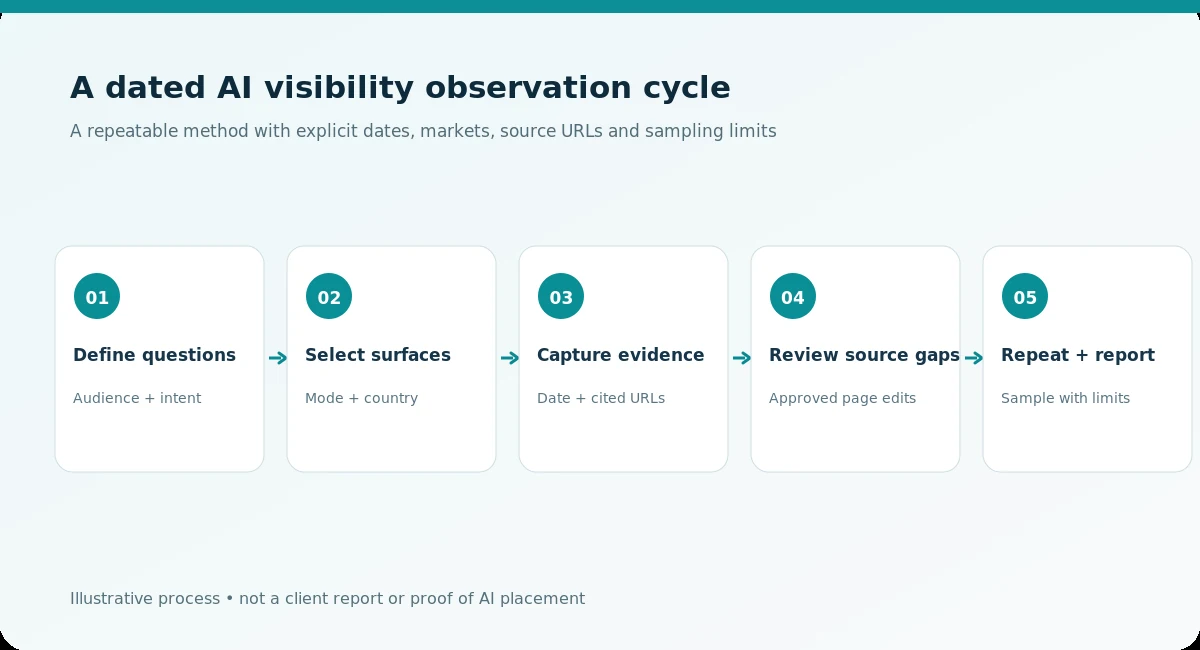
You cannot meaningfully compare AI answers without recording how, when and where they were observed. Our first step is a dated baseline built from an approved prompt set and a named selection of accessible AI products or modes.
For each observation, the log records, where available:
- Exact question and its buyer intent, for example, research, comparison or local discovery.
- Market and context, US or UK, relevant city if specified, device or interface, and whether the experience was logged in.
- Platform and mode, such as an AI chat product with web search enabled or a search-engine AI result, including the displayed model or mode when available.
- Date and run, the time observed and a repeat identifier.
- Brand appearance, whether the organization was named, whether its facts were described correctly, and which competitors were named, if any.
- Visible source evidence, cited URLs, references or source panels where available; record none observed rather than assuming a hidden citation.
- Follow-up, an identified fact gap, page owner, recommended correction and review date.
Example: a practical healthcare GEO assessment record
The example below illustrates a deliverable format; it is not an actual client audit, a real AI-generated response or proof of performance.
Buyer question
Illustrative entry: Which London clinics offer a particular diagnostic test?
Market and surface
Illustrative entry: London, UK; selected AI search surface and mode recorded at assessment
Observed information gap
Illustrative entry: The clinic’s public test page does not specify the operating locations
Proposed correction
Illustrative entry: Verify the service-location relationship and update the test and branch pages
Evidence and approval
Illustrative entry: Approved test inventory, current branch records and clinical reviewer where needed
Retest plan
Illustrative entry: Repeat the same question under documented conditions and record mentions and visible sources
Reporting limit
Illustrative entry: A clearer answer is not proof of an AI ranking, referral or booked appointment
This makes the AI visibility assessment for healthcare providers tangible. It also shows where the agency’s deliverable ends and a platform’s independent answer begins.
How we report samples, not invented market share
Each package uses its agreed fixed question set, observed once per selected AI surface each month, with repeats for 20% of the questions to illustrate answer variability. We label the exact number of questions, platforms, runs, citations and brand mentions. A higher sampled mention rate is not automatically an increase in market-wide share, patient demand or revenue.
Where access and eligibility allow, we can also review first-party information from search and analytics products. Bing Webmaster Tools, for example, has an AI Performance report showing citations, cited pages and grounding-query groups across supported Microsoft AI experiences. Those grouped phrases are not exact user prompts and should not be treated as universal search-volume data. Bing Webmaster Tools’ AI Performance announcement.
Clarify Your Brand, Services, Locations and Expertise
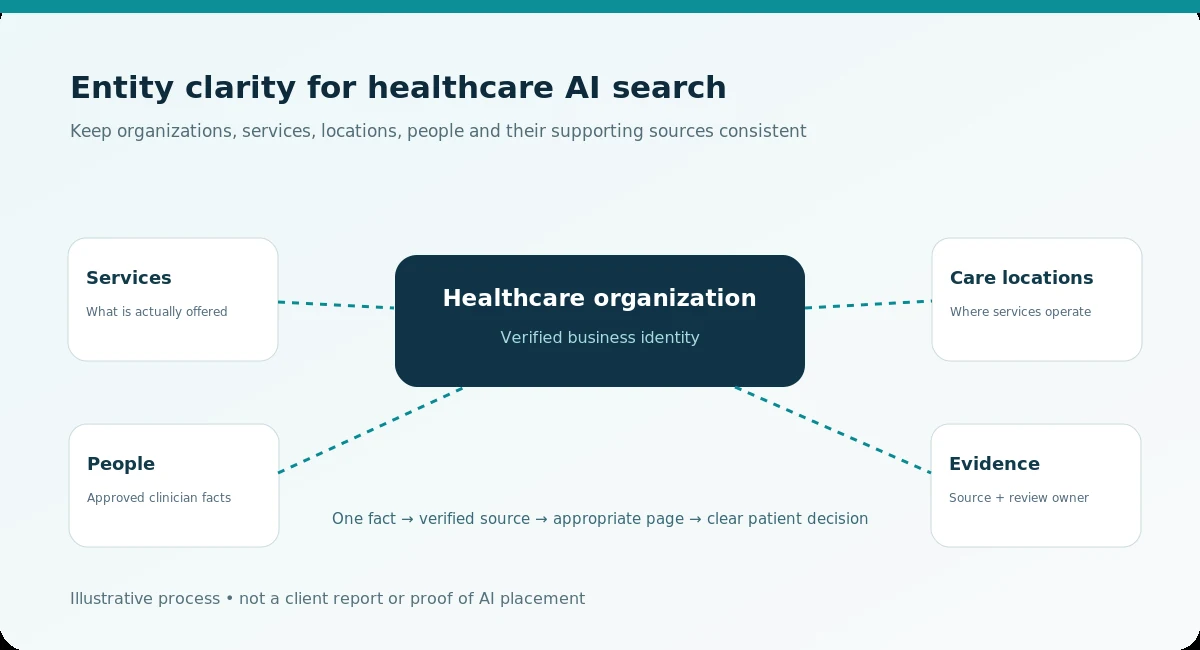
Healthcare organizations can have complicated public identities. A hospital may have multiple sites, a consultant may work at more than one facility, and two departments may offer similar tests with different referral requirements. If public pages conflict, people can become confused, and search tools may encounter the same ambiguity.
We prepare an entity and evidence register that distinguishes:
- Organization: the verified brand and, where useful, the legal operator; legitimate business profiles and contact channels.
- Care location: correct address, services available, hours and accessible enquiry details for each operating site.
- Service or treatment: who provides it, its indications in carefully reviewed language, and the authoritative destination page.
- Clinician or team: accurate credentials, specialties and affiliations approved by the organization.
- Source evidence: which page supports each important factual statement and who is responsible for reviewing it.
A well-structured page should answer a concrete question without depending on hidden accordion text or a decorative diagram. We pair contextual internal links with accessible HTML descriptions, and recommend structured data only where it describes real visible information. Generic `llms.txt` files or extra schema do not promise inclusion in search-generated answers.
Improve Content That AI Answers Can Reliably Reference
Our content review focuses on questions that matter to patients and buyers, rather than producing hundreds of nearly identical AI-oriented pages.
Make the answer direct. For example, the first paragraph of a provider service page should state what the service is, the relevant audience and the next step. Additional details can follow in sections for process, suitability, preparation, aftercare or practical questions, where clinically appropriate.
Distinguish facts from marketing claims. Provider qualifications, accreditation, operating locations, costs, supported treatments and reported outcomes must be checked before being presented as facts. Testimonials and case studies require appropriate permission. We do not manufacture patient stories, clinician identities or ranking screenshots.
Resolve conflicts at their source. If the website, business listings and external profiles disagree about a branch’s services, we prioritize verified corrections and the canonical source page. Repetition alone will not fix inaccurate information.
Improve evidence and attribution. Material medical claims should have an identified clinical reviewer and a suitable evidence source. Where a treatment page cites a guideline, the link should remain accessible and current; where first-party claims are made, the appropriate records and approvals should exist.
Connect the journey. An answer can lead to another question. The content architecture should connect service pages, clinicians, locations, relevant supporting articles, costs where published and a usable enquiry path.
A useful deliverable: the evidence improvement brief
For each selected page, we can record the intended buyer question, current wording, proposed improvement, source or approver, related entities, internal links and validation status. This makes the work reviewable by practice managers, clinicians and marketers before publication.
Track Citations, Referrals and Business Outcomes Separately
An AI brand mention, a visible website citation, an identifiable website visit and a qualified patient enquiry are four different events. Treating them as one growth metric overstates what the data proves.
Sampled brand mention
What it can tell you: Brand appeared in a tested response
What it cannot prove: Overall platform visibility or recommendation share
Visible citation
What it can tell you: A URL was visibly referenced in the observed answer
What it cannot prove: That a user clicked or that a content edit caused the citation
Cited-page or grounding report
What it can tell you: Supported AI experiences referenced particular pages or grouped terms
What it cannot prove: Every prompt, the exact reason for citation or total demand
Identifiable referral visit
What it can tell you: A visit was tagged or reported from a source when detectable
What it cannot prove: All AI-origin visits, because referral data can be missing
Qualified enquiry
What it can tell you: A genuine contact concerning an applicable service and market
What it cannot prove: A completed booking or collected revenue
For healthcare organizations, analytics implementation must be reviewed for appropriate data collection and consent. We should not place identifiable patient health information into general-purpose analytics, advertising platforms or AI tools. Clinical, legal and privacy specialists should approve sensitive workflows as needed; DigiTaTop does not promise legal certification by delivering GEO.
The monthly report should answer three questions
What was observed? The fixed questions, surfaces, repeat runs, visible mentions and citations, with dates and sample sizes. What changed on the website? The exact approved edits, sources, owner and publication status. What should happen next? The unresolved facts, the most valuable page improvements, and any meaningful referral or enquiry evidence.
No platform can guarantee future mentions, citations or referrals. Our goal is to improve source quality and reduce avoidable ambiguity, then evaluate the evidence honestly.
Healthcare GEO vs SEO: Which Service Should You Start With?
Improves organic search eligibility, crawlability and page usefulness
Healthcare GEO / AI search optimization: Reviews how relevant AI experiences surface and describe available information
Maps service, location and educational keywords to appropriate URLs
Healthcare GEO / AI search optimization: Maps natural-language buyer questions to answers, entities and evidence
Improves technical SEO, content, internal links and authority
Healthcare GEO / AI search optimization: Uses those foundations and adds answer/source observation and evidence-gap reviews
Tracks indexed pages, impressions, clicks and qualified conversions
Healthcare GEO / AI search optimization: Tracks sampled mentions/citations, available AI reports, detectable referrals and related enquiries
Cannot guarantee Google rankings
Healthcare GEO / AI search optimization: Cannot guarantee AI answer inclusion or recommendation
If your site is hard to crawl, key service pages are missing or local SEO is weak, healthcare SEO may be the better first investment. If the technical foundation is working but the public description of specialties, locations and evidence is fragmented, a targeted healthcare GEO program may help clarify those sources. Many organizations need both, but shared editorial and technical work should have one accountable owner and one allowance.
Buyers searching for generative engine optimization for healthcare should evaluate the full scope: verified information, useful content, eligible search foundations, transparent AI observations and meaningful business measurement. No special schema property or `llms.txt` file substitutes for those basics.
See all healthcare marketing services or review the delivery process.
Healthcare GEO Packages and Starting Prices
DigiTaTop offers three healthcare GEO service tiers with clear starting fees and monthly allowances. All prices are in USD; your written proposal confirms the included platforms, markets, deliverables and exclusions.
AI Foundation
Starting at
$950/ month, USD
Active SEO add-on: $450/month
Establish a disciplined AI-search baseline for one clinic.
- One brand and one location
- 20 fixed buyer questions
- 3 selected AI surfaces
- 2 existing-page improvements / month
- 2 editorial outreach attempts / month
- Monthly observations, 20% repeat sample
AI Authority
Starting at
$1,750/ month, USD
Active SEO add-on: $750/month
Explore a broader question set for a competitive practice.
- One competitive practice
- 40 fixed buyer questions
- 4 selected AI surfaces
- 4 existing-page improvements / month
- 4 editorial outreach attempts / month
- Monthly observations, 20% repeat sample
AI Network
From
$3,000/ month, USD
Active SEO add-on: $1,250/month
Coordinate verified information across a healthcare group.
- One brand, up to 3 locations
- 60 fixed buyer questions
- 4 selected AI surfaces
- 6 existing-page improvements / month
- 6 editorial outreach attempts / month
- Monthly observations, 20% repeat sample
Share your specialties, locations and current SEO setup. We will recommend a suitable plan.
What the First 90 Days Can Look Like
Days 1–30: verify facts and establish the observation baseline
Confirm the service and location inventory, review accessibility and indexed-source readiness, agree exact buyer questions and test conditions, record the first observation log and develop a prioritized source-gap plan. Clinical review responsibilities and publication permissions are established before medical claims are changed.
Days 31–60: improve the highest-value sources
Apply approved existing-page improvements within the purchased allowance, correct confusing organization/service relationships, document source attribution, and undertake relevant editorial outreach attempts. Retest the same questions under comparable conditions while recording platform variability and missing data.
Days 61–90: compare observations and refine priorities
Review repeat samples, cited sources and any available first-party search/AI reporting; assess whether relevant referrals or qualified enquiries can be distinguished reliably. Summarize completed work versus external outcomes, then recommend whether SEO, content, local visibility or further GEO activity is the next most valuable step.
This is a possible delivery sequence, not a forecast of citations, traffic, booked appointments or revenue within 90 days.
Healthcare GEO for the US and UK
Patients in both markets may ask about a procedure, a practitioner, costs, location and trust, but health-system terminology, insurance or payment context, referral practices and advertising expectations differ. A United States clinic should not inherit an NHS-oriented explanation; a UK practice should not publish US-specific insurance assumptions. Localize real service availability and terminology based on the intended audience rather than duplicating pages with only a country name changed.
Content involving medical risks, diagnosis, treatment claims and outcome statistics requires appropriate clinical approval. Privacy-sensitive tracking and advertising should be reviewed under applicable requirements by qualified advisers. DigiTaTop serves these markets from Egypt; a GEO engagement does not imply a US or UK physical office.
Why Work With a Healthcare GEO Agency That Documents the Evidence?
A healthcare GEO agency should explain exactly what it can deliver. DigiTaTop’s proposed method is auditable because it uses fixed buyer questions, named AI surfaces, dates and markets, source URLs where shown, approved page changes, defined package quantities and explicit reporting limits. Healthcare organizations can review this evidence with their marketing lead and appropriate clinical approver rather than relying on unverifiable “rank in AI” promises.
Before signing, ask to review a sample anonymized observation-log format and a sample page improvement brief. Actual client case studies or proprietary results should be shown only when permissioned, with the project, period and methodology identified. A conceptual illustration is not client proof.
Frequently Asked Questions
What are healthcare GEO services, and are medical GEO services different?
Healthcare GEO services improve the clarity, accessibility and supporting evidence of healthcare organizations’ public information for AI-assisted search, while monitoring selected AI experiences. “Medical GEO services” generally refers to the same work for doctors and medical providers; healthcare GEO can also include hospitals, dental practices, laboratories and larger healthcare groups. Both complement SEO.
Can you guarantee my clinic appears in ChatGPT or Google AI Overviews?
No. AI answers vary with the question, platform, market, mode and time. No ethical GEO provider can guarantee a recommendation, citation, ranking or exact traffic outcome. We commit to the defined research, updates and transparent observations.
How do GEO, healthcare SEO and AEO work together?
SEO supports crawlable, useful website content and traditional search visibility. Healthcare GEO adds question-based AI observations, entity and evidence review, and selected source improvements. Answer engine optimization (AEO) overlaps with making relevant answers clear and well supported. None of these methods can guarantee that an AI product will display or cite a given provider.
How do you measure AI search visibility?
We agree fixed prompts, markets and surfaces, then record exact observations with dates, brand mentions, visible citations and repeat runs. When available, first-party AI reporting and identifiable referrals are reviewed separately. We report the sample size and missing-data limitations.
How much do your healthcare GEO services cost?
Published starting prices are $950, $1,750 and from $3,000 monthly for standalone Foundation, Authority and Network tiers. Active-SEO add-ons are $450, $750 and $1,250 monthly respectively, with shared allowances rather than duplicated audits. An approved proposal confirms terms and exclusions.
Will AI search optimization for my medical practice require new pages?
Not necessarily. It often starts with improving existing service pages, provider and location information, internal links and credible evidence. New website pages or substantial content production are separately scoped unless included in the agreed proposal. We avoid creating near-duplicate pages for “medical GEO” and “healthcare GEO” when they serve the same intent.
Which healthcare providers can use this service?
Depending on fit and approved scope, potential clients include doctors, clinics, dental practices, fertility providers, ophthalmology practices, medical centers, hospitals and diagnostic organizations. The observation prompts and page priorities must reflect actual services, verified credentials and operating locations.
What do you need from our organization to start?
We need the website and relevant account access, verified service and location information, target markets, priority specialties and a decision-maker for marketing approval. A qualified clinical reviewer should approve medical claims and sensitive content. The baseline can begin after the observation surfaces and deliverables are agreed.
Request a Healthcare GEO Assessment
If you want to understand how your practice is described in AI-assisted search, start with the questions prospective patients ask and the sources they might consult. We can examine the website’s readiness, propose a suitable baseline and identify the work most likely to improve information quality and buyer understanding.
To request a proposal, share: your website, healthcare specialty, number of operating locations, US or UK target market, current SEO arrangement, existing content and clinical-review contact, and three to five buyer questions you would like evaluated. We will recommend a scope, observation method and approval process, not promise placements.
Connect AI search visibility with a clear healthcare website and an agreed marketing strategy. Compare our pricing and packages to choose a suitable starting scope.