
Digital Marketing for Medical Laboratories & Diagnostic Centers
Medical laboratory marketing works best when people can quickly confirm what a diagnostic provider offers, where a service is available, how to arrange an appointment or sample collection, and which practical requirements apply. A medical laboratory may need to reach patients booking blood tests, physicians referring for imaging, and organizations looking for laboratory partnerships. Those audiences have different questions and need different digital journeys.
DigitaTop Agency develops healthcare marketing strategies for medical laboratories, diagnostic centers, imaging practices and multi-branch diagnostic groups. We connect laboratory SEO, local search visibility, medical imaging marketing, website design, eligible paid advertising and measurable enquiry pathways around the services a provider actually delivers. We also distinguish clinical information from marketing claims, so test descriptions, preparation instructions and equipment statements can receive appropriate professional approval.

Medical Laboratory Marketing for Diagnostic Providers
A medical laboratory marketing agency needs to understand an operational detail that generic campaigns miss: not every test or examination is offered at every branch. A central laboratory may process samples collected elsewhere. An imaging center may offer MRI at one site, CT at another, and ultrasound only at specified times. A home sample-collection service may have eligibility or geographic limits. Marketing that ignores these differences can create confusion and low-quality enquiries.
As a diagnostic center marketing agency, DigiTaTop approaches laboratory and imaging visibility as a combination of verified service information, patient-friendly website architecture, branch-level discoverability, responsible promotional activity and useful reporting. We help suitable audiences reach the right location, service and contact pathway.
Our digital marketing services may be suitable for independent diagnostic providers, pathology laboratories, radiology and imaging centers, multi-location laboratory chains, and providers offering both testing and imaging. Every engagement begins by clarifying actual services, operational ownership, geography and approval requirements.
Who We Help: Laboratories, Imaging Centers & Diagnostic Groups
| Provider type | Common search and decision need | Priority to assess |
|---|---|---|
| Medical testing laboratory | Available tests, locations, collection instructions, accepted referral or payment arrangements | Accurate test pages, branch search visibility and enquiry routing |
| Diagnostic imaging center | Available examinations, equipment details where verified, referral requirements and appointment process | Imaging service pages, medical imaging marketing and local search |
| Pathology or specialist testing provider | Test scope, intended referring audience, specimen requirements and service territories | Clinically reviewed explanations and professional referral journeys |
| Multi-branch diagnostic network | Which services and collections are available at each location | Central service inventory, unique branch pages and consistent business profiles |
| Hospital-affiliated diagnostic service | Department relationships, booking channel and the responsible facility | Department architecture, verification and practical navigation |
A patient who searches for a nearby blood test may want branch hours and collection details. A clinician arranging imaging may care about referral criteria and a dependable contact route. A business partner evaluating reference laboratory services needs service scope and relationship information. Mixing these audiences into one vague page weakens clarity.
Medical Laboratory SEO & Diagnostic Center Local Search
Medical Laboratory SEO for Test and Imaging Searches
Medical laboratory SEO begins with understanding which searches represent a real service offered by the provider. For diagnostic center SEO, this also means reviewing imaging center SEO and medical imaging SEO opportunities without duplicating near-identical pages. An effective content structure can separate laboratory services, diagnostic imaging, clinical preparation information, branch availability and booking pathways without building thin near-duplicate pages for every keyword variation.
For example, a provider may need a core medical laboratory services page, individual high-demand test categories, a patient preparation area and relevant location pages. An imaging provider may need pages for MRI, CT, ultrasound, X-ray or mammography only where the examination is truly available and the description is clinically approved. Clear, accurate pages help visitors understand the service and their next step.
Our healthcare SEO services can assess technical indexing, search intent, service-page clarity, metadata, internal links and content quality. A medical SEO strategy should connect each discoverable topic to a real service and destination, with no misleading implications about diagnosis, eligibility or outcomes.
Local SEO for Medical Laboratories and Imaging Branches
Healthcare local SEO is particularly important when people need a nearby place for testing, imaging or sample collection. Each eligible Google Business Profile should accurately represent a real location, including name, contact details, hours and offered categories. Multiple profiles for a single location should not be created merely to target extra keywords.
A useful local-search plan examines:
- Whether each eligible branch can be found by its correct name and address.
- Whether the branch page states which tests or examinations are available there.
- Whether call, directions and booking links reach the relevant location.
- Whether business hours, temporary closures and accessibility details stay accurate.
- Whether reviews receive professional, privacy-conscious responses without confirming anyone’s status as a patient.
Local search performance should be measured branch by branch, not solely through an aggregate network dashboard. Google’s Business Profile guidelines help define eligible locations and appropriate representation.
Medical Laboratory Website Design & Imaging Center Websites
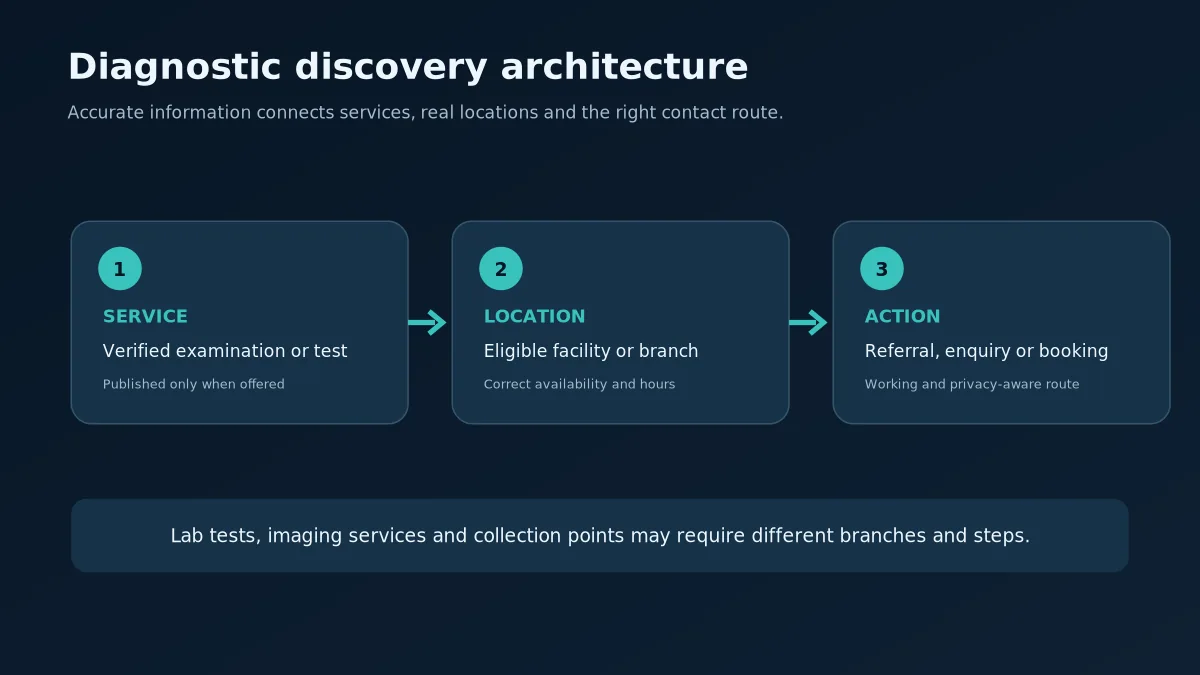
A modern laboratory website is more than an online brochure. It should help patients and referring professionals answer practical questions without navigating through unrelated promotional copy. DigiTaTop can assess or scope medical website design and development for diagnostic providers, including structured service navigation, accessible mobile pages, service-location relationships and useful contact actions.
The Service-Branch-Appointment Architecture
| Information layer | What the visitor should find | Verification owner |
|---|---|---|
| Diagnostic service | Clear purpose, eligible audience, practical service description | Laboratory or clinical lead |
| Location or branch | Availability of the service, address, hours and contact method | Operations or branch manager |
| Booking or referral | Whether an appointment or referral is required and how to proceed | Scheduling and clinical team |
| Preparation and practical guidance | Any preparation, restrictions or result-access process the provider approves for publication | Qualified laboratory or clinical reviewer |
| Enquiry confirmation | Clear next steps and a privacy-conscious form or call route | Operations and privacy owner |
This structure can support both single-location facilities and large networks. The design should never imply that every branch performs every service. Where online appointment or results systems are needed, integration scope, security requirements, vendor responsibilities and costs are agreed separately.
Medical Laboratory Website Design That Converts the Right Enquiries
A useful page about diagnostic imaging should make it clear where the examination takes place and what prospective patients need to do next. Contact buttons must work, forms should avoid requesting unnecessary health details and mobile visitors should not be forced to search through multiple screens for a relevant phone number.
Conversion work also means distinguishing a click on a booking button from a completed request, a confirmed appointment and an attended visit. These are different business events, with different operational causes.
Diagnostic Imaging & Radiology Marketing Services
Diagnostic imaging marketing differs from laboratory test marketing because people may search for an examination, a specific radiology facility, a named specialist or a referral process. A diagnostic imaging marketing agency should connect those searches to approved, location-specific information, rather than implying that every facility offers every examination. Radiology marketing also needs to consider relationships with referring practices, radiologists and hospital departments when these are genuine parts of the provider’s service.
For an MRI-focused center, the priority may be a trustworthy examination page with accurate location and referral information. A radiology group with multiple modalities may need separate MRI, CT, ultrasound, X-ray, mammography or DEXA pages for services it actually provides. A hospital-affiliated imaging department may require department and campus navigation, plus distinct public and professional contact routes. Each operating model needs its own service structure and contact journey.
Medical imaging SEO and imaging center SEO can examine whether examination pages are discoverable, whether the site correctly names the facility and its locations, and whether patient and referrer questions receive clear answers. Imaging-service pages should explain only verified capabilities, preparation requirements, access arrangements and contact steps. Radiologist qualifications, equipment specifications and claims about interpretation need appropriate clinical approval.
For multi-service providers, correcting five important service-location pages and their appointment pathways may matter more than creating fifty near-duplicate pages. DigiTaTop scopes medical SEO services and healthcare website design around these verified service and location differences.
Google Ads & Paid Search for Diagnostic Centers
Paid search can help an eligible diagnostic provider reach people actively looking for available testing or imaging services. But Google Ads for medical laboratories should be built around approved services, geographic relevance, appropriate landing pages and the site’s ability to handle enquiries. Some health-related advertising categories, targeting methods and claims are restricted or require additional assessment.
DigiTaTop can assess campaign structure, eligible search terms, location targets, ad copy, policy-sensitive categories, destination pages and privacy-conscious measurement as part of healthcare PPC management. An ad for a service should lead to a page where its actual branch availability and practical next step are clear.
A worked planning example: a diagnostic network receives broad requests for MRI appointments, but two branches do not offer MRI. The first action is to verify availability and correct branch destinations before increasing advertising spend. Location-qualified campaigns can then be evaluated for permitted services. This hypothetical example illustrates how we prioritize improvements.
Advertising spend and management fees are separate. The published DigiTaTop Paid Search Essential offer starts at the higher of $950 per month or 12% of managed ad spend, with a $750 one-time setup; suitability and operating limits depend on the agreement. A laboratory-specific proposal confirms the included work and campaign requirements.
Healthcare GEO, AI Search Visibility & Diagnostic Content
A diagnostic provider may be discovered through traditional search, maps, voice interfaces or AI-assisted answers. Consistent, accessible service information can help both people and search systems understand the difference between a laboratory, an imaging facility, a collection point, a department and an individual examination.
For healthcare GEO and AI-search optimization, useful information includes exact organization names, locations, actual service availability, referral rules, verified claims, relevant sources and answer-ready practical explanations. It also includes keeping outdated descriptions and contradictory branch statements out of the site. Our healthcare AI-search optimization service addresses these information-quality and observability questions.
Accurate, useful answers for patients and referring professionals guide this work.
Patient Enquiries & Physician Referral Marketing
Diagnostic providers may serve self-pay patients, people using insurance or publicly funded routes, referring physicians, hospitals and institutional buyers. Those audiences should not be sent through one unexplained booking or contact journey. Physician referral marketing in this context means making verified professional-service information findable and usable, not offering referral incentives, promising clinical referrals or making unapproved professional claims.
| Journey | Questions to answer | Suitable website and contact experience |
|---|---|---|
| Self-pay diagnostic enquiry | Is a self-pay route available? Are indicative prices published and current? Is a referral needed? | Approved pricing or quote guidance, relevant location, eligibility caveats and enquiry route |
| Insurance or other funded route | Is the provider accepted for the specific arrangement? Is preauthorization or a referral required? | Verified payer/funding information and a clear route to the billing or scheduling team |
| Referring clinician | Which test or imaging service is available? What referral information and turnaround statements are approved? | Professional-facing service pages, verified requisition/referral requirements and clinical contact details |
| Institutional partner | What service scope, coverage area and relationship process are available? | Business or professional enquiry route, documented capability and approved contact owner |
We confirm insurance, self-pay and referral arrangements with your team before describing them on the website. Patient price information, specimen logistics and clinical suitability require the right operational or clinical owner.
Referral-facing Information That Reduces Avoidable Enquiries
For providers with an actual clinician-referral pathway, laboratory digital marketing can help organize a verified test or modality directory, location-specific availability, referral criteria, ordering instructions, sample handling information where approved, and professional contact options. A medical imaging practice might need a specific referring-clinician entry point rather than a public booking form.
An agency may structure pages and measure appropriate business-level contact actions, but the provider controls clinical acceptance criteria, relationship arrangements, regulatory compliance and patient information. Clear professional information helps referring teams understand the available services and contact the right person.
Verified Laboratory Quality, Accreditation & Capabilities
Trustworthy laboratory digital marketing includes explaining what the facility is demonstrably qualified and authorized to do. Where relevant, a client website can make its laboratory identity, scope of testing, quality information and contact details easy to verify. Accreditation logos and technical claims should appear only when the facility has the required permissions and the claim accurately reflects the current scope.
In the United States, a laboratory that performs covered testing should verify the appropriate CLIA certification information; collection-only sites and certain other arrangements have different rules. In the United Kingdom, UKAS medical laboratory accreditation under ISO 15189 can provide useful, verifiable quality information when the individual laboratory and the relevant activities are accredited. Imaging-service accreditation and laboratory accreditation must not be treated as interchangeable.
DigiTaTop can help organize approved evidence and disclosures on a healthcare website. We do not issue accreditations, audit laboratory competence or guarantee compliance. Client laboratory leaders and qualified reviewers retain responsibility for claims about testing disciplines, machines, turnaround times, result accuracy and professional capabilities.
Multi-location Diagnostic Network Marketing
Multi-location marketing for laboratories depends on a maintainable service inventory. A network may have collection sites, full-service laboratories, imaging facilities and co-located departments. The marketing architecture should follow these real differences, not treat all branches as interchangeable.
A practical branch registry can capture: branch name and address, public hours, service eligibility, collection versus processing capability, imaging equipment when verified, booking contact, referral prerequisites and page/profile ownership. Marketing teams can use that approved inventory to prevent location errors across website pages, maps and paid campaigns.
For organizations operating across the United States or United Kingdom, patient expectations, terminology, regulations and privacy requirements differ. A US laboratory marketing campaign may involve particular HIPAA questions; a UK diagnostic provider must consider UK privacy and advertising rules. DigiTaTop identifies marketing and tracking decisions that need your clinical, legal and data-protection teams’ approval.
What a Laboratory or Imaging Marketing Assessment Can Deliver
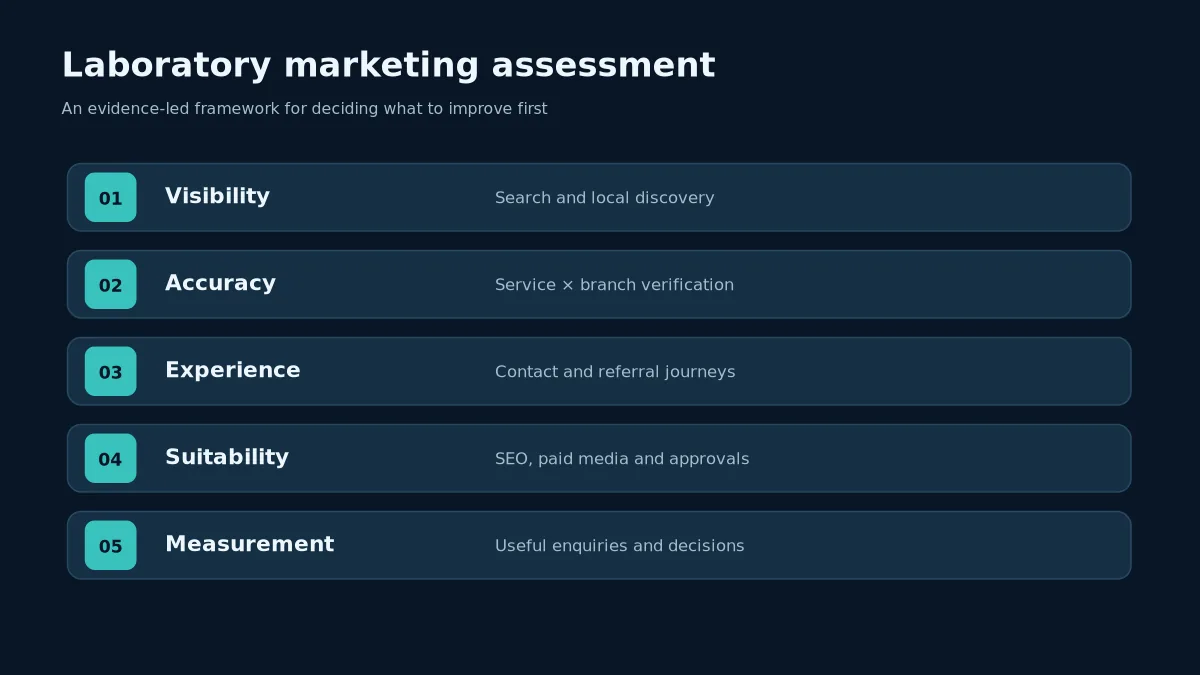
A useful first engagement produces a readable findings document with decisions and next steps. A scoped laboratory or diagnostic center marketing assessment can follow five workstreams. The number of facilities, selected service lines, markets, data sources and depth of review are agreed before work begins.
| Assessment workstream | Tangible output | Decision it supports |
|---|---|---|
| Search and local visibility | Priority service queries, relevant pages and branch-profile findings | Where discovery is failing |
| Service-location accuracy | Verified availability gaps and content inconsistencies for selected services and branches | Which information requires correction |
| Website and enquiry journey | Mobile contact-path review and landing-page issues | Which changes reduce enquiry friction |
| Channel and policy suitability | SEO/PPC priorities and advertising-eligibility questions | Where additional investment is appropriate |
| Measurement and action plan | Defined enquiry events, owners and phased recommendations | What to implement and evaluate first |
Example Assessment Handover
A practical deliverable can combine a short executive summary, a selected service-branch inventory, annotated page and local-profile findings, enquiry-path observations, a channel-readiness table and a prioritized action plan. The hypothetical examples below show how findings and responsibilities can be presented.
| Illustrative finding | Evidence to request or check | Decision and responsible owner |
|---|---|---|
| MRI is mentioned on every branch page, but only two sites offer it | Approved service-branch inventory and published page content | Correct location claims , operations and web content owners |
| Referral guidance is missing for a supported examination | Approved booking/referral procedure | Add clinician and patient pathways , clinical and scheduling owners |
| A collection point appears as a full testing laboratory | Facility role and applicable public listing criteria | Correct branch classification , location and local-search owners |
| Calls and enquiry actions cannot be separated by service area | Tracking configuration and available aggregate reports | Define privacy-aware events , marketing and privacy owners |
Your proposal confirms the included work. It should state the number of branches and services reviewed, the depth of keyword and advertising analysis, the report or presentation format, whether a review meeting or revisions are included, timing, price and exclusions. Full analytics implementation, ongoing PPC management, clinical validation, accreditation verification and new landing-page production are separate unless expressly quoted.
Illustrative Diagnostic Center Readiness Review
Consider a multi-location imaging group with inconsistent opening hours and broad “book an MRI” buttons that do not identify the actual imaging site. A sensible sequence is to confirm the service inventory, correct the location pages, validate call routing and only then expand paid visibility. Reported contact actions should be compared with the intake team’s definition of a qualified enquiry. This hypothetical example shows how operational accuracy guides the marketing plan.
Choose the Right Diagnostic Marketing Starting Point
For an Independent Laboratory or Collection Network
A laboratory and collection-site operator may need a test catalog that distinguishes specimen collection from actual analysis, accurate hours, eligibility information and a contact route for the right site. The first assessment can focus on the selected tests, eligible locations and enquiries the provider accepts.
For an Imaging or Radiology Center
A medical imaging marketing assessment can prioritize modality pages, radiology SEO, referrer-facing information, self-pay or insurance details only where offered, and appointment/contact routes by facility. The initial discussion should identify the available examinations and which branches perform them.
For a Multi-branch Laboratory or Imaging Network
Start by reconciling service availability across locations, the branch information architecture, local profiles, central versus local booking routes and account ownership. Then prioritize the highest-value areas for healthcare marketing strategy, local SEO or eligible paid campaigns.
A Practical 90-Day Diagnostic Marketing Roadmap
Days 1-30: Verify and prioritize
Confirm organization and branch details, service availability, priority audiences, clinical approval owners, website condition and available performance data. Review high-intent discovery and identify preventable misinformation or broken enquiry paths.
Days 31-60: Improve the important journeys
Within the agreed scope, improve priority service and branch pages, local profile consistency, relevant internal links, contact paths and any approved campaign requirements. Validate tracking against privacy rules and measure genuine completed actions, not merely clicks.
Days 61-90: Evaluate and decide what scales
Review which branches and services attract relevant attention, whether enquiries can be qualified, what the intake process reveals, and which channels deserve additional investment. Your proposal confirms the delivery schedule and work included at each stage.
Measuring Enquiries Without Exposing Patient Information
For diagnostic providers, clicks, calls, enquiry submissions, booked appointments and completed tests are not interchangeable metrics. Reports should distinguish recorded marketing actions from confirmed operational outcomes. Where analysis touches patient information, the organization must determine what can be processed, under what contracts, legal basis and safeguards.
A good measurement plan may consider branch-level searches, directions, website interactions, completed business enquiries and responsibly reported qualification categories. It should not automatically transmit symptoms, test names tied to identifiable users, patient records or referral details to ordinary advertising platforms.
US regulated healthcare entities should review HHS tracking-technology guidance in its current legal context, including the 2024 court ruling affecting part of the guidance. UK providers should assess relevant ICO storage-and-access technologies guidance. These issues require client-side privacy and legal decisions.
Why Choose DigiTaTop for Laboratory & Diagnostic Marketing?
DigiTaTop connects the disciplines that determine whether a diagnostic provider can be found and contacted responsibly: search visibility, practical service information, trustworthy websites, appropriate paid media, brand clarity and reporting. Our approach starts with the actual operational footprint and asks which changes matter most before recommending channels or larger packages.
A diagnostic marketing proposal should clearly identify the reviewed branches and services, deliverables, approvals, reporting definitions, and any website or media costs excluded from the project. That keeps the relationship focused on decisions the provider can inspect and approve.
For broader marketing support, explore our healthcare digital marketing services or learn about DigitaTop Agency.
Frequently Asked Questions
Does DigiTaTop provide medical laboratory marketing services?
Yes. DigiTaTop develops marketing scopes for laboratories, diagnostic imaging centers and multi-location diagnostic organizations. Services can include SEO, local visibility, websites, eligible Google Ads, content structure and marketing strategy. Exact services and deliverables are confirmed in the proposal.
What is the difference between medical laboratory SEO and diagnostic center SEO?
The terms overlap, but a laboratory may prioritize tests, sample collection and branch information while an imaging provider may prioritize examination-specific service pages, location availability and referral or appointment pathways. A combined provider may need both structures connected on one website.
Can you help diagnostic imaging centers promote MRI, CT and ultrasound services?
Yes, where the provider offers those examinations. Diagnostic imaging and radiology marketing can help make approved MRI, CT, ultrasound and other service information easier to find, including patient, self-pay and professional-referral routes where those options actually exist. Service availability, equipment claims, eligibility, funding and advertising restrictions require client verification before publication.
Can a laboratory have a Google Business Profile for each branch?
Eligible, genuinely staffed and customer-facing locations may qualify for individual Business Profiles under Google’s rules. Profiles should represent actual businesses, not duplicate pages created for keywords. Collection sites, departments and shared premises need case-specific assessment.
Do you handle marketing for multiple laboratory or diagnostic center locations?
Yes. Multi-location planning can cover an approved branch registry, service-location mapping, local pages and profiles, booking routes, reporting by location and coordinated campaign scope. The number of branches and services covered is agreed contractually.
How much does digital marketing for medical laboratories cost?
Pricing depends on service lines, locations, current website condition and the work requested. DigiTaTop publishes general healthcare strategy, PPC, website and other service starting prices; a diagnostic network receives a tailored scope. Advertising budget, custom development and clinical review requirements may be separate.
How do you manage patient privacy and clinical accuracy in laboratory marketing?
The healthcare organization confirms offered services and approves substantive medical claims, laboratory credentials and any accreditation statements through qualified personnel. Marketing measurement should minimize sensitive data; client privacy and legal owners approve regulated tracking and sharing. DigiTaTop does not replace clinical, accreditation or legal review.
Should a diagnostic provider start with SEO, Google Ads or a website redesign?
Start by finding the biggest obstacle. If services and branch information are inaccurate, fix that first. If qualified visitors cannot book or contact the right team, improve the website journey. If service and landing-page readiness are sound, eligible paid search may support defined demand. SEO can strengthen longer-term discovery alongside these priorities.
Discuss Your Diagnostic Marketing Priorities
Tell us whether you operate a laboratory, imaging center, collection-point network or mixed diagnostic provider; where you work; which services and branches matter most; and what would make a useful business enquiry. DigiTaTop can then discuss a practical scope and the next steps for improving discovery, clarity and conversion.
Request a Laboratory or Imaging Marketing Consultation · See All Healthcare Marketing Services · Back to Who We Help