
IVF & Fertility Marketing Agency for Fertility Clinics
DigiTaTop helps IVF centres, fertility specialists and clinic groups connect search visibility with suitable consultation enquiries. Bring IVF SEO, local search, websites, responsible paid search and AI-search discovery into a plan built around your real services, clinicians and locations.
Give prospective patients clearer information about consultation routes, treatment options and clinic availability. Start with a scoped fertility marketing assessment for your United States, United Kingdom or agreed target market.

IVF Marketing Built Around Informed Patient Decisions
People looking for fertility care may be seeking a diagnosis, comparing treatment pathways, considering how to finance care or checking that a clinic is licensed and qualified. Fertility patient acquisition is only valuable when the information is truthful, the enquiry is relevant and the next step is suitable. DigiTaTop would first validate a clinic’s licensed activities, clinician credentials, location-by-treatment availability, referral requirements, scheduling capacity and clinical review process. Only then should a keyword strategy or campaign promise a particular assessment route.
A trustworthy fertility website explains who provides the service, what the initial consultation involves, how treatment options are discussed, what costs or funding arrangements can be stated accurately and where a visitor can find reliable success-rate information. It should also make clear when an individual’s chances of success depend on clinical factors and cannot be predicted from a marketing headline. In the United States, the CDC’s ART success-rate resources explain the limitations of clinic-average statistics; in the UK, the HFEA provides regulation and patient information about licensed fertility services.
Good marketing creates confidence to ask informed questions. It does not promise a baby, imply an add-on works without sufficient evidence, or use fear of running out of time as an advertising tactic. A real clinic’s clinical team remains responsible for assessment, consent and treatment decisions.
What Makes Fertility Marketing Different from General Healthcare Marketing?
Fertility decisions often involve repeated research visits, partners or support networks, private treatment costs, waiting times, clinical uncertainty and sensitive personal information. Search intent also varies sharply: “fertility specialist near me” may signal a first consultation; “IVF cost” may signal financial planning; “egg freezing consultation” may involve a different life decision; and “IVF second opinion” may signal prior treatment experience. These deserve different information architecture and ethical conversion paths rather than one generic contact form.
Our medical marketing strategy services connect this decision context to an agreed service inventory, credible content and the practice’s actual enquiry-handling capacity. Related advice is available through medical marketing for specialist doctors and marketing for medical clinics.
Fertility Marketing by Treatment and Clinic Type
The planning matrix below connects available services with useful information and appropriate consultation routes. The clinical team must verify that every service is offered, licensed where required and accurately described before a page or campaign is launched.
| Clinic service or audience | Illustrative discovery intent | Content and next-step priority | Meaningful measure |
|---|---|---|---|
| General fertility consultation | Fertility clinic near me; fertility specialist consultation | Credentials, assessment process, verified location, referral or self-booking information | Suitable first-consultation enquiries |
| IVF / ICSI | IVF clinic; IVF treatment information; IVF cost | Treatment explanation, alternatives, transparent pricing information, success-rate context | Qualified IVF consultation requests |
| Egg freezing and fertility preservation | Egg freezing consultation; fertility preservation clinic | Appropriate service scope, process, storage and fee considerations, clinical assessment | Suitable preservation consultations |
| IUI and initial fertility assessments | IUI treatment centre; intrauterine insemination consultation | Availability and clinical suitability assessment, cost and referral requirements | Relevant first-consultation requests |
| Donor treatment and third-party reproduction | Donor egg clinic; donor programme information | Availability and eligibility accurately stated; legal and counselling pathways | Correctly routed specialist enquiries |
| Male fertility services | Male infertility specialist; semen analysis service | Service scope and actual provider, testing/assessment pathway | Relevant male-fertility enquiries |
| Reproductive endocrinology and specialist reviews | Reproductive endocrinologist; fertility second opinion | Verified credentials, complex referral options, prior-record procedures | Appropriate specialist assessments |
| Embryology-associated services | Embryology laboratory information | Accurate lab capabilities, quality information approved by the centre, patient-facing explanations | Informed enquiries, not promised outcomes |
| Multi-location fertility groups | Fertility centre in [city]; named clinic | Unique branch pages, correct treatment inventory and regional consultation routes | Enquiries and bookings by actual branch |
IVF and ICSI Marketing
A high-quality IVF clinic marketing page should distinguish an initial consultation from clinical eligibility and treatment. Explain where visitors can find an overview of IVF or ICSI, the treating team, genuine centre location, stages of assessment, possible questions about medication and laboratory work, transparent financial information and a path to discuss individual circumstances. If success rates appear, show their measure, timeframe, source and limitations using clinically reviewed information. In the UK, claims must align with HFEA and advertising requirements; in the US, use CDC/SART reporting in appropriate context rather than cherry-picked percentages.
Egg Freezing and Fertility Preservation Marketing
Egg freezing marketing often attracts early-stage researchers who need unbiased explanations of the process, costs, storage, limitations and clinical suitability. It should not imply that freezing eggs guarantees a future child. The page can explain how to arrange a consultation and what the centre will discuss, without presuming a person’s circumstances or projecting an outcome. Only create separate location or service pages when those services are truly available at the relevant clinic.
Reproductive Endocrinology, IUI, Donor and Male Fertility Marketing
Reproductive endocrinology marketing and male-fertility pathways require more precision than a generic IVF booking form. Where the clinic provides intrauterine insemination (IUI), the IUI page should describe a consultation and assessment route rather than implying that a searcher is suitable for treatment. Donor services should address verified eligibility, legal, counselling and consent processes relevant to the location. Male fertility searches need a named clinical or testing pathway with accurate referral information. Each of these service pages should be clinically reviewed and linked only to real, available services.
Inclusive access matters. Where applicable and genuinely offered, fertility clinics should explain consultation routes for single intended parents, same-sex couples and other family-building pathways without presuming anyone’s identity, diagnosis or treatment eligibility. Accessibility, language clarity, respectful photography and transparent cost information help people assess a clinic without being singled out by sensitive advertising targeting.

IVF SEO for Fertility Clinics
IVF SEO helps prospective patients find the right fertility provider and reliable treatment information through relevant searches. The focus is accurate clinic information and appropriate consultation enquiries. A strong programme starts with technical crawlability, treatment-to-location mapping, verified clinic and specialist entities, mobile usability and useful content addressing real decision points.
Fertility clinic SEO works best when technical site health, local discovery and medically reviewed service content connect to a suitable appointment route. A clinic may need one clear IVF/ICSI page, a separate IUI page if that service is truly offered, clinician profiles, actual branch details and practical pricing or funding guidance. The aim is not to rank every page for “IVF” but to help the right prospective patient find relevant, trustworthy information and reach the appropriate team. Our medical SEO service supports the technical and content foundations behind that strategy.
How Fertility SEO, PPC and Local Search Work Together
A useful IVF patient acquisition strategy combines channels according to their roles rather than treating them as interchangeable. Organic SEO can establish well-reviewed treatment and specialist resources. Local SEO helps people identify genuine clinics and the services available at each branch. Paid search can introduce a verified consultation offer to relevant searches when platform and jurisdiction rules permit. Website conversion work then removes avoidable friction, while approved reporting distinguishes initial enquiries from booked and attended consultations. Healthcare PPC and healthcare website design should complement, rather than replace, the clinic’s core medical information.
| Channel | Primary job | What the clinic should receive | Measure to review |
|---|---|---|---|
| IVF and fertility SEO | Make accurate service and provider content discoverable | Clinically approved treatment pages, technical fixes, contextual internal links | Non-branded visibility and relevant consultation journeys |
| Local SEO | Match an actual branch with a real service | Accurate branch records and local landing pages | Appropriate enquiries by location |
| Search advertising | Reach eligible treatment and assessment searches | Policy-reviewed ads, service-matched pages, approved negatives and budget controls | Permitted cost per qualified consultation request |
| Conversion optimisation | Help a visitor take the correct next step | Clear assessment CTAs, accessible contact routes and form handling | Contact completion, booking and attendance where appropriately measured |
A Search-Led Fertility Website Architecture
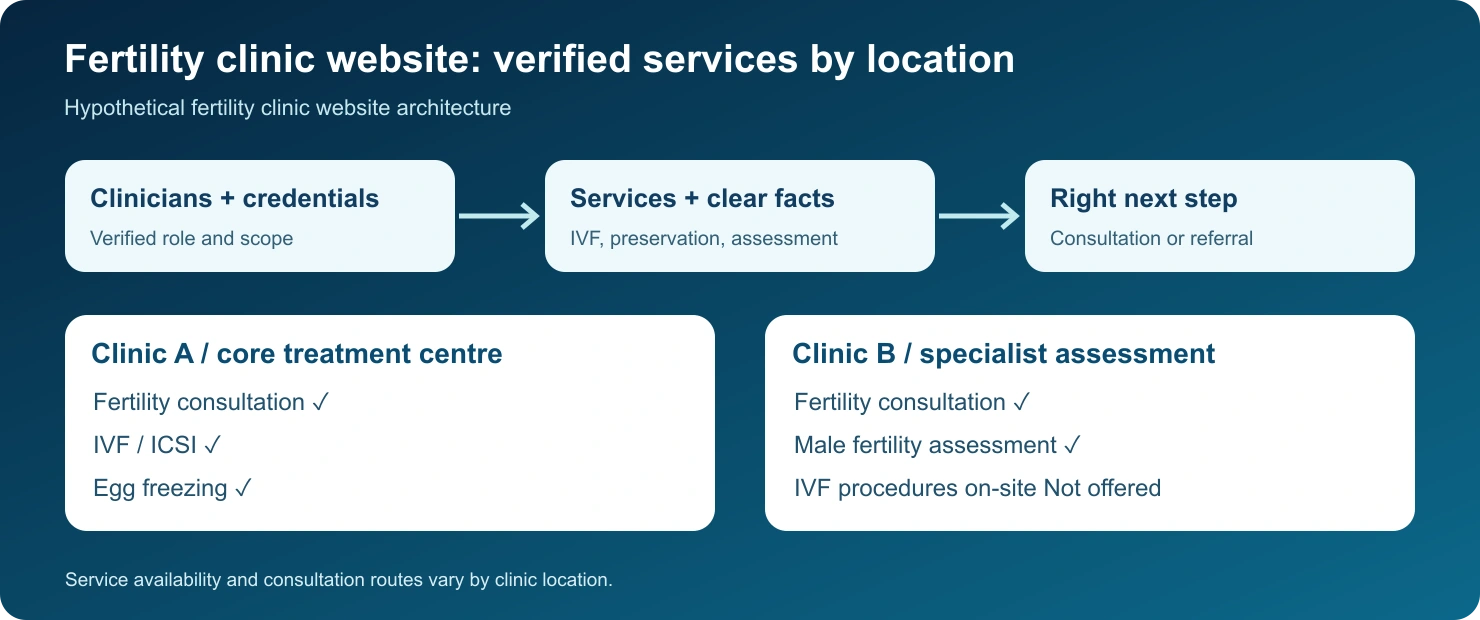
A well-structured fertility clinic website can organise verified clinicians, real branches, licensed treatment offerings and patient information into a helpful navigational system. A service page should not claim a treatment is available at every branch. Location pages should include only actual clinicians and services. Informational articles should answer clinically reviewed questions, link to the appropriate assessment route and state medical review responsibility.
| Page type | What it should verify | Purpose |
|---|---|---|
| Clinic group overview | Real business identity and care scope | Trust and navigation |
| Actual location page | Address, hours, contacts, available providers and treatments | Local discovery and correct booking |
| Clinician profile | Credentials, actual role, registration where applicable, approved specialty | Named clinician discovery |
| IVF/ICSI service | Offered treatments, consultation process, risks and decision support | Treatment discovery and appropriate evaluation |
| Egg freezing service | Availability, suitability assessment, risks, pricing and storage information | Fertility preservation enquiries |
| Results and pricing information | Source, date, relevant population and transparent inclusions/exclusions | Honest comparison and affordability planning |
| Patient resources | Clinically reviewed questions and referral/appointment information | Informed decisions and AI-search usefulness |
Illustrative two-location scenario: Clinic A offers initial fertility consultations, IVF and egg freezing; Clinic B offers initial consultations and male-fertility assessment but does not provide IVF procedures on-site. Clinic B’s local page should not imply that it performs IVF. Instead, it can explain where a patient can access the group’s IVF service if a valid internal referral route exists. This hypothetical example shows how service availability shapes the website.
Sample Service-to-Location Blueprint
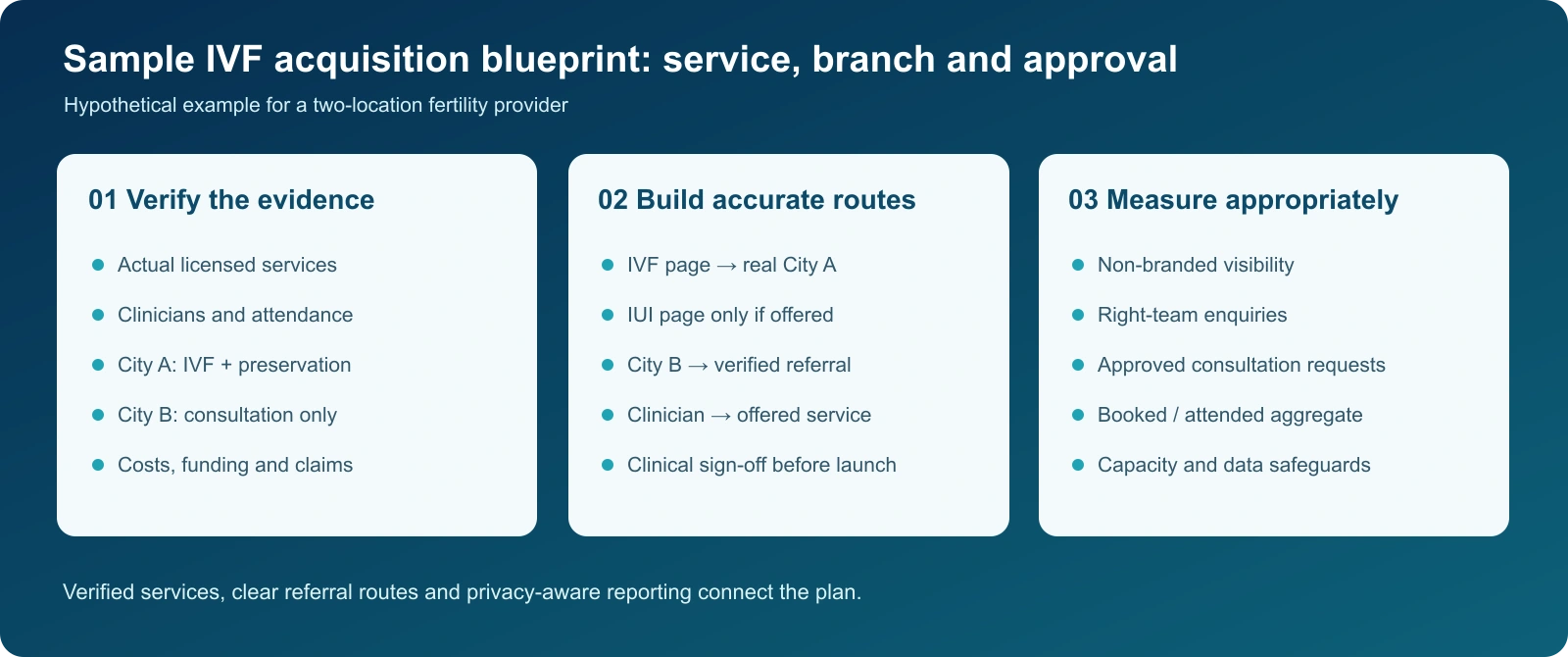
Consider a hypothetical two-location fertility provider: its City A clinic is licensed and staffed for IVF/ICSI and egg freezing, while City B handles consultations and male fertility assessments. Before creating location landing pages, the team would validate licensing, clinician attendance, booking capacity, referral instructions, fees and every treatment’s availability. The output is a service-location matrix and a content brief for each approved page.
| Example URL on a client's site | Verified information required | Intended internal-link route | Approval checkpoint |
|---|---|---|---|
/treatments/ivf/ | Actual IVF scope, clinician, process, clinical-reviewed costs and outcome context | Link to City A, clinicians and contact team | Clinic's medical reviewer |
/treatments/iui/ | IUI genuinely offered, consultation and eligibility process | Link to the branch offering IUI, if any | Treatment/service inventory owner |
/treatments/egg-freezing/ | Actual preservation availability, storage policy and fee explanation | Link to City A and the relevant clinician | Clinical and legal review |
/locations/city-a/ | Address, verified IVF services, hours, real professionals, phone | Link to IVF and egg-freezing pages | Branch manager |
/locations/city-b/ | Address, consultations and male assessment only | Link to appropriate referrals; no false IVF-on-site claim | Branch manager |
/team/doctor-profile/ | Genuine credentials, roles, locations and approved bio | Link to actually performed services and locations | Clinician |
/costs-and-funding/ | Clear treatment inclusions/exclusions, eligibility and source dates | Link to each relevant treatment page | Pricing and compliance owners |
How the example connects: The City B location page may explain how a visitor can access IVF care at City A through an existing, verified process, but should never claim the procedure occurs at City B. A treatment FAQ can link to the genuine service page; a service page can link to its relevant clinician and location. The clinic must approve all medical claims before launch.
Local SEO for IVF and Fertility Clinics
Local fertility searches require more than placing a city name in a template. Each real clinic should have accurate Google Business Profile details, appropriate primary categories, its own hours and contact information, and clear links to the correct location page. Keep directory citations and on-site details consistent. Ask for honest reviews only through compliant, non-coercive processes; never disclose someone’s fertility treatment or patient relationship in a public response. For clinics with multiple branches, check each actual service against location availability and appointment capacity before claiming it on a listing.
Read how broader local healthcare SEO supports site structure and entity consistency, while healthcare website design supports accessible mobile enquiry paths.
Ethical IVF PPC and Paid Search Advertising
Fertility PPC can connect relevant searches with accurate treatment and consultation information, but it requires sensitive-health safeguards. Google Ads treats infertility and pregnancy-related interests as sensitive health topics for personalised advertising. That restricts certain advertiser-curated audience targeting options; a team should check the current campaign and location-specific Google policies before launching. Search-based keyword campaigns still require careful eligibility, landing-page accuracy and policy review, not assumptions that every remarketing or customer-match tactic is permitted. See Google’s sensitive-health personalisation policy and birth control, fertility and testing advertising policy.
An illustrative campaign might separate verified IVF consultations, egg-freezing consultations and specialist fertility assessments when each is actually offered. Each landing page should match the service and location, explain the next clinical step, be precise about fees if stated and avoid exaggerated success-rate language. Negative keyword research should remove irrelevant queries rather than conceal legitimate patient questions. No copy should claim a guaranteed pregnancy or promise that everyone is suitable for a treatment.
In the UK, the Advertising Standards Authority and fertility regulator have specifically challenged misleading success-rate, superiority and pricing claims. The ASA’s December 2025 fertility ad enforcement report illustrates why every promotional claim needs appropriate evidence and context. We connect healthcare PPC management to clinical sign-off and a controlled measurement plan.
AI Search Visibility for Fertility Clinics
Patients may use Google AI Overviews, AI Mode, Bing, ChatGPT, Gemini, Claude or Perplexity to explore what a fertility clinic does, how to compare options or what questions to raise at a consultation. AI-search optimisation should improve the accessibility and verifiability of useful clinic information, not manufacture medical certainty or promise mentions by any AI platform.
For a fertility provider, this means consistent legal business identity; genuine clinician and location pages; transparent service scope; clinically reviewed explanations; careful success-rate context; meaningful internal links; appropriate structured data; and pages that answer questions directly. We can design concise, evidence-linked answers and original resources that are easy for readers and retrieval systems to understand. Helpful, accessible pages make clinic information easier to discover and assess. Google’s AI features guidance confirms that regular indexing, snippets and sound SEO principles remain foundational.
Questions an AI Search Result Should Be Able to Answer Accurately
A clinic’s website should help answer which fertility services it offers, at which actual locations, who provides them, what an initial consultation involves, how pricing is explained, where reported success figures come from and how an interested person can make an appropriate enquiry. The clinic’s responsible team confirms these facts before they appear online.
A fertility clinic marketing agency should connect those verified facts with relevant searches, clear service pages and suitable contact routes. A practical plan explains the role of each channel, the work to be delivered and how consultation quality will be measured.
Fertility Marketing in the United States and United Kingdom
The USA and UK differ in fertility-provider regulation, service funding, clinical referral routes and advertising constraints. Effective fertility clinic marketing in the USA and UK must localise the information patients actually need, not merely exchange “center” for “centre.” In the US, a patient may want to understand employer fertility benefits, insurance coverage, self-pay estimates and the distinction between consultation fees, medication and laboratory charges. In the UK, information may need to distinguish NHS funding eligibility from self-funded care, HFEA-licensed activities and the full expected private-treatment cost. These details must be confirmed for each clinic and location; no universal funding eligibility or financial benefit is implied.
| Topic | United States | United Kingdom |
|---|---|---|
| Provider identity | Confirm clinician qualifications, practice identity, real office locations and state-specific restrictions | Confirm licensed activities, clinician registration, actual HFEA-licensed premises where applicable |
| Outcome reporting | Use CDC/SART reporting carefully; avoid unsupported comparisons and individual outcome promises | Use HFEA-verified success-rate data with accurate context; avoid misleading rankings |
| Treatment pricing and funding | Explain potential insurance or employer fertility benefits, self-pay items, medication, coverage criteria and exclusions where verified | Explain NHS versus private pathways, eligibility uncertainty, itemised pricing and likely additional costs where verified |
| Advertising | Follow applicable healthcare laws and platform sensitive-health targeting restrictions | Follow ASA/CAP requirements, HFEA rules and applicable platform advertising policies |
| Privacy | Assess HIPAA obligations and tracking-vendor disclosures based on actual data flows | Assess UK GDPR/PECR obligations and special-category health data processing |
| Local discovery | True geographic coverage, clinician pages and practice-specific listings | Genuine branch pages, local private-care pathways and referral information |
Truthful Success Rates and Treatment Add-On Claims
An advertising percentage needs a clearly described outcome measure and relevant patient group. A live-birth rate is not interchangeable with a clinical-pregnancy rate, nor is a clinic average a forecast for an individual. UK regulators caution against selective or outdated outcomes and unsubstantiated “best clinic” claims. The UK Competition and Markets Authority’s fertility-clinic guidance also addresses material omissions in treatment prices and evidence for treatment add-ons. The HFEA’s 2026 add-ons statement reinforces why an add-on cannot be advertised as improving everyone’s chances without evidence.
In the United States, the American Society for Reproductive Medicine’s guidance on social media stresses accurate outcome information and the ethical limits of online medical advice. Any clinical rates, treatment descriptions, patient stories or price figures should be confirmed by the clinic and reviewed against the applicable requirements before publication.
Treatment Costs, Funding and Informed Comparisons
A fertility clinic’s cost page can help visitors distinguish an initial consultation from an IVF cycle, medication, laboratory procedures, storage, donor-related services and optional add-ons. A UK clinic should identify whether NHS-funded appointments are available and under what verified pathway; a US clinic should clarify which insurance or employer programmes it actually accepts. Where the answer depends on individual circumstances, explain the assessment required rather than publishing an unsupported universal price. For UK clinics, the HFEA clinic comparison resource helps patients evaluate services, ratings and success-rate context alongside practical considerations.
A page about success rates should not imply that a higher percentage alone means a better clinic. The relevant denominator, timeframe, patient group and clinical outcome must be explained. Advertising should never imply that an unproven add-on guarantees a better chance of success. This is also a content advantage: a clear, well-sourced answer serves people and is easier for search and AI systems to interpret accurately.
Websites, Conversion Optimisation and Privacy-Aware Measurement
A fertility clinic website must combine compassion with clear navigation and operational usefulness. Useful features include accessible clinician and location pages, concise treatment summaries, phone and appointment options, relevant insurance or funding information if verified, readable consent notices and practical referral guidance. Avoid automatic pop-ups that suggest a visitor has a fertility condition or capture sensitive details without a clear purpose.
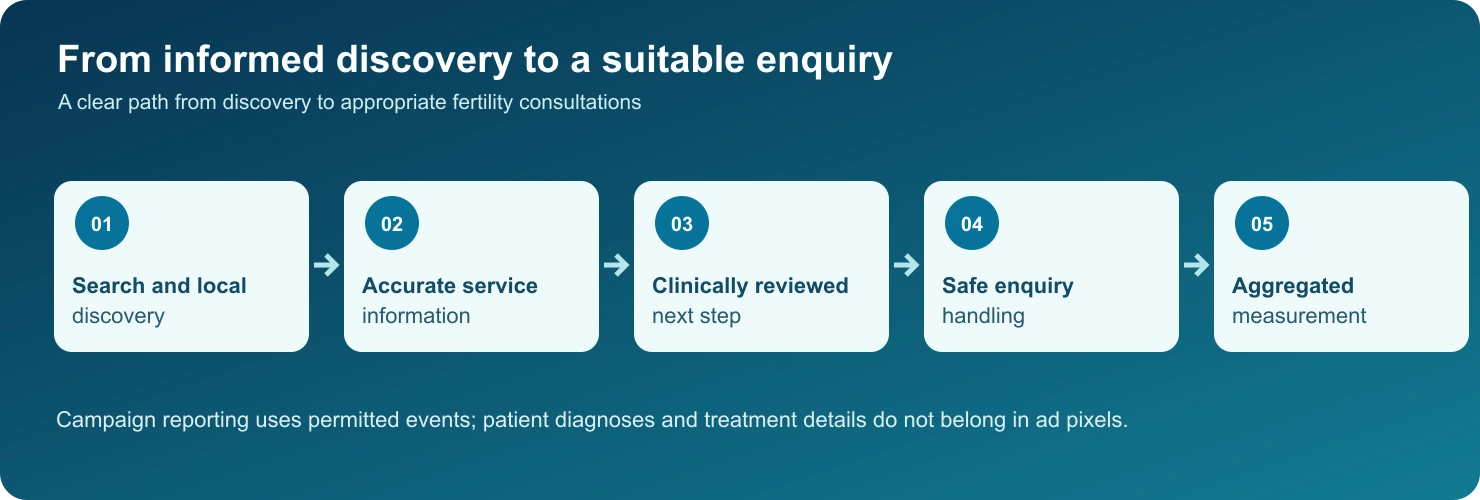
Marketing reporting should distinguish visibility from care access: impressions and clicks → general enquiries → administratively qualified enquiries → consultation requests → scheduled appointments → attended consultations, where lawful and the clinic can supply aggregated outcomes. The final stages belong in approved practice systems, not in unconstrained advertising event payloads. Treatment type, patient diagnosis, identity, sensitive form values and appointment details should not be indiscriminately sent through ad pixels or public analytics tools.
For HIPAA-regulated US practices, the HHS tracking-technology guidance discusses when data flows can involve protected health information, with an important 2024 court decision limiting one portion of the guidance. For UK practices, privacy counsel should assess UK GDPR and PECR requirements, including any sensitive health-information processing. We recommend measurement planning with the practice’s privacy and technical owners, rather than a blanket claim that a generic tracking setup is compliant.
How Do We Measure Qualified Fertility Enquiries?
Use an agreed, privacy-aware scorecard. A marketing platform may measure permitted page engagement and non-sensitive contact events, while a clinic’s approved systems can maintain consultation booking and attendance records. When lawfully available in aggregate, report cost per qualified consultation request or cost per attended consultation, with the denominator, exclusions and attribution limits made explicit. Avoid treating a high click-through rate as clinical or financial success.
| Funnel measure | What it means | Why it matters |
|---|---|---|
| Non-branded fertility visibility | Relevant discovery searches and pages | Shows whether new prospects can find reliable information |
| Relevant enquiries | Calls or forms reaching the right team | Separates useful interest from generic traffic |
| Administratively qualified enquiries | Requests matching an offered service and legitimate catchment | Helps assess enquiry quality without inferring diagnoses |
| Booked consultations | Confirmed appointments in authorised clinic systems | Reveals scheduling friction |
| Attended consultations | Aggregated attended appointments when permissible | Better reflects operational follow-through |
| Cost per qualified consultation | Eligible marketing spend divided by appropriately defined qualified consultations | Supports channel and budget decisions; not a treatment-outcome measure |
| Capacity by verified branch | Slots and offered services confirmed by the clinic | Prevents campaigns creating demand for unavailable appointments |
Only send permitted, minimum-necessary signals to advertising or general analytics systems. Patient identity, diagnoses, appointment details, treatment status and sensitive form contents must not be passed indiscriminately through pixels or remarketing lists. US HIPAA obligations and UK privacy laws require case-specific review, not a blanket assertion that any tracking stack is compliant.
What a DigiTaTop Fertility Marketing Engagement Can Deliver
An initial engagement is defined around your clinic’s scope, resources and objectives. Rather than treating every client as one “fertility clinic,” we specify the deliverables to be agreed and who approves medical information. The example framework below shows how deliverables and responsibilities can be agreed.
| Workstream | Example deliverable | Clinic-side input |
|---|---|---|
| Discovery and strategy | Service-location inventory, audience/search map, prioritized opportunities | Confirmed licensed services, real clinics, operational constraints |
| Technical SEO | Indexability, internal-link and template audit with prioritized fixes | Website access and release approval |
| Content and clinical review | Service-page and FAQ briefs, source register, sign-off workflow | Named clinician or authorized medical reviewer |
| Local search | Location accuracy plan and genuine service mapping | Official business and branch details |
| Paid search | Campaign structure, ad-policy review, approved landing pages | Budget, eligibility and compliance approval |
| CRO and measurement | Contact-path audit and aggregated reporting specification | Form routing, privacy review, clinic CRM definitions |
| AI-search clarity | Evidence-backed buyer questions, consistent entities and references | Verification of public factual statements |
What Your Fertility Marketing Assessment Should Produce
An assessment is valuable when it ends with decisions, not a long list of generic SEO errors. Following agreement on scope, a practical IVF marketing diagnostic could include a treatment-by-location inventory, a prioritized search and website opportunity list, competitor positioning observations, a consent-conscious measurement review, and a proposed owner and next step for each recommendation. The clinic would identify an operational contact and an authorised clinical reviewer so factual corrections can be confirmed.
| Proposed assessment output | Decision it supports |
|---|---|
| Verified service and location matrix | Which searches and landing pages are legitimate? |
| Search and competitor gap summary | Which commercial and informational opportunities are relevant? |
| Patient-information and conversion review | Where do visitors lack clarity or reach the wrong team? |
| Privacy and claims-risk observations | Which items need legal, platform-policy or clinical review? |
| Prioritised release plan with responsibilities | Which tasks should be approved, funded and implemented first? |
The final deliverables, turnaround, data access and fees are specified in a written proposal before the assessment starts; your proposal confirms the agreed scope.
A Practical First 90 Days
Days 1-30: verify and prioritise. Confirm clinical scope, clinic locations, the current website and enquiry workflow; analyse existing performance and candidate keyword groups; identify security, crawl and data-handling risks; establish a content approval process. Days 31-60: build the agreed foundations. Prepare or improve priority service and location content, internal linking, technical repairs and suitable landing-page journeys; submit clinical and compliance-sensitive claims for approval. Days 61-90: launch approved improvements and learn. Validate measurement, refine relevant search programmes, review qualified enquiries and agree the next release cycle. Your proposal confirms the schedule, based on access, budget, clinical review and implementation capacity.
Why Choose DigiTaTop for IVF and Fertility Marketing?
DigiTaTop connects healthcare-focused search strategy, technically sound websites, accountable content and practical enquiry quality. For fertility teams, that means a consistent process: verify services and locations; identify relevant search intent; build clinically reviewed information; align permitted advertising with real appointment routes; and measure suitable enquiries with appropriate privacy safeguards. The sample matrices and architectural examples on this page show how that process can be planned and evaluated before work starts. Your proposal identifies the delivery team, responsibilities and relevant evidence you can review.
Before appointing a fertility marketing agency, ask to see the proposed service-location audit, a sample medically reviewed content brief, examples of search and landing-page decisions, and a clear reporting definition for a qualified enquiry. Confirm ownership of the domain, analytics, advertising accounts and creative assets; ask who signs off clinical claims, fees, testimonials and sensitive-data handling. The right partner should show its workflow and limitations as clearly as it describes its services.
A decision to work together begins with your organisation’s priorities: opening a new verified branch, improving existing IVF consultations, making egg-freezing information more useful, reducing wrong-service enquiries or strengthening local recognition. We propose a scoped plan rather than prescribing the same channel mix to every clinic. Learn more about our approach to healthcare marketing, healthcare PPC, medical SEO and healthcare web development.
How to Choose an IVF Marketing Agency
A credible partner should be able to show how its process fits your clinical reality, not only how many keywords it proposes. Request a sample deliverable and ask whether the agency distinguishes IVF, IUI, egg freezing, donor treatment and male-fertility enquiries where services actually exist. Ask how it verifies US or UK advertising constraints, who reviews claims, whether it uses restricted audience targeting, and how it interprets consultation-quality metrics. Insist on clear account ownership, approval rights, transparent fees and an exit/handover process. Compare proposed work against your team’s capacity and intended care pathways; a large traffic forecast is not a substitute for verified evidence or a workable booking process.
What Makes DigiTaTop's Approach Distinct?
Our proposed operating model joins clinic-service-location verification, technical SEO, patient-decision content, policy-aware paid search and privacy-conscious reporting in one auditable workflow. This is particularly useful when a fertility group has different services, clinicians and booking routes by branch. It enables a clinic to assess concrete deliverables, site architecture, prioritised content briefs, administrative enquiry definitions and a first-90-days backlog, before investing in broad promotional claims. Explore our healthcare marketing services and medical website development approach.
Frequently Asked Questions
What does an IVF and fertility marketing agency do?
An IVF and fertility marketing agency helps genuine fertility providers improve how they are discovered and understood, through search optimisation, real location visibility, patient-facing content, clinic websites, appropriate paid advertising and enquiry measurement. Work should reflect licensed service availability, clinician approval and relevant advertising and privacy requirements, not promises about pregnancy outcomes.
How is IVF SEO different from general healthcare SEO?
IVF SEO applies the fundamentals of technical SEO, internal linking and useful content to unusually sensitive decisions about treatment options, outcomes, costs, timelines and provider credentials. Fertility content needs clinically reviewed explanations, careful success-rate context and a verified clinician-to-service-to-location structure. It should also distinguish first consultations from established-patient or specialist pathways.
Can a fertility clinic advertise IVF or egg freezing on Google Ads?
Depending on location, service and current platform rules, certain fertility-related ads may be allowed, but sensitive health subjects face special restrictions on personalised targeting and some fertility-related promotions are restricted in particular countries. Campaign and destination eligibility must be reviewed before launch. Google Ads policies do not override national advertising, medical or data-protection law.
How should a fertility clinic communicate IVF success rates in marketing?
Use current, clinically approved and properly sourced statistics with the correct outcome definition, reporting period, relevant patient groups and context. Explain that individual chances vary. Avoid cherry-picked percentages, vague “highest success” claims, guarantees or suggesting that a clinic average predicts any visitor’s outcome. UK HFEA and US CDC/SART information offer important reference points.
How much does fertility clinic marketing cost in the USA or UK?
Costs depend on the number of actual locations and services, existing website condition, content and medical review requirements, local competition, paid-media scope and reporting complexity. A sound proposal separates one-time audit or build work, ongoing agency fees, ad spend and any additional production costs. DigiTaTop confirms the scope and fees in writing before work begins.
How long does IVF SEO take to show results?
Timeframes vary with the existing site’s technical condition, indexability, market competition, approved content, location footprint and available resources. Technical fixes can be validated soon after deployment, whereas organic visibility and qualified enquiries may develop over a longer period. No agency can guarantee a ranking or booking volume by a specific date. A first-90-days plan should specify deliverables and reporting milestones, not promised outcomes.
How do you measure patient enquiries without exposing sensitive information?
Start with aggregated, appropriately permitted measurements such as service-page discovery, calls to the right team and administratively qualified consultation requests. Review tracking technologies with the clinic’s privacy and technical owners, minimise data, and avoid transmitting diagnoses, form contents, appointments or other protected or sensitive details through advertising pixels. US HIPAA and UK data-protection obligations depend on the circumstances and systems involved.
What should an IVF marketing agency deliver in its first 90 days?
A realistic initial plan should verify actual services, locations, clinical reviewers and booking capacity; audit technical SEO and local listings; prioritise appropriate treatment and location pages; define approved paid-search and content tasks; and establish permitted reporting for qualified consultation requests. The exact deliverables and timing depend on the clinic’s resources and written scope. Progress is evaluated against completed work, agreed milestones and consultation-quality measures.
Request a Fertility Marketing Assessment
If your fertility centre needs clearer visibility and a more trustworthy route to consultations, share your website, US or UK market, real locations, priority services and current contact journey. We can discuss an IVF marketing assessment of technical and local search, treatment-page clarity, competing providers, enquiry friction and privacy-aware measurement. The proposed output can be a concise opportunity summary and prioritised next-step plan, subject to written agreement on deliverables, timing, data access and any fees. Your clinical team retains responsibility for medical advice and treatment decisions.