
Dental Marketing Agency for Dentists & Dental Practices
DigiTaTop is a dental marketing agency helping dentists, specialist practices and dental groups connect search visibility with suitable patient enquiries. Bring dental SEO, local search, websites, paid campaigns and AI-search discovery into one practical plan.
Make it easier for prospective patients to find the right practice, understand available treatments and request an appointment. Start with a scoped assessment for your United States, United Kingdom or agreed target market.
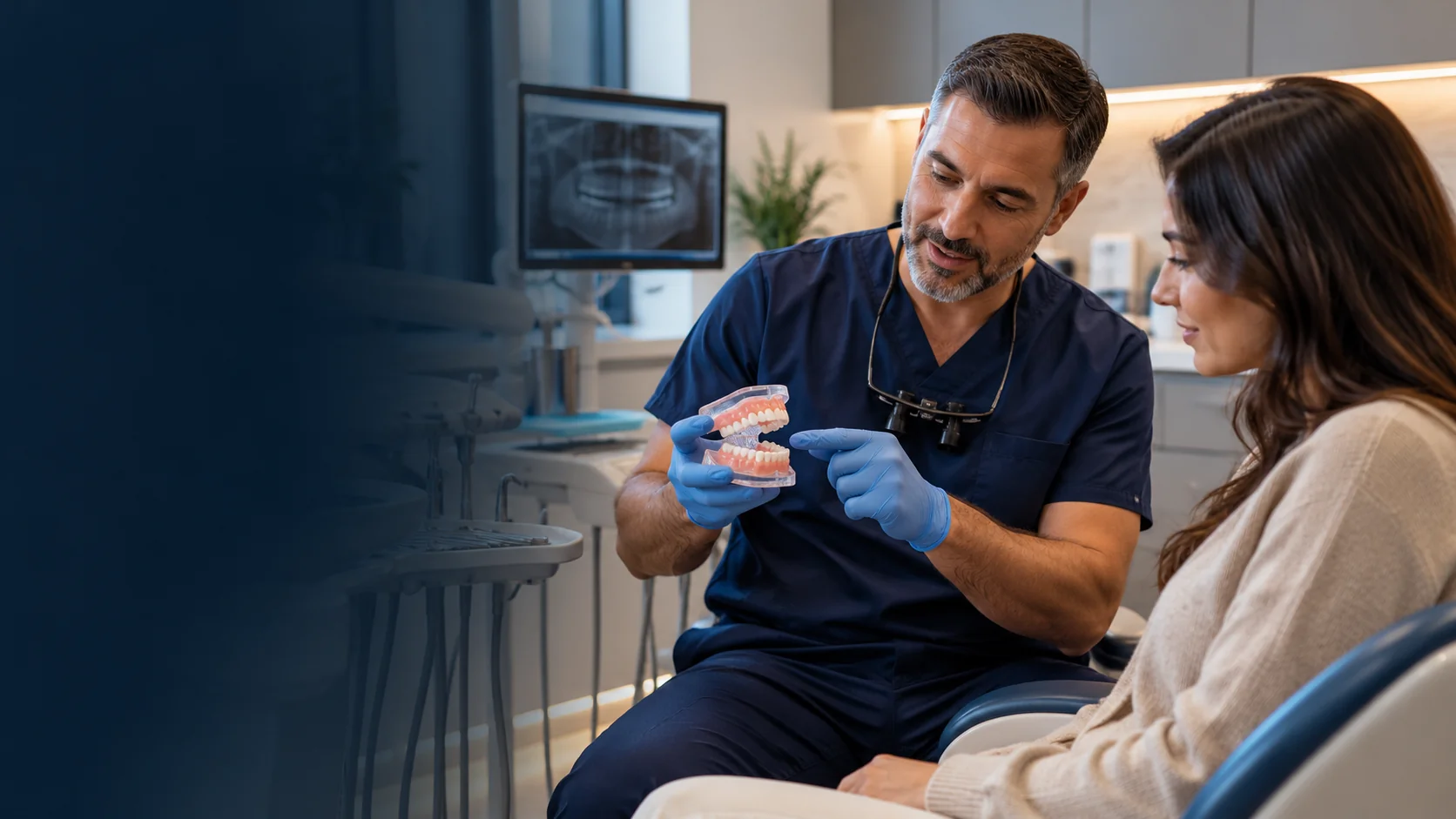
Dental Marketing Built Around the Actual Practice
Dentist marketing should make it easier to choose an appropriate provider, not treat clinical care like an impulse purchase. The starting point is a verified inventory of the dental practice: clinicians and their registrations or licenses, locations, appointment availability, services actually offered, emergency arrangements where available, payment information that the practice can substantiate, and referral rules for specialist treatment.
Our approach can be tailored to general and family dentistry, cosmetic dental services, dental implants and restorative dentistry, orthodontics and clear aligners, periodontics and endodontics, paediatric or pediatric dentistry, oral surgery and multi-site practices. Each campaign reflects the practice’s actual services and verified practitioner qualifications.
We distinguish between first-appointment enquiries, treatment-assessment enquiries, professional referrals and existing-patient requests. Those contact types should be routed correctly, with patient privacy considered throughout. A location page should not advertise an implant assessment or orthodontic consultation if the relevant provider is unavailable there.
For broader service context, explore marketing for doctors and medical specialists, medical clinic marketing and our healthcare marketing services.
Our Dental Practice Marketing Framework
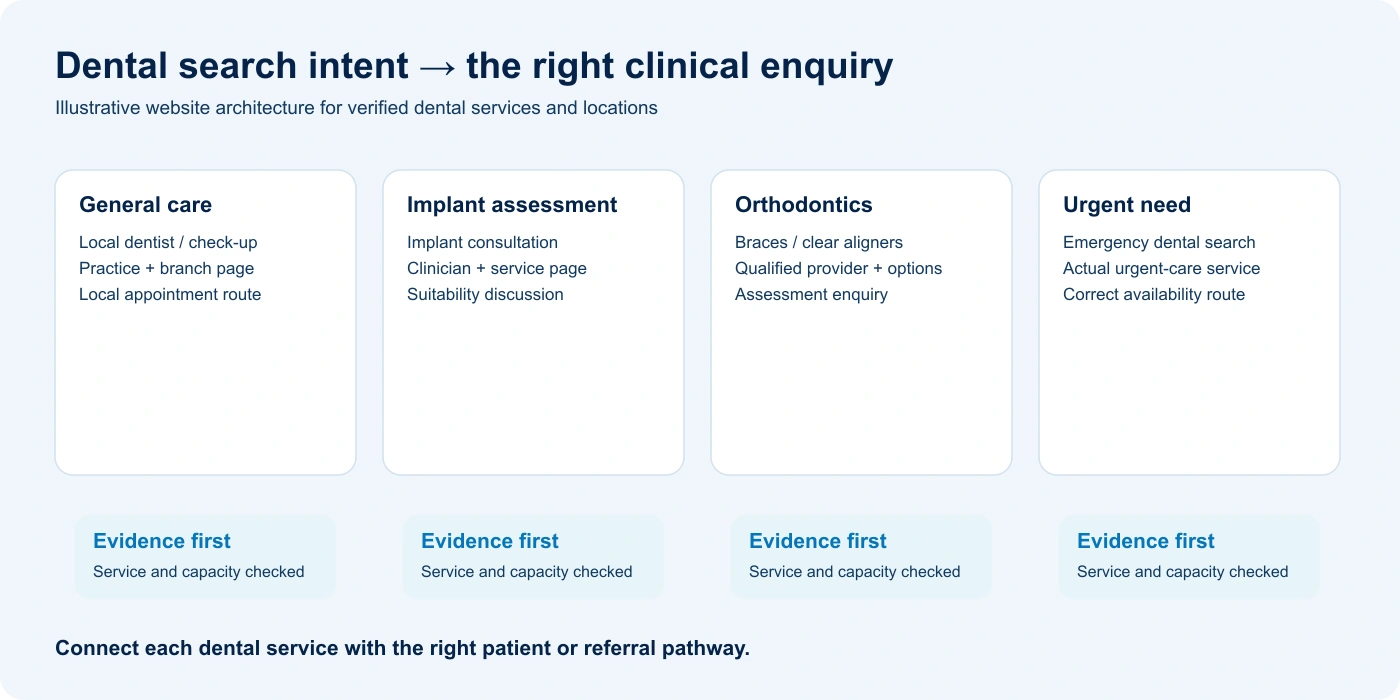
We approach online marketing for dentists as a chain of verifiable decisions rather than a list of unrelated channel activities. The framework sets out what we verify, improve and measure.
- Confirm practice capacity and eligibility. Document each clinic’s locations, practitioners, licensure or GDC registration, available appointments, actual treatments, referral requirements and relevant advertising boundaries.
- Map search intent to the right page. Separate dentist-near-me searches, named-practitioner searches, routine care, urgent dental needs, elective cosmetic enquiries, orthodontics and complex restorative assessment. Connect each distinct search need with the most relevant practice, treatment or location page.
- Build trustworthy evidence. Use current practice details, clinically reviewed explanations, valid professional profiles, consistent contact information and approved patient stories only when lawful and properly authorised.
- Improve enquiry handling. Make phone, appointment and enquiry routes visible, mobile-friendly and appropriate to the service. Distinguish an implant assessment request from an emergency appointment or existing-patient question.
- Measure and improve responsibly. Review search visibility, relevant landing-page activity, valid appointment requests, qualified calls and operational follow-up using analytics configured for privacy and applicable healthcare requirements.
Illustrative Dental Patient-Acquisition Journey
Hypothetical planning example. Imagine a group with two real locations: one provides general dentistry and cosmetic consultations, and the other also has an appropriately qualified clinician who provides implant assessments. First we would confirm each location’s actual services and appointment routes. Next we would improve the main dental-practice pages, build truthful practitioner and location details, identify whether a separate implant assessment page serves distinct demand, and publish clinically reviewed patient questions that link to the correct service.
A visitor searching for a nearby dental check-up should see the right location, hours and available booking route. Someone considering an implant should be able to learn what an assessment involves, who will assess suitability, whether alternatives may be discussed and where the consultation is available. The practice could then evaluate valid enquiry types against a baseline instead of counting every button click as a patient gained.
Dental SEO for Practices and Specialists
Dental SEO services help search engines and prospective patients understand your services, practitioners and locations. A useful strategy combines technical SEO, a clean page hierarchy, relevant treatment pages, clinical editorial review and clear contact paths. It avoids creating dozens of near-identical city pages or promises that every practice will rank first for “dentist near me.”
Dental SEO Strategy: Practice, Treatment, Clinician and Location
A clear dental website usually needs a practice overview, genuine locations, current clinician profiles, service descriptions for actually offered treatments, and helpful supporting content. Specific treatment pages can address the searcher’s question and link to the correct assessment or booking option. For example, an implant assessment page should not replace general information on missing teeth, and an article comparing braces and aligners should link to the appropriate orthodontic consultation page where offered.
| Search intent | Appropriate page and information | Suitable next action |
|---|---|---|
| “dentist near me” or “dental practice [city]” | Practice and actual branch profile, hours, contact, accepted services | Location-specific appointment enquiry |
| “cosmetic dentist [city]” | Verified cosmetic treatment information, practitioner competence, balanced expectations | Treatment assessment request |
| “dental implants [city]” | Actual implant assessment offering, clinician, location, options and caveats | Assessment enquiry if available |
| “orthodontist [city]” / “clear aligners [city]” | Accurate registered specialist status where claimed and clear aligner offering | Appropriate clinician consultation |
| “emergency dentist [city]” | Real urgent-care availability, hours and triage instructions | Approved urgent contact route, never a false 24-hour promise |
| “children's dentist” / “paediatric dentist” | Verified family or pediatric scope, age range and clinicians | Child-appropriate booking path |
For technical foundations and content architecture, see our medical SEO services and healthcare SEO and content planning.
How Dental SEO, PPC and Websites Work Together
A dental SEO agency engagement should not begin with isolated blog posts. Start with the pages that explain real treatments, clinicians and clinic locations; make them useful, crawlable and linked to appropriate enquiry options. Dental clinic marketing then connects these pages to local Google results, editorial answers and paid campaigns instead of sending every visitor to a generic homepage.
For example, a prospective patient searching for a dentist nearby may be best served by an accurate clinic and appointment page. An implant consultation search may call for a carefully reviewed service page and a clear assessment route. A paid-search landing page can support that same intent, but only if claims, clinician details, consent handling and the form all match the actual service. Local SEO develops discoverability over time while Google Ads can be used for separately budgeted, eligible demand. A healthcare website design review closes avoidable mobile, trust and booking gaps; medical SEO and healthcare PPC support the wider channel strategy.
| Channel | Best use for an appropriate dental practice | What the practice should measure |
|---|---|---|
| Organic dental SEO | Make true service, clinician, treatment and location information discoverable | Relevant non-branded visibility, qualified enquiry sources and page quality |
| Local SEO and Google Business Profile | Help nearby patients identify a real, eligible practice and correct location | Accurate location discovery, direction requests and qualified local enquiries |
| Google Ads or other eligible paid media | Test high-intent demand where available services and compliant messaging are clear | Qualified calls and forms, booked consultations and agreed acquisition costs |
| Dental website and conversion optimization | Make the correct next step easy on mobile across relevant service pages | Usable forms, answered calls, appointment requests and booking friction |
| Clinically reviewed content and AI-search readiness | Answer comparison questions with verifiable facts and useful internal links | Query coverage, brand fact accuracy and observable referral or mention signals |
The most useful channel mix depends on the practice’s capacity, location demand, ethical advertising boundaries and budget. We select priorities from your starting position and measure progress against agreed goals.
Dental Marketing by Treatment and Practice Type
A general dental clinic, implant provider, orthodontic specialist and multi-location group have different commercial priorities. A strategy should account for what the practice can deliver, which patients it wishes to serve and how it converts an enquiry responsibly.
| Practice or service line | Search and content focus | Enquiry pathway and consideration |
|---|---|---|
| General and family dentistry | Local dentist searches, check-ups, family care, hygiene where provided | Local booking, practice hours, new-patient availability |
| Cosmetic dentistry | Veneers, tooth-colour concerns, whitening where permitted, smile consultation | Balanced treatment information, clinician assessment, no guaranteed aesthetic results |
| Dental implant and restorative practices | Dental implant assessment, replacement options, rehabilitation scope | Suitability assessment, alternatives and transparent provider/location details |
| Orthodontics and clear aligners | Orthodontic consultation, braces, aligner comparisons, provider qualifications | Verified specialist titles and appropriate consultation route |
| Periodontics, endodontics and oral surgery | Actual specialist service, clinician and referral availability | Professional referral or patient enquiry as offered |
| Pediatric/paediatric dentistry | Family needs, age-appropriate service and clinician information | Suitable guardian contact, realistic appointment options |
| Multi-location dental groups | Branch, clinician, service availability and location accuracy | Correct practice selection and branch-specific booking |
Good dental digital marketing helps patients understand appropriate options and find accurate practice information. For dental implant marketing, that could mean an implant assessment page explaining clinician oversight and alternatives. Cosmetic dentistry marketing should focus on honest consultation expectations and verified examples rather than guaranteed smile outcomes. Orthodontic marketing should distinguish braces and aligner enquiries while checking specialist titles. We build campaign priorities from the practice’s capacity and verified service mix, not a generic high-value-treatment list.
Local SEO and Google Maps for Dentists
Local SEO for dentists is central to many dental-practice discovery journeys, especially where patients compare treatment availability across nearby clinics. Each eligible practice location needs accurate public details, appropriate business categories, current opening hours, a working website destination and a reliable way to contact the correct team. We consider the local website, Google Business Profile, location-specific service availability and reputation together rather than treating Maps as a separate channel.
A useful local dental SEO plan can include auditing duplicate and inconsistent listings, improving the accuracy of individual dentist and practice profiles where permitted, mapping treatment pages to real locations, adding visible directions and access information, and checking that contact options work on mobile. For multi-location dental groups, distinct pages should contain actual differences, team, address, hours and services, not boilerplate descriptions with a swapped town name.
Reviews are important for evaluating a practice, but review requests and responses must avoid incentives, manipulation and private patient disclosures. A public review response should not confirm patient status or treatment details without a valid basis. Learn how we approach healthcare marketing services and local healthcare marketing.
Dental Websites That Make Enquiries Easier
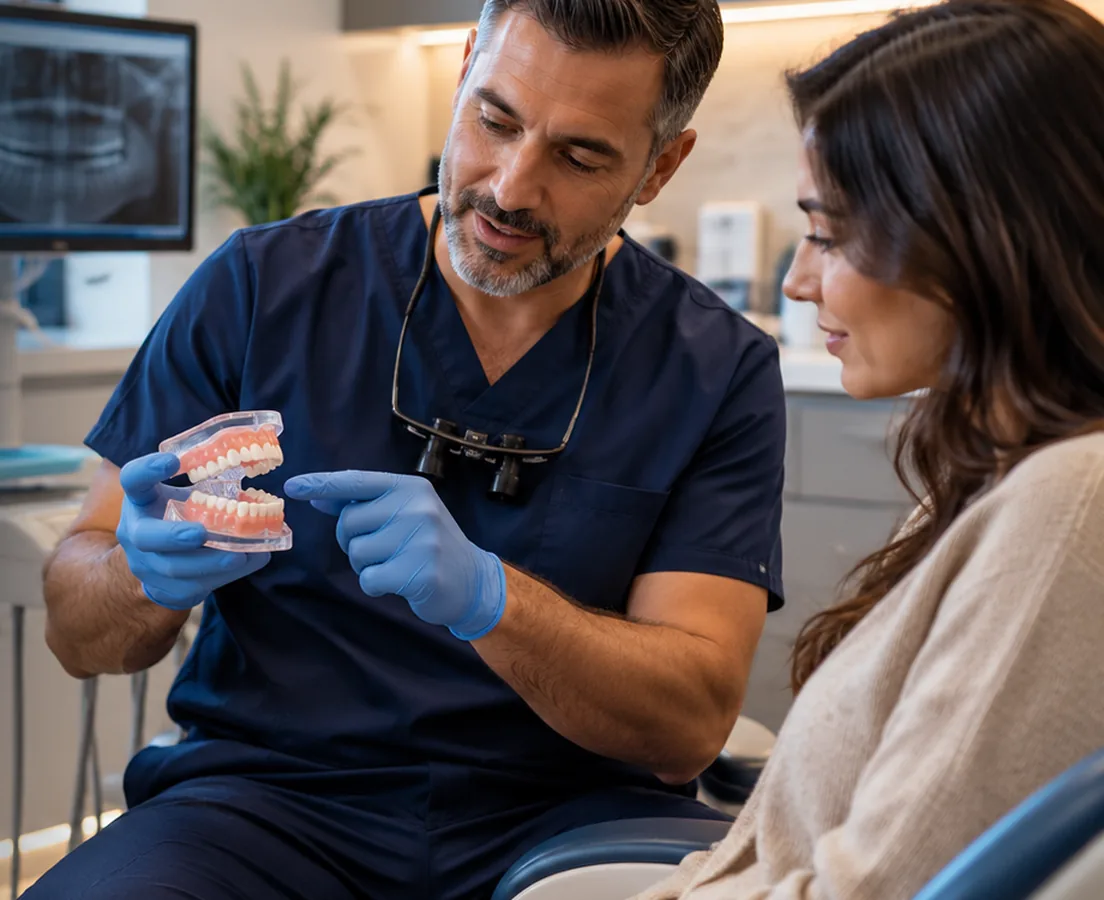
Your website should let visitors establish whether a practice is right for them before submitting a form. Useful patient pathways combine clear navigation, readable treatment information, responsive mobile design, clinician profiles, accessible contact options and straightforward booking steps.
- Make the clinic real. Show the actual team, actual practice locations, current opening hours, verified qualifications and services, and practical accessibility information.
- Show the next step. Label a CTA “Request an implant assessment” only if that service and workflow actually exist; otherwise use a broader consultation request.
- Explain cost responsibly. Where the practice publishes prices, plans or finance options, present confirmed terms and necessary qualifications rather than invented “from” rates.
- Reduce form friction. Ask only for the information needed to route an enquiry and use appropriate privacy notices, retention practices and secure handling.
- Measure meaningful actions. Distinguish phone clicks from answered calls, general forms from valid new-patient enquiries, and bookings from completed care.
A website can be attractive and still lose enquiries through a confusing clinic selector, slow mobile navigation, missing practitioner information or broken call buttons. Our healthcare website design services and conversion-focused marketing strategy connect page experience to a defined business outcome.
Google Ads, Dental PPC and Responsible Promotion
Dental PPC advertising, including carefully scoped Google Ads and eligible Meta Ads campaigns, can support treatment and location enquiries while organic visibility develops. Keyword relevance alone does not make a clinical claim permissible; audience targeting, remarketing and consent require platform- and jurisdiction-specific review. We separate general dental enquiries from specialist, cosmetic and emergency intent, align ads with available services and check the associated landing pages and conversion routes before launch.
For example, an ad about implants should reach a suitable implant-assessment page with truthful clinician information and realistic next steps. An emergency-dentist campaign should run only where the location genuinely offers an appropriate urgent service. A clear-aligner promotion needs accurate brand and provider descriptions, and any price or outcome statement must be supported. Campaign design also needs to account for each advertising platform’s healthcare policies and local requirements.
Reporting should emphasize qualified enquiries and agreed operational indicators, not simply impressions or clicks. Conversion tracking in a healthcare context requires careful review of what data is collected, who receives it and whether approvals, contracts or configurations are necessary. We coordinate healthcare PPC with website and analytics work rather than assuming that more ad spend alone will solve a practice’s growth needs.
Dental Content Marketing and AI Search Visibility
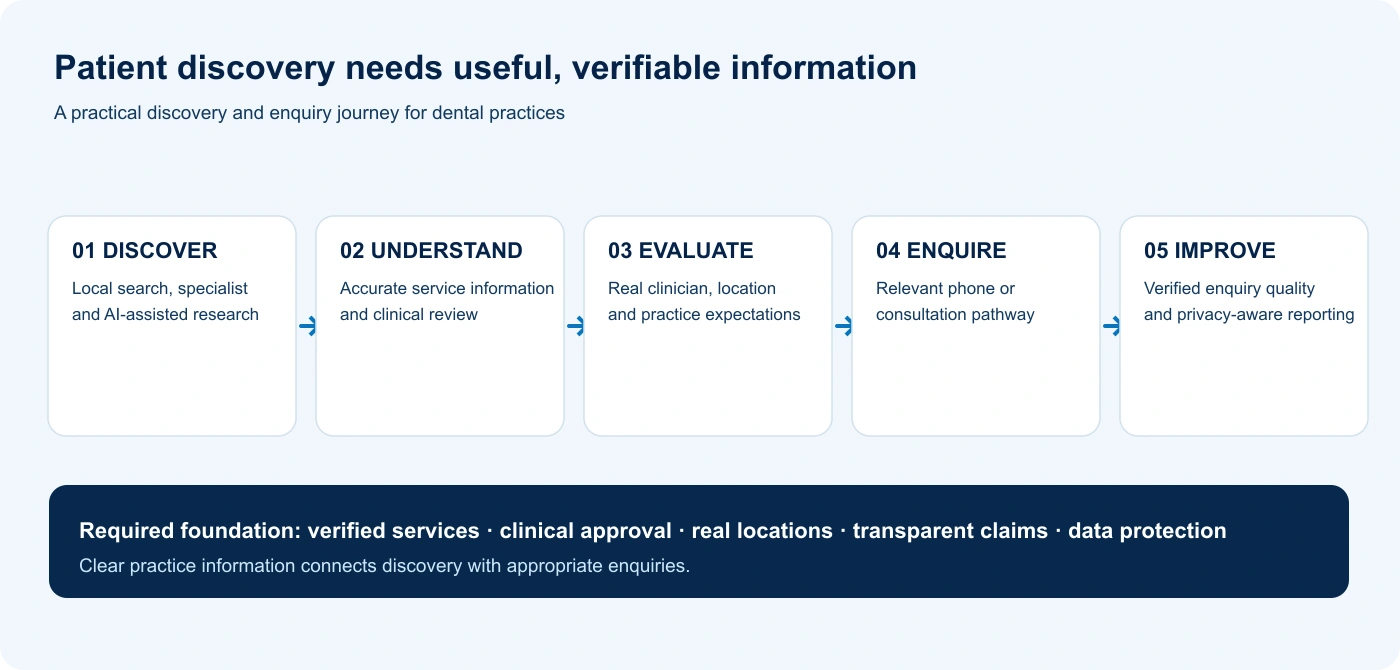
Patients and practice owners now explore healthcare services through conventional search engines and AI-assisted experiences. Dental AI search optimization starts with consistent, useful, verifiable information: real practitioners, treatment availability, coherent service pages, accurate location details and clear answers to questions that affect the choice of practice. Clear, source-backed information helps people and search systems understand the practice.
Relevant content topics may include what happens at a consultation, differences between assessment types, preparation requirements communicated by the practice, available treatment alternatives, referral steps, recovery information reviewed by a qualified clinician and practical cost questions where reliable information exists. For treatment content, the practice’s responsible clinician should review patient-facing medical statements before publication. Marketing copy should never diagnose readers or present elective treatment as necessary for everyone.
A strong dental content architecture connects information → suitable service → real clinician or clinic → qualified enquiry, with plain-language explanations that answer the user’s immediate question. We review whether content can be understood out of context, whether figures or claims are substantiated, whether service availability is verifiable, and whether related pages are linked meaningfully. For AI-driven discovery, we also review factual accuracy in surfaced brand mentions, whether practice facts can be substantiated, and the questions people use when comparing providers. When measurable, we distinguish actual AI-originating website referrals from third-party mention estimates and manually verified answer examples.
What Makes Dental Content Useful in AI-Assisted Search?
Useful answers give a direct response and evidence: the available service, the clinician who offers it, the location, any important limitations, and a clear next action. For example, an orthodontic service page should accurately describe assessment routes rather than promise that clear aligners suit everybody; a private UK dentistry page should explain private/NHS status where relevant. Consistent facts across practice pages, profiles and authoritative mentions can improve the reliability of information discovery, and helps prospective patients evaluate their next step.
Questions that a dental decision-maker may ask an AI system include: Which dental marketing channels work for a new practice? How does dental implant marketing differ from routine care? Should my dental group use one website or location-specific pages? How can we evaluate a dental SEO agency? Useful answers connect verifiable service information with practical selection criteria.
Google states that established SEO practices, accessible text, useful content, internal links, and accurate structured data, remain foundational for its AI search features; a special “AI schema” is not required. See Google’s guidance on optimization for AI search. DigiTaTop’s AI search and GEO marketing services can be planned alongside the wider content strategy when relevant.
Dental Marketing in the USA and UK
A cross-border dental marketing strategy should not use identical copy everywhere. The United States and United Kingdom have different professional titles, privacy requirements, patient expectations and service-access arrangements. DigiTaTop plans to localize content after checking the actual practice’s eligibility, services and market. A buyer comparing a dental marketing agency in the USA should expect state-aware service and clinician verification; a practice researching dental marketing in the UK should expect GDC-aligned terminology, clear NHS/private status and consent-aware patient contact flows.
| Planning dimension | United States | United Kingdom |
|---|---|---|
| Patient discovery | Dentist, dental office, insurance-network and location searches may matter | Dentist, dental practice, private dentist and local town searches may matter |
| Practice descriptions | State licensure, insurance participation and specialty representations need verification | GDC registration, specialist-list titles and NHS/private/mixed status require careful accuracy |
| Marketing claims | ADA ethics, FTC requirements, state regulations and applicable platform policies | GDC ethical advertising rules, ASA/CAP rules and relevant data-protection requirements |
| Enquiry tracking | Assess whether systems process protected health information; HIPAA may apply | Assess UK GDPR/privacy obligations and appropriate consent/processor arrangements |
| Service pages | Validate individual clinician, actual service location, accepted patients and payment facts | Validate practitioner details, availability, private/NHS pathways and truthful price representations |
In the US, the American Dental Association’s marketing and advertising guidance stresses truthful claims and appropriate treatment of reviews, testimonials and privacy. US regulated entities should also examine HHS guidance on online tracking technologies in light of its stated legal limitations and the specific data flows involved.
In the UK, the General Dental Council’s advertising guidance addresses truthful advertising, professional registration, specialist titles, practice website information and clear private/NHS status. The UK Advertising Standards Authority’s guidance on before-and-after photos also explains substantiation expectations. These checkpoints inform the practice’s professional, advertising and privacy review before campaigns launch.
Multi-Location Dental Groups and Specialist Referrals
A multi-practice dental organization needs a dependable relationship between brand-level information and local truth. Parent pages may explain the organization and common capabilities, while location pages must accurately show address, facilities, participating clinicians, available treatments and booking arrangements. An implant specialist’s availability should not be copied across all branches without evidence.
Referral-focused practices may need a distinct pathway for fellow dental professionals: referral criteria, required records, who accepts referrals and how the practice confirms receipt. This should be separate from the public new-patient form where the workflows differ. For growth across multiple offices, we use consistent site structure and measurement definitions without pretending each location has identical demand.
We also consider operational constraints, clinician capacity, call handling, contact-centre coverage, appointment scheduling and differences between elective treatment assessment and routine care. Attracting enquiries that the practice cannot appropriately serve is a conversion and trust problem, not a marketing success.
Measuring Dental Marketing: From Enquiry to Attended Appointment
A dental practice can receive more clicks but still have fewer useful appointments. We therefore define conversion events by operational meaning, agreed access and applicable privacy obligations. A call-button click is an interaction; it does not prove a conversation took place. A form submission is not automatically a qualified new-patient enquiry. A booked consultation is not necessarily an attended appointment or completed treatment.
| Measurement stage | Example definition to agree with the practice | Common pitfall |
|---|---|---|
| Discoverability | Non-branded searches and eligible local exposure for real service lines | Treating all impressions as potential appointments |
| Contact attempt | Relevant call click, web form or tracked enquiry | Double-counting the same visitor across channels |
| Qualified enquiry | Valid request for a service the clinic offers, in an eligible location | Counting spam, out-of-area contacts or existing-patient questions |
| Booked consultation | Appointment accepted in the practice's scheduling process | Counting every call as a booking |
| Attended consultation | Appointment confirmed as attended by the practice's approved reporting process | Equating bookings with completed consultations |
| Commercial outcome | Aggregate, lawfully accessible high-level treatment or revenue outcome where appropriate | Importing protected patient details into advertising platforms |
A Worked Measurement Example
Consider a clinic offering routine appointments and implant assessments. Before promoting either, we would agree which location accepts each enquiry, what counts as a qualified contact, and whether appointment outcomes can be reported in aggregate. The first month would establish the baseline and tracking reliability; later reviews would examine the quality of calls and forms alongside visibility changes. If enquiries rise but consultations do not, the investigation may focus on missed calls, practice capacity, unclear expectations or inappropriate traffic, not simply a request for more advertising budget. This hypothetical example shows how measurement can guide practical improvements.
Patient retention also belongs in the wider practice journey when appropriate, but communications with existing patients require a separate permission, privacy and practice-policy review. It should not be merged indiscriminately with new-patient advertising attribution.
Reputation, Patient Consent and Dental Photography
Patient testimonials, smile photographs and treatment stories can help people understand a practice, but only when their use is properly reviewed. Avoid invented reviews, manipulated before-and-after imagery, unsupported satisfaction claims and undisclosed endorsements. A realistic stock or AI-generated illustration must not be represented as the actual clinician, premises or patient outcome.
For authentic media, confirm permission and whether consent covers the intended channels and uses. Before-and-after photos should be truthful, representative and contextualized with relevant limitations when allowed. A responsible dental marketing plan also ensures public review replies do not disclose confidential treatment information. For broader identity work, see healthcare branding and healthcare social media marketing.
How to Choose a Dental Marketing Agency
Comparing a dental digital marketing agency or dental SEO company requires more than checking an agency’s claimed rankings. Ask how the proposed team verifies treatment availability, who reviews clinical content and what the agency counts as a qualified enquiry. A capable partner should explain how it would distinguish an emergency dental enquiry from an elective cosmetic assessment or a returning-patient contact.
Useful selection questions include: Which existing pages already meet intent? Who owns Google Business Profiles, analytics accounts and creative assets? How will practitioner credentials, prices and review permissions be checked? What does the proposed engagement actually deliver? What happens if a practice has multiple clinics with different treatment menus? Which reporting signals can be collected lawfully and accurately? How will changes be approved before going live?
DigiTaTop emphasizes transparent scoping, verified service information, thoughtful content architecture and a measurable route from discovery to appropriate enquiry. Compare our healthcare services and marketing packages for the broader available scope.
Why DigiTaTop's Dental Marketing Approach Is Different
Many agencies offer SEO, paid media and website design. Our proposed dental practice marketing approach starts with questions a generic channel plan may overlook: Is the advertised treatment actually offered at this branch? Can the claimed clinician qualification be verified? Does the practice accept the kind of enquiries the campaign may generate? Who approves clinical claims, images and prices? And will reporting distinguish enquiries from appointments?
A Clear Scope Before a Campaign Goes Live
We structure proposed work around a practice-and-location inventory, a demand and search-intent map, accurate page ownership, appropriate clinical-review gates, contact-path testing and measurement definitions. For a dental implant practice, the plan may emphasize a clinician-reviewed assessment page; for general dentistry, reliable local practice data may take priority; for a dental group, branch-level accuracy and referral routing may be the starting point. The sequence is chosen from the practice’s current position rather than a one-size-fits-all package.
What evidence should you expect from any dental marketing agency? Ask to review who will do the work, what the approved scope includes, how factual claims are verified, who controls the website and ad accounts, what approvals are required, how results will be defined and which relevant examples can be documented. Explore DigiTaTop’s broader healthcare approach and healthcare marketing strategy services.
Dental Marketing Assessment and Deliverables
An initial discovery conversation can clarify your markets, real services, locations, current website and channels, responsible reviewers, appointment goals and measurement limitations. We can then agree a scoped assessment instead of prescribing every marketing service at once.
Depending on the agreed scope and access, deliverables can include a dental keyword-to-page opportunity map, a review of local practice visibility, a clinician/treatment/location content inventory, a website conversion-path assessment, priority content and technical fixes, and a 30/60/90-day implementation outline. The proposed scope also identifies needed clinical approvals, account access, existing data limitations, expected ownership of deliverables and a reporting approach. Your written proposal confirms the included deliverables.
What the First 90 Days Could Include
| Planning window | Example work, subject to approved scope | Decision or deliverable |
|---|---|---|
| Days 1-30: establish the baseline | Confirm real services, practitioners and branches; audit technical access, local listings and enquiry tracking | Prioritized issues, agreed KPIs and a practical page/channel plan |
| Days 31-60: fix priority journeys | Improve high-intent pages, appropriate calls to action and local information; prepare paid tests where eligible | Implemented or approval-ready changes and initial quality review |
| Days 61-90: evaluate and refine | Review qualified enquiry evidence, early search signals, missed-contact gaps and clinical sign-offs | Next-quarter priorities and transparent recommendations |
Your proposal confirms the delivery schedule, based on account access, practice approvals, budget and website condition. The recommendation should distinguish actions that reduce patient confusion, quick wins that remove known obstacles, and longer-term work to develop durable search authority.
We agree success measures from your baseline visibility, competition, service capacity, enquiry quality and follow-up procedures. Your proposal confirms the budget and timetable. See healthcare marketing pricing or contact our team to discuss the relevant scope.
Frequently Asked Questions
What does a dental marketing agency actually do?
A dental marketing agency helps eligible dental practices become easier to discover, compare and contact for services they genuinely provide. Work may combine dental SEO, local search, websites, content, paid campaigns and reputation processes. The suitable combination depends on real practitioner qualifications, appointment capacity, service lines and market conditions.
How much does dental marketing cost in the USA or UK?
Costs depend on market competition, practice and location count, current website condition, required channels, content-review work and media spend. Separate advertising budget from agency fees, and request a written scope with deliverables, review responsibilities and reporting definitions. Our healthcare marketing packages provide context; a written proposal confirms the fees for your dental practice.
How long does dental SEO take to show measurable progress?
Some technical and on-page fixes can be implemented quickly; indexing, competitive search visibility and qualified appointments often require a longer observation period. Timelines vary by baseline, competition, authority, content quality and clinician capacity. A credible dental SEO provider agrees milestones without guaranteeing first-page rankings or fixed patient numbers.
What should a dental marketing agency deliver in its first 90 days?
A sensible first-quarter plan can establish verified treatment and location information, a prioritized search-intent map, a baseline for qualified enquiries, clear account and content responsibilities, and an agreed list of high-impact fixes. Depending on scope, it may also include improved local listings, landing pages or controlled ad tests. The first 90 days establish a clear baseline, evidence of completed work and practical next steps.
Should dental practices invest in SEO, Google Ads or both?
SEO can improve the discoverability of accurate service and location information over time; eligible Google Ads can test specific intent with a separately controlled budget. Both need suitable landing pages, compliant claims and reliable enquiry handling. Practices should choose a mix based on location demand, resources, treatment availability and whether qualified consultations, not only clicks, can be measured.
How does dental marketing differ between the USA and UK?
In the USA, state licensure, specialty representation, truthful advertising and appropriate handling of health-related information require local checks. In the UK, GDC rules on registration and specialist titles, accurate NHS/private status, ASA advertising requirements and data protection matter. In both markets, verify clinician and clinic facts before campaigns go live.
How can I tell whether a dental campaign produces qualified patients?
Use an agreed reporting chain: useful search exposure, valid new-patient enquiries, suitable calls or assessment requests, consultations booked, and, where lawfully and practically available, aggregate attended appointments. Avoid equating button clicks with booked patients. Check duplicates, spam, existing-patient queries and whether the practice can serve the incoming demand.
What happens during a DigiTaTop dental marketing assessment?
We begin with your practice’s website, services, locations, marketing goals and current enquiry pathway, then agree the assessment’s scope, required access, deliverables and any fee before work begins. A scoped output may include a treatment-page and local-search opportunity review, priority conversion fixes, measurement recommendations and an illustrative 30/60/90-day plan. Contact DigiTaTop to discuss the appropriate level of work.
Request a Dental Marketing Assessment
Your dental practice needs a marketing plan grounded in the care it actually delivers, the locations it serves and the enquiries its team can handle. Find out where qualified dental enquiries are being lost: request a discovery conversation about local search visibility, treatment pages, practice profiles, mobile contact pathways and reporting. DigiTaTop can recommend a scoped assessment and next-step plan once services, access, approvals and pricing are agreed.