
Digital Marketing for Doctors & Medical Specialists
A doctor’s online presence should help the right people find accurate information about their qualifications, clinical services, practice locations and consultation options. As a digital marketing agency for doctors, DigiTaTop Agency helps physicians, surgeons and private medical consultants connect those essentials through doctor SEO, medical website design, local search, eligible Google Ads, doctor branding and marketing strategy.
Physician digital marketing connects your personal website, hospital profiles, clinic websites and local listings. We work to make that information consistent and useful, so prospective patients can understand which services you actually offer, where you consult and how to contact the appropriate practice.

Digital Marketing Agency for Doctors & Medical Specialists
Medical marketing for doctors starts with the named physician’s expertise, services and consultation locations. Patients may search for a named physician after a referral, compare specialists for a particular condition, or look for an appointment near their home. They need clear, verified details about the clinician and the healthcare setting, not a collection of generic promotional promises.
An independent doctor’s website may be the main point of discovery and enquiry. A consultant working across several hospitals needs the doctor profile, clinic affiliations and location-specific information to agree. A surgeon may need detailed, clinically approved information about consultations and treatment eligibility. In every case, the doctor and the organization need a practical way to keep these details current.
Our role as a healthcare marketing agency for doctors is to connect verified professional information with the website, local search presence and enquiry path, not simply increase traffic. Clinical decisions, treatment explanations and medical claims remain subject to approval by an appropriate qualified healthcare professional.
Who This Service Is For
- Individual doctors and physicians: build clear named-doctor visibility, a professional website and relevant consultation pathways.
- Medical specialists and surgeons: connect specialty searches with accurate expertise, treatment information and actual practice locations.
- Private consultants: coordinate professional visibility when appointments are offered through several hospitals or practices.
- New practices: develop the brand, website, local discovery and measurement foundations before scaling promotion.
- Established doctor-led practices: assess technical search gaps, inconsistent profiles, low-quality enquiries and opportunities to improve the patient journey.
How Patients Discover and Evaluate a Medical Specialist
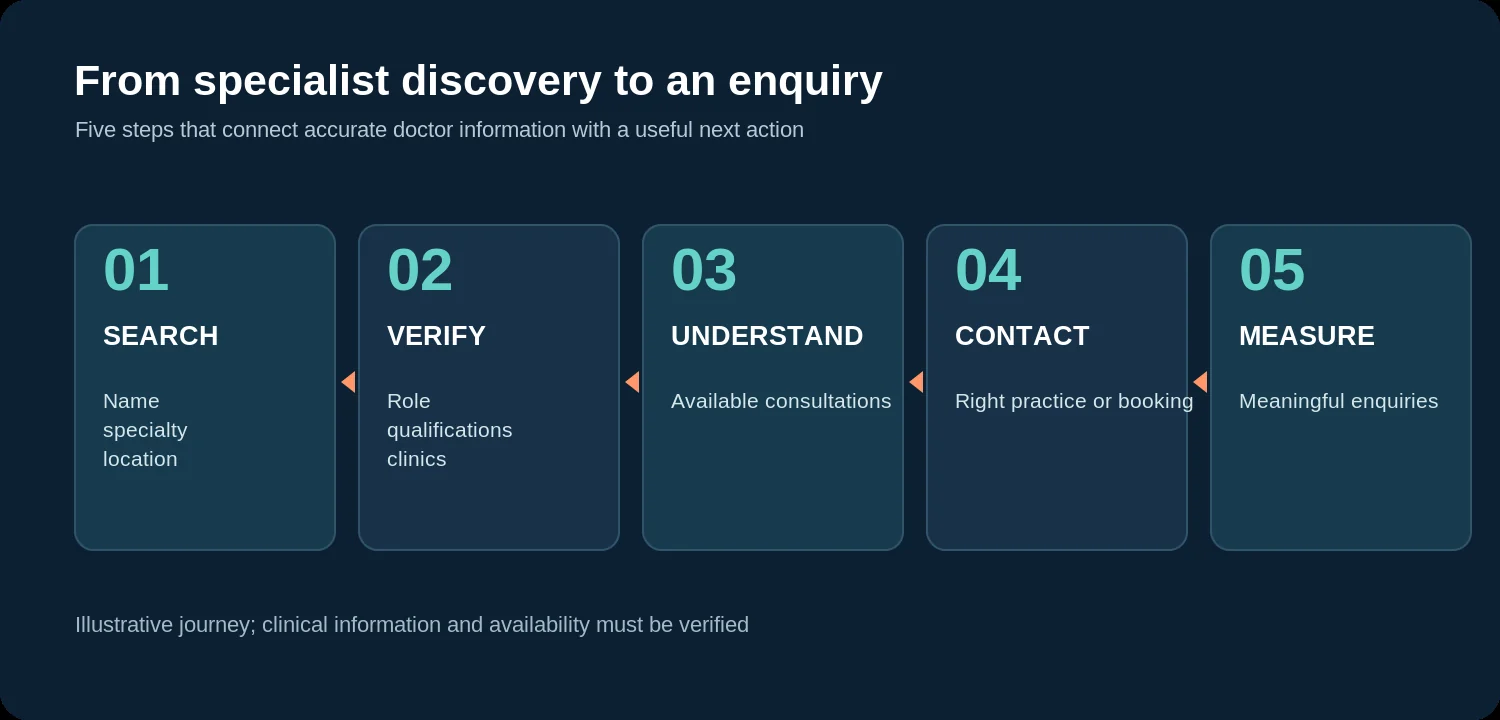
A potential patient can follow several routes: a recommendation leads to a name search; a symptom-related question leads to general education; a treatment search leads to a service page; or a location search leads to a clinic listing. Those journeys should converge on reliable information rather than conflicting descriptions.
Named-doctor or referral search
What the person needs: Verified identity, specialty, qualifications, consultation locations
Relevant marketing work: Doctor profile, brand consistency, search visibility
Specialty search in a city
What the person needs: Available specialist services and a trustworthy local option
Relevant marketing work: Doctor SEO, local SEO, service pages
Treatment or procedure research
What the person needs: Balanced, medically approved explanation, eligibility and possible next steps
Relevant marketing work: Medical content strategy and clinical review
Clinic or hospital search
What the person needs: Correct clinician affiliation, service availability and contact details
Relevant marketing work: Service–doctor–location architecture
Returning visitor ready to contact
What the person needs: Mobile-friendly enquiry route, working telephone or booking link
Relevant marketing work: Website UX and conversion measurement
Help prospective patients find the right specialist, understand available services and contact the appropriate practice.
Doctor SEO Services: Build Visibility Around Real Expertise
Search engine optimization for doctors should connect their professional name, specialty, the services they genuinely provide and the locations where they see patients. Strong pages answer useful search questions, use descriptive headings, load accessibly and make relationships between clinicians, services and practices clear.
Physician SEO can include a review of the existing website, technical accessibility, page indexing and canonical structure, search-intent mapping, the professional biography, consultation pages, medically reviewed service content, internal links and measurement. For a physician with several affiliations, we also assess the consistency of their professional details across websites and public profiles.
A doctor may need one comprehensive profile before many separate pages. For example, a retina specialist could need a verified biography, practice locations and appropriately reviewed information about available retinal consultations. Creating dozens of thin pages for minor keyword variations is unlikely to help a prospective patient choose confidently.
Our healthcare SEO services explain the broader technical and content scope. For an individual physician, the priority is how those methods support identifiable expertise and real consultations.
Local SEO for Doctors and Specialist Practices
Local searches involve more than placing a city name in headings. Relevant information includes the right doctor or practice name, eligible Google Business Profile configuration, telephone number, consultation address, actual hours, supported services and accessible directions or contact routes.
For a doctor based within a clinic, the relationship between the practitioner’s profile and the clinic’s listing must follow Google’s current eligibility rules. A doctor with multiple specializations should not automatically create a separate profile for each specialty. Where a practitioner works at several locations, each listing decision needs to reflect real public-facing eligibility, rather than duplicating names or creating virtual locations.
Local visibility work may review profile completeness, legitimate categories, practice information, professional affiliations, service descriptions, photos and appropriate review-response workflows. No agency can guarantee a top local ranking, and changes to a profile may require verification.
Website Design for Doctors and Private Medical Consultants
A doctor’s website often has a different job from a hospital site. It should introduce the professional clearly, explain where they consult, identify appropriate services and make it easy to take an informed next step. A professional site is useful only when the content can be maintained as affiliations, available consultations or policies change.
A practical doctor website design or physician website redesign can include a verified professional biography, selected consultation or specialty pages, location information, relevant questions, mobile navigation, clear contact actions and a content management system the owner can access. Booking-system links or integrations are separately scoped; a new custom booking application is not automatically included.
Our healthcare website design and development service covers responsive WordPress and Elementor projects, content structure, accessibility considerations, SEO-safe migrations and clearly defined handover responsibilities.
Doctor Website Information Checklist
Doctor biography and professional role
Why it matters: Helps visitors identify the practitioner and verify relevant qualifications
Actual consultation services
Why it matters: Prevents confusion between general specialty expertise and services currently offered
Practice affiliations and locations
Why it matters: Shows where appointments or enquiries are handled
Patient-friendly service explanations
Why it matters: Supports understanding without replacing individual medical advice
Mobile contact and appointment route
Why it matters: Allows visitors to reach the correct practice or booking provider
Privacy and accessible design
Why it matters: Helps visitors use the site without unnecessary disclosure of health information
Update ownership
Why it matters: Keeps credentials, services, affiliations and hours accurate over time
Google Ads and PPC for Doctors: Promote Eligible Services Responsibly
Google Ads for doctors can support defined consultation or service demand, where the advertising is allowed, the claimed service is available and the practice is able to respond. It should not be assumed that every procedure, targeting method or remarketing strategy is permitted for every market.
A focused PPC for doctors brief might begin with an eligible service, verified practice location, search-intent group, relevant landing page, separate management and advertising budgets, and a definition of a useful enquiry. Search terms and negative keywords should be reviewed against actual demand and service eligibility. A campaign sending all searches to a generic homepage can miss the information a prospective patient is looking for.
We define campaign success more carefully than clicks alone. Recorded call or form events are not automatically qualified enquiries, and enquiries are not automatically confirmed appointments. Tracking approaches also need to account for health-related data and applicable US or UK requirements before any sensitive signals are sent to advertising systems.
See our healthcare PPC and medical Google Ads management service for the published operating tiers, setup fees, platform scope and exclusions.
Doctor Branding & Physician Professional Reputation
Physician marketing services and doctor branding need a coherent visual and verbal identity. A doctor’s professional presence may span a website, clinic directories, social accounts, professional profiles, educational content and paid advertisements. These channels should consistently describe the person’s actual qualifications, scope and location without implying unverified accolades or affiliations.
Healthcare branding for doctors can help organize the doctor’s positioning, identity, website presentation and approved communication materials. The individual’s professional brand should remain clearly distinguishable from the brand of a clinic or hospital that may also employ or host them.
For medical social media, useful work can include professional education, an approved content calendar, suitable video topics and a process for clinical review. Patient images and testimonials must not be used without appropriate permissions and assessment. Social content is not a substitute for personalized medical care, and direct messages should not become an unprotected patient-record system.
Medical Specialist Marketing for Doctors & Surgeons
Medical specialist marketing, including marketing for surgeons, should reflect each specialty’s actual patient journey rather than applying the same message to every doctor. DigiTaTop considers service availability, the evidence required for clinical claims, referral patterns, advertising eligibility and the points at which patients make decisions.
Ophthalmologists and retina specialists
Typical information priorities: Doctor identity, eye examinations, retinal care and relevant consultation pathways
Marketing consideration: Verify services, location and clinical approval before creating treatment pages
Dentists and dental specialists
Typical information priorities: Practice access, consultation types, available treatments and dental team
Marketing consideration: Distinguish location-focused searches from broader treatment education
IVF and fertility specialists
Typical information priorities: Practitioner credentials, clinic affiliation, careful explanation of care pathways
Marketing consideration: Sensitive-topic advertising restrictions and cautious outcome claims
Dermatologists
Typical information priorities: Medical assessment versus aesthetic treatment enquiries
Marketing consideration: Separate service intent and verify patient-image permissions
Plastic and cosmetic surgeons
Typical information priorities: Specialist qualifications, suitable consultations, balanced information
Marketing consideration: Higher scrutiny of promotional claims, imagery and treatment risks
Private GPs and consultants
Typical information priorities: Named-professional searches, appointment locations and referral routes
Marketing consideration: Keep hospital affiliations and practice details aligned
Cardiologists and heart specialists
Typical information priorities: Professional credentials, heart clinic locations, available diagnostic services and referral routes
Marketing consideration: Clear information about non-emergency consultations and secure professional referrals
Orthopedic surgeons and musculoskeletal specialists
Typical information priorities: Joint, spine and sports injury services, specialist expertise and consultation locations
Marketing consideration: Connect condition-specific questions with accurate service information and appropriate enquiry routes
We tailor each specialty’s marketing plan to its services, patient needs and advertising eligibility, with clinical input from your team.
How Doctor Marketing Differs From Clinic Marketing
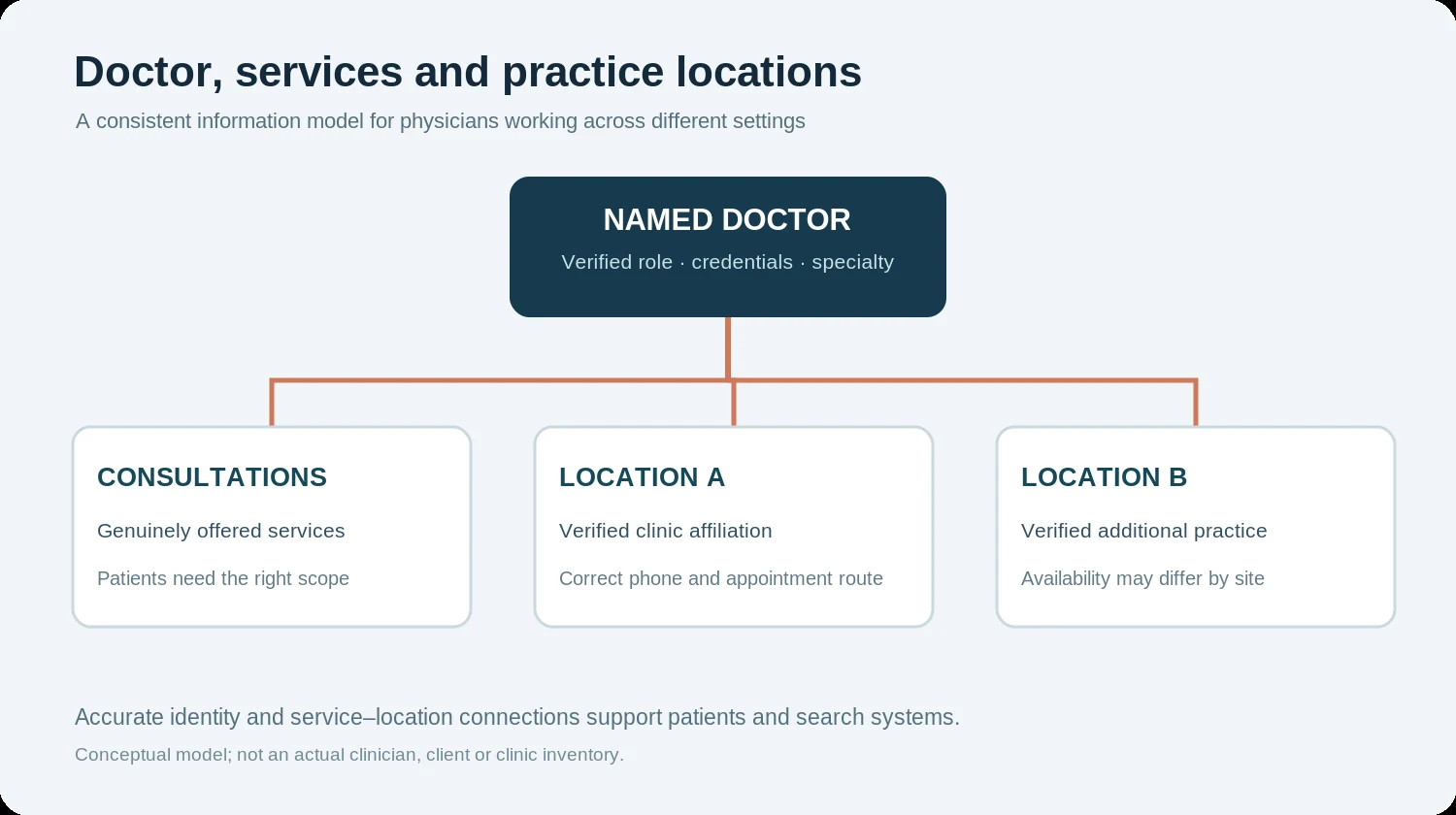
A doctor and a clinic can be related without being interchangeable. The doctor is a named professional with qualifications and a clinical role. The clinic is an organization with locations, services and sometimes multiple practitioners. If both are represented online, their pages should describe the relationship accurately.
For a solo practitioner, a compact website may serve both the professional and practice needs. For a consultant seeing patients across several hospital sites, a main doctor biography might link to the correct individual practice pages without suggesting the consultant owns each hospital. For a multi-doctor clinic, the website should explain which clinician offers which service at which location.
Named physician, qualifications and professional identity
Clinic-focused priority: Clinic brand, team and organizational services
Consultation availability for that physician
Clinic-focused priority: Availability of services across providers
One or more verified practitioner affiliations
Clinic-focused priority: Branches, departments and clinic facilities
Doctor-specific questions and professional education
Clinic-focused priority: Broader service and location information
Correct pathway to book with a named specialist
Clinic-focused priority: Routing to the appropriate department or clinician
This distinction also protects against duplicate pages and mixed search intent. Medical practice marketing needs consistent doctor–service–location information even when a physician also markets an individual professional identity. Our Who We Help overview compares doctors, clinics, hospitals and diagnostic providers.
What You Receive From a Doctor Marketing Assessment
Before recommending a website rebuild, SEO retainer or Google Ads budget, DigiTaTop can scope a practical review of how patients discover a doctor, verify professional information and request a consultation. The exact depth, number of locations reviewed and deliverable format are defined in the proposal.
A defined assessment can provide a written decision brief with five concrete outputs:
Professional-profile verification checklist
What it examines: Doctor name, credentials, specialty, existing biographies and public affiliations
How it informs the next step: Identifies details requiring confirmation or correction by the doctor
Doctor–service–location visibility map
What it examines: Which consultations are offered at each real location and how the website and public profiles describe them
How it informs the next step: Identifies conflicting affiliations, missing service information or weak location routes
Website and consultation-path review
What it examines: Mobile presentation, practitioner credibility, relevant service content and contact or booking usability
How it informs the next step: Prioritizes on-page and enquiry-path fixes before buying additional traffic
Search and channel suitability review
What it examines: Named-doctor searches, specialty and local demand, eligible paid-search opportunities and current campaign constraints
How it informs the next step: Compares SEO, local search, content and PPC against the doctor’s actual objectives
Prioritized action plan
What it examines: Findings, recommended sequence, approvals, responsible parties and useful measurement definitions
How it informs the next step: Establishes an agreed scope, dependencies and a reviewable way to assess progress
Illustrative assessment: A private ophthalmologist sees patients at two clinics, but a website page lists an outdated location and its reporting counts telephone-button clicks as completed appointments. The first recommendations would be to verify both consultation locations, correct contact routing and distinguish interactions from actual enquiries.
How We Turn the Assessment Into a Doctor Marketing Plan
- Confirm the source of truth. Produce an approved practitioner, service and location inventory, with the clinical owner responsible for verifying credentials and treatment claims.
- Prioritize the patient journey. Identify which named-doctor, specialty, website and local-discovery gaps have the clearest relationship to consultation enquiries.
- Choose the necessary work. Scope doctor SEO, eligible Google Ads, website changes, professional branding, social content or healthcare GEO and AI-search optimization only where relevant to the objective and resources.
- Specify responsibilities and measurements. Deliver a sequence of tasks, approvals and reporting definitions that distinguish clicks, useful enquiries, appointment requests and confirmed bookings where legally and operationally measurable.
For a larger engagement, a separate healthcare marketing strategy can define budgets, additional market research and execution responsibilities. The assessment and any implementation phase are separately scoped unless the signed agreement explicitly combines them.
United States and United Kingdom: Different Professional and Marketing Contexts
For a US physician, the website may need to explain specialty, relevant professional credentials, treatment or consultation types, practice affiliation and locations in familiar US terminology. Local profiles, advertising eligibility and online tracking need to reflect the practice’s actual business and applicable rules.
For private consultant marketing in the UK, patients may look for the consultant’s name, specialty, clinics or hospital affiliations and private appointment routes. The UK’s GMC guidance expects a doctor’s public communications and advertising to be accurate and trustworthy, with suitable disclosure of risks and no misleading implications about outcomes.
DigiTaTop operates from Dokki, Giza, Egypt and can support agreed international healthcare marketing scopes. All medically substantive content needs professional approval by the appropriate client-side healthcare reviewer.
Medical Content, Professional Trust and AI-Assisted Discovery
Useful doctor marketing depends on identifiable, accurate information. Clinical pages should distinguish fact from opinion and provide relevant context. Provider biographies, location pages, website navigation and structured information should agree with what a practice actually offers.
Clear, consistent information also helps people evaluate a physician when researching through AI-assisted search. Our healthcare AI-search optimization work focuses on content clarity and observable visibility measures rather than promised placements.
A medical specialist should retain control of clinical approvals, accurate credentials and patient information. Before medically substantive content is published, the practice should assign an appropriately qualified reviewer to verify clinical explanations and claims, while DigiTaTop handles the agreed marketing and editorial production tasks.
Choosing the Right Medical Practice Marketing Services
A new specialist website with weak professional information may need profile accuracy and a practical contact route before paid advertising. A reputable doctor with an effective website but limited visibility might begin with technical, local and service-page SEO. An established specialist seeking to promote a verified, eligible consultation may consider narrowly scoped PPC. If enquiries are frequent but poorly qualified, first examine reporting and follow-up rather than buying more clicks.
DigiTaTop offers individually scoped projects and ongoing services. Typical published starting points include healthcare SEO from $1,750 per month, paid search management at the higher of $950 per month or 12% of managed ad spend (plus setup and separate media spend), and healthcare website projects from $6,500 one-time. These are entry prices with defined allowances and exclusions; they are not a combined doctor-marketing package. See all healthcare marketing prices and packages for current terms.
Frequently Asked Questions About Marketing for Doctors
Do you offer digital marketing services for individual doctors?
Yes. DigiTaTop scopes digital marketing for individual doctors, physicians, consultants and medical specialists. Work can cover a verified professional website, physician SEO, eligible Google Ads, branding, local discovery and useful consultation-enquiry paths. The exact service mix depends on the doctor’s practice locations, services and priorities.
What is the difference between SEO for doctors and local SEO for doctors?
Doctor SEO can include technical website improvements, professional biographies, specialist service information and content that matches relevant search intent. Local SEO focuses on verified practice details, eligible business profiles, map and location-based discovery, and correct links between the professional and the practice. Most doctor-led practices need the two to work together.
Can a doctor advertise consultations with Google Ads?
Some consultations and medical services may be eligible for Google Ads, but availability depends on the service, country, ad format, certification needs, targeting method and other platform rules. DigiTaTop assesses the proposed campaign and landing page and requests clinical approvals before launch. No agency can guarantee an ad will be accepted.
Can you create a personal website for a specialist who works at multiple hospitals?
Yes. A doctor website can explain the professional’s background and show verified consultation locations or affiliations, linking to the appropriate booking routes. The website must not imply that the specialist owns a facility or offers a service at a location where they do not practice. Integrations and booking functionality are separately scoped.
How much does digital marketing for doctors cost?
Costs depend on whether the practice needs one-time website or branding work, an ongoing SEO engagement, paid advertising management or a combination. DigiTaTop publishes scoped starting rates on its pricing page, with media spend, setup, software and some third-party work charged separately. A proposal defines the exact deliverables and responsibilities.
Do you work with ophthalmologists, dentists and fertility specialists?
DigiTaTop’s healthcare marketing scope can be adapted to these and other specialties where the services, market, medical approval and advertising rules are understood. The content and campaigns should reflect each specialty’s real care pathways and claims restrictions instead of reusing an identical template.
Can SEO and AI search optimization help a doctor become more discoverable?
Clear professional information, accessible webpages, accurate specialty and location details, and reliable service explanations support digital discoverability. SEO can address search-engine visibility; GEO adds structured observation of selected AI responses and related content improvements. Rankings, AI citations and patient volumes cannot be guaranteed.
What information should I share before requesting a doctor marketing proposal?
Share your professional website, specialties, offered consultations, practice locations, target market, objectives and business-level marketing information. Do not send patient records, symptoms, medical histories or other sensitive clinical information through general marketing enquiries. DigiTaTop can then propose a suitable initial scope.
Find the Right Starting Point for Your Doctor Practice
Launching a Doctor's Professional Website
If you are establishing a new professional presence, start by confirming your credentials, actual specialties, the clinics where you accept consultations and who manages each booking route. A focused doctor website, essential service information and appropriate local visibility may be more useful initially than a broad advertising campaign.
Growing an Established Specialist Practice
If you already have a website and active profiles, the useful next step may be a doctor marketing assessment of discoverability, consultation pages, current advertising eligibility, practice affiliations and enquiry quality. The recommended work can be narrowed to the highest-impact verified gaps instead of starting every channel again.
Request a specialist practice marketing review
When enquiring, share your specialty, website URL, target country or city, verified consultation locations and main business objective. This information helps us recommend a relevant scope; please do not send patient records, medical histories or symptoms through the general contact form.
Discuss Your Doctor Marketing Goals
Whether you are building your first professional website, improving physician search visibility or evaluating Google Ads for an established practice, the useful first step is an accurate picture of your services, locations and current patient enquiry journey.
Tell us which doctor website, local visibility or consultation-enquiry challenge you want to address first. We can then discuss an appropriately scoped assessment or implementation project with defined deliverables, responsibilities and measurement limits.