
Ophthalmology Marketing Agency for Eye Clinics & Surgeons
DigiTaTop helps ophthalmologists, eye clinics and surgical practices connect search visibility with suitable patient enquiries and professional referrals. Bring ophthalmology SEO, local search, websites, paid search and AI-search discovery into a plan built around your actual clinicians, services and locations.
Make the next step clearer for cataract assessments, refractive consultations and specialist referrals. Start with a scoped marketing assessment for your United States, United Kingdom or agreed target market.

Ophthalmology Marketing Built Around Patient Decisions
Ophthalmology digital marketing should help people distinguish between available eye-care services, verify the clinician and location, understand the next step, and decide when to seek appropriate clinical advice. It should never turn an urgent symptom into a sales funnel or suggest that a particular patient is suitable for surgery before examination. An honest website explains clinical qualifications, services actually offered, appointment and referral arrangements, accessible contact options and patient information reviewed by the practice.
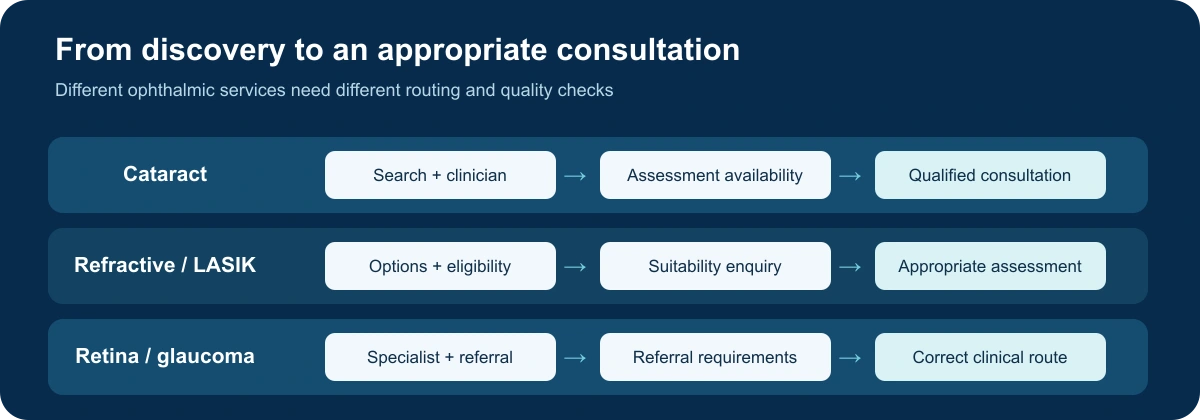
An ophthalmic marketing plan must respect clinical urgency and suitability. Patient acquisition is a business objective, not a substitute for professional referral criteria, clinical triage or informed consent. The acquisition journey is not one funnel. An elective refractive consultation may start with research about options, price considerations and suitability screening. Cataract enquiries may involve older adults, carers, insurer or NHS pathways, and questions about assessment. Retina referrals may depend on a clinician’s referral, clinical urgency and a tightly coordinated scheduling team. Glaucoma care may involve ongoing monitoring rather than a single procedure. We map these distinctions before choosing pages, campaigns or conversion events.
Our starting point is an agreed practice service-and-location inventory: who provides each service, where it is available, how patients are accepted, whether a referral is required, what contact options are appropriate and who clinically approves public-facing explanations. We pair that with existing search visibility and lead handling to identify opportunities without assuming every sub-specialty is offered by every provider.
For wider context, see marketing for doctors and medical specialists, medical clinic marketing and healthcare digital marketing services.
Ophthalmology Marketing by Service Line
The right search intent depends on the actual specialty, referral rules and patient needs. The framework below connects each service with suitable information, contact routes and measures.
| Ophthalmic service | Typical discovery intent | Content and conversion priority | Appropriate measure |
|---|---|---|---|
| General ophthalmology | Eye specialist, ophthalmologist near me, named consultant | Clinician credentials, conditions assessed, location and appointment requirements | Relevant first-visit enquiries |
| Cataract surgery | Cataract surgeon, cataract assessment, private cataract surgery | Surgery assessment pathway, alternatives, risks, realistic next steps, insurer/private information where verified | Qualified cataract assessments |
| LASIK and refractive surgery | Laser eye surgery, LASIK consultation, vision correction options | Clear suitability screening, risks and alternatives, transparent consultation process, substantiated price information | Appropriate refractive consultation requests |
| Retina and medical retina | Retina specialist, retinal disease clinic, referral to retinal surgeon | Specialist profiles, accepted referrals, urgency instructions and clinically reviewed information | Correctly routed specialist referrals |
| Glaucoma | Glaucoma specialist, glaucoma monitoring clinic | Monitoring services, referral criteria, follow-up process and actual clinic capacity | Relevant appointments and ongoing-care enquiries |
| Paediatric / pediatric ophthalmology | Children's eye specialist, paediatric ophthalmologist | Age ranges served, caregiver questions, appointment and referral policies | Suitable family enquiries |
| Oculoplastics and other subspecialties | Named subspecialist or verified procedure | Provider scope, candidacy discussion, risks, treatment alternatives | Clinically appropriate assessment requests |
| Multi-location eye groups | Ophthalmology clinic in a city, surgeon at named branch | Correct provider-location relationships, unique service availability and accessible contact routes | Bookings and qualified enquiries by location |
Cataract Surgery Marketing
Cataract surgery marketing starts with patient questions that need accurate context. A practice page should explain what happens at a cataract assessment, who performs it, what a patient can ask about available lens options, and how to discuss risks, alternatives and expected recovery with their treating clinician. It should not promise spectacle independence or use simplified success statistics without appropriate evidence and qualification. Site navigation should make the difference between a cataract information page, surgeon profile, clinic location and consultation request clear.
LASIK and Refractive Surgery Marketing
LASIK marketing and laser eye surgery marketing attract research-heavy audiences, but not every interested visitor is eligible. Good landing pages introduce the clinician, eligibility assessment, potential benefits and limitations, alternatives, price explanations if approved, and a calm path to a consultation. Claims such as “risk-free,” “painless” or “guaranteed vision” are unsuitable. The American Academy of Ophthalmology’s refractive-surgery advertising guidance emphasizes truthful claims and adequate substantiation.
Retina, Glaucoma and Specialist Referral Marketing
Retina specialist marketing requires a different conversion model. Some patients arrive via clinical referrals; others search for an identified specialist or service. Pages should identify the team, locations, referral mechanisms, relevant diagnostics actually provided and urgent-contact instructions approved by the provider. Similarly, glaucoma services may need longitudinal communication and follow-up information. Avoid optimizing medical urgency as a marketing pressure tactic, and never replace emergency guidance with a standard sales form.

An Ophthalmology Website and Patient Acquisition Blueprint
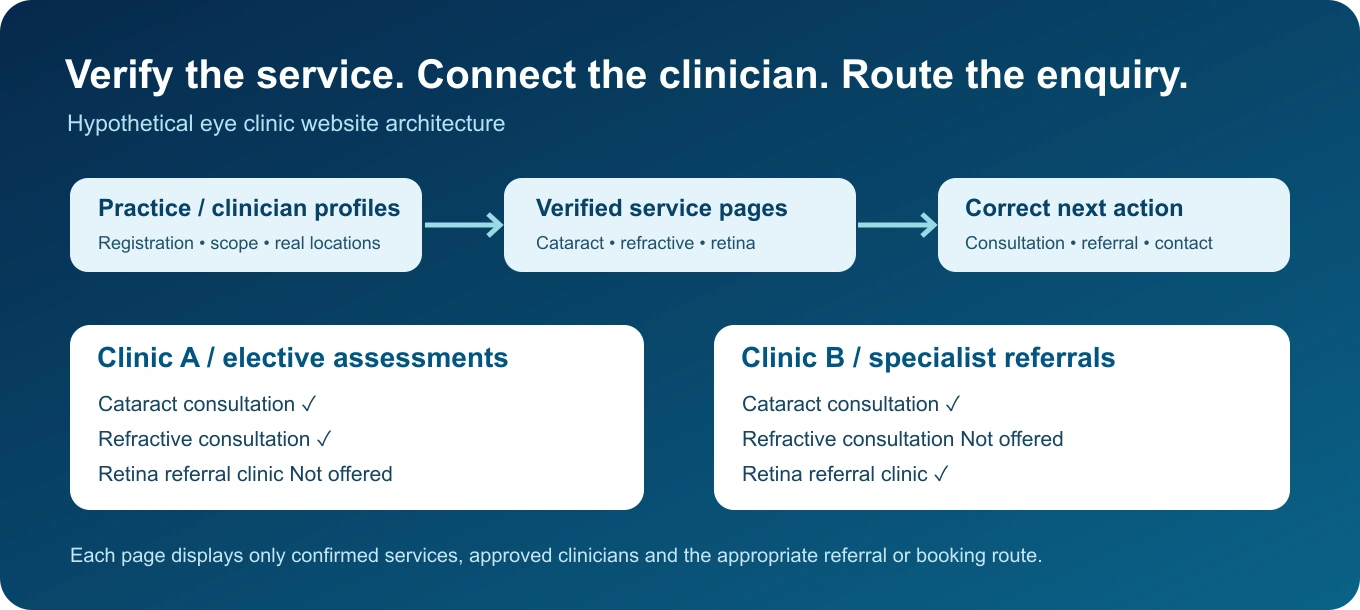
A credible ophthalmic marketing strategy should show what will be built, not just name the channels involved. Consider a hypothetical ophthalmology group with two real clinics, three ophthalmologists, a cataract assessment service at both sites, a refractive service at one and a clinician-led retina referral clinic at the other. This hypothetical example shows how service availability shapes the website.
Example Website Architecture for an Eye Clinic
| Example page type | Information the page must verify | Search and enquiry role |
|---|---|---|
| Practice overview | Real name, scope, contact routes and clinical oversight | Brand and general ophthalmology discovery |
| Clinician profile for each ophthalmologist | Registration, approved credentials, genuine subspecialty, actual consulting sites | Named consultant and ophthalmologist searches |
| Clinic A / Clinic B | Address, access, opening hours, phone, available clinicians and services | Local search and correct branch selection |
| Cataract assessment | Services actually offered, clinician, eligibility process, location, appropriate alternatives | Cataract consultation discovery |
| Refractive surgery assessment (Clinic A only) | LASIK/PRK/SMILE only if genuinely provided; consultation, screening, risks and pricing rules | Laser eye surgery marketing and suitable assessment enquiries |
| Retina referral information (Clinic B only) | Accepted referral routes, contact details, urgency policy and specialist availability | Retina specialist marketing and clinician referrals |
| Patient information and referral guidance | Clinically reviewed explanations, publication/review accountability and next steps | Helpful discovery, patient confidence and referrer clarity |
A service should not appear on a clinician or location page merely because another branch provides it. For example, the Clinic A cataract page should link to its actual assessing surgeons and consultation instructions; the Clinic B retina page should explain clinician referral routes, not send someone with urgent symptoms into a routine marketing form. Each page should lead to a verified contact method and the correct administrative team.
From Search Query to the Right Consultation
A realistic ophthalmology acquisition plan connects search query → appropriate page → verified clinical scope → safe contact or referral route → team qualification → scheduled or accepted assessment. A campaign for a cataract assessment may target people comparing available surgeons and locations; LASIK advertising may lead to a consultation about suitability, alternatives and risks; retina discovery may focus on the referrer rather than an unqualified consumer lead.
For a practice with multiple sites, this mapping also determines Google Business Profile services, internal links, paid-search exclusions and reporting segments. It prevents misleading location claims, wasted spend and the assumption that a high form-submission count equals effective care access.
Our Five-Part Eye Care Growth Framework
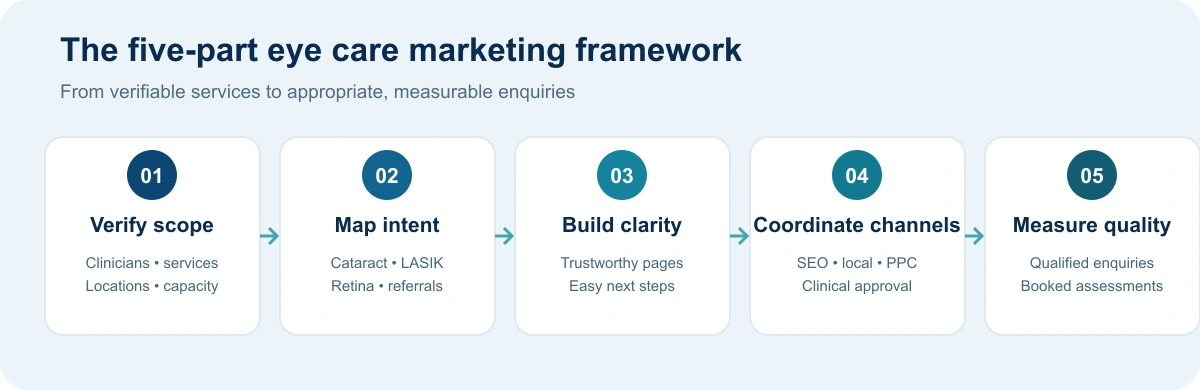
The DigiTaTop approach connects service accuracy, search visibility and enquiry quality. Each stage is adapted to the ophthalmology practice’s actual scope and approved with its clinical and administrative teams.
- Verify clinical scope and capacity. Confirm provider licensing or registration, clinic addresses, real services, referral eligibility, appointment capacity, documentation owners and approval requirements.
- Map commercial and clinical search intent. Separate brand searches, “ophthalmologist near me,” elective refractive enquiries, cataract surgery research, retina referrals and follow-up care. Assign each intent to the most useful existing or proposed page.
- Build credible pages and connected discovery. Improve clinician bios, service information, entity relationships, structured headings, location evidence and accessible booking routes. Use clinically approved educational materials that explain decisions, not just sell procedures.
- Coordinate relevant search and paid channels. Link local SEO, service-page optimization, content, Google Ads and appropriate reputation activity to the same verified service inventory; avoid campaigns for unavailable services.
- Measure useful enquiries, then refine. Report search visibility, calls and forms separately from assessed leads, booked consultations, attended visits and accepted referrals wherever privacy-safe and operationally available.
Illustrative example: a two-site eye group. Suppose one location offers cataract assessments and general ophthalmology, while the second also runs a retina referral clinic. An effective plan would map each clinician to the correct site, link cataract service pages to the right consultation location, create a distinct retina referral pathway only where offered and exclude retina queries from generic refractive ads. This hypothetical example shows how we connect services with appropriate enquiry routes.
What a DigiTaTop Ophthalmology Engagement Can Deliver
DigiTaTop’s differentiator is an integrated, clinician-verified service-and-location plan carried through to search architecture, conversion routing and operational reporting. An engagement is agreed around the practice’s verified services, systems, capacity and approvals.
| Workstream | Example tangible output | Practice-side verification |
|---|---|---|
| Discovery and validation | Surgeon / service / location matrix with referral and appointment constraints | Practice manager and clinical lead confirm scope |
| Organic search and content | Search-intent map; prioritized surgeon, service and clinic page briefs; technical remediation list | Clinician approves medical wording and credentials |
| Local search | Branch-by-branch profile corrections and provider-location consistency checklist | Authorized business owner verifies locations and hours |
| Paid acquisition | Relevant campaign and landing-page map with negatives, approved messaging and service availability | Practice approves budget, claims and consultations offered |
| Conversion and data | Phone/form journey map, event definitions, privacy review and aggregate reporting example | Operations and privacy owners approve data handling |
| Delivery governance | Prioritized backlog, owners, dependencies, reporting cadence and account ownership | Responsibilities and fees agreed in the proposal |
A useful review can reveal that the main bottleneck is a missing clinician profile, wrong branch destination or unanswered call rather than insufficient advertising. That kind of diagnosis helps the practice invest in the most relevant next action. For background on DigiTaTop’s wider approach, explore medical SEO services, healthcare marketing strategy and healthcare website development.
Ophthalmology SEO for Eye Clinics and Surgeons
SEO for ophthalmologists should make qualified practice information accessible to search engines and humans. An eye-care website needs technically sound pages, useful service-level copy, verifiable clinician information and clear internal navigation. A specialist ophthalmologist marketing plan should explain what an actual clinician does and where they practise, not merely repeat a high-volume query. It also needs a deliberate difference between ophthalmology and optometry: practices should describe the service delivered and the type of professional who provides it, rather than treating “eye doctor,” “optician,” “optometrist” and “ophthalmologist” as interchangeable professional titles.
We prioritize the fundamentals: crawlable pages, clean canonical URLs, one primary H1, sensible descriptive headings, mobile performance, accessible navigation, internal links and indexed pages with meaningful content. A procedure page should answer the visitor’s question and point to the appropriate clinician, relevant location, contact channel and related clinical information. An information article about a condition should not compete with a provider’s commercial page for the same intent.
On a typical ophthalmology website, the key architecture includes a clear practice homepage, individual ophthalmologist profiles, accurate location pages, verified treatment/assessment pages, referral guidance and clinically reviewed educational resources. Clinical content should distinguish general information from personalized recommendations. For execution detail, see medical SEO services and healthcare SEO and content planning.
Connect Eye-Care Searches with Relevant Services
The search terms that matter depend on the practice and the clinical service. An eye clinic may need visibility for its ophthalmologists, actual consultation locations and verified surgical assessment services. People researching LASIK may be comparing their options, while those seeking a retina specialist may already have a referral. Effective ophthalmology SEO connects each search to a page that gives the right clinical context and an appropriate next step.
Our medical SEO services address the underlying search architecture; ophthalmology-specific planning adds the details of clinician credentials, surgical and medical eye-care services, referral pathways and locations. The result is a more coherent website for patients and referrers, with relevant services clearly connected to clinicians, locations and contact options.
Local SEO for Ophthalmology Practices
Patients frequently need a real clinic, not merely a website that mentions their city. Local SEO for eye clinics begins with correct business names, phone numbers, addresses, maps pins, location-specific hours, appointment routes and clinician associations. Google Business Profile information should reflect the actual location and category; service descriptions and photos must not imply equipment, procedures or specialties a location lacks.
A multi-location ophthalmology group should have a useful page for each genuine branch, with unique address and access information, available services and actual clinicians. Cross-link branch pages to relevant surgeon profiles and clinical service pages where they genuinely apply. Avoid mass-producing near-identical suburb pages or listing the same procedure at every branch regardless of availability.
Reputation management should encourage authentic feedback without scripting outcomes, exposing patient information or buying positive reviews. Reply policies must account for patient confidentiality and local healthcare rules. Explore our broader healthcare marketing strategy services and medical clinic marketing.
Websites and Conversion Paths That Match the Clinical Service
An ophthalmology website design project succeeds when visitors can identify the relevant ophthalmologist, understand where to go and complete the next appropriate step. A retina referral pathway should not look identical to an elective laser-surgery enquiry. For planned, non-urgent assessments, show a clear phone or consultation action; for urgent clinical concerns, display practice-approved instructions that do not route emergencies into a marketing inbox.
Useful conversion improvements include accessible appointment controls, readable contact details on mobile, form fields limited to what is necessary, service-specific follow-up routing and clear answers to practical questions about location and assessment arrangements. Where a patient portal or sensitive data might be involved, analytics and forms require additional privacy and security review. DigiTaTop offers healthcare website design and healthcare branding in coordination with the practice’s clinical and administrative responsibilities.
PPC and Paid Search for Ophthalmology
Ophthalmology PPC can complement organic discovery for clinically appropriate search intent, particularly when a practice has available consultation capacity for verified services. Account structure should distinguish LASIK evaluation, cataract assessment, named-provider, branch and general ophthalmology searches. Retina campaigns may need tighter referral qualification rather than high-volume consumer acquisition.
Ad copy should accurately state the service and match its landing page. Price claims, promotional offers, patient stories, before-and-after imagery and clinical safety claims require appropriate substantiation and review. Campaign goals should distinguish calls and initial form submissions from qualified consultations; a large number of clicks is not proof that suitable patients were acquired.
Paid acquisition also depends on practical operations: missed-call handling, available appointment slots, pre-consultation guidance, exclusions for irrelevant queries and sensible geographic settings. The practice should approve tracking and data collection before tags or pixels are deployed. Learn about healthcare PPC management and healthcare social media marketing.
AI Search Visibility for Eye Care Providers
People may ask Google AI experiences, ChatGPT, Gemini or Perplexity comparative questions such as “How do I find a cataract surgeon in my city?” or “What should I check before choosing a LASIK consultation?” Strong AI-search optimization for ophthalmology starts with accessible, accurate, source-backed information: well-described services, named clinicians and registrations, actual locations, clear consultation processes and content that answers a question without exaggeration.
Our approach makes the practice’s facts easier to discover and verify. Service and location pages should contain descriptive text, consistent entity relationships, clinically signed-off answers, accessible images and meaningful internal links. A comparison of cataract assessment versus refractive consultation, for example, can clarify the audience and next step without giving personal medical advice.
Google states that its AI search features do not require special markup beyond normal SEO; pages still need to be eligible for indexing, discoverable and useful. See Google Search Central’s AI features guidance. DigiTaTop connects this work to healthcare AI-search optimization services and established medical SEO.
Questions Worth Answering Clearly
A useful ophthalmology page addresses who provides a service, which location offers it, whether a referral is necessary, what a consultation involves, how suitability is evaluated and how a patient contacts the right team. The practice’s responsible clinical team verifies claims about clinical indications, outcomes, treatments, risks, prices and insurance coverage. These answers can improve buyer confidence and may help people evaluate providers in both conventional and AI-assisted discovery.
Answers Eye Clinic Owners Need Before Hiring a Marketing Agency
What Should an Ophthalmology Marketing Agency Do in the First 90 Days?
It should first validate the service, clinician and location inventory, audit existing search and enquiry problems, identify what can be measured lawfully and propose a prioritized implementation backlog. Next, it may fix high-impact website or local-search issues and launch approved campaigns where appropriate. By the third phase, the practice should have clearly defined reporting, accountable owners and documented next steps, supported by a baseline for enquiry and appointment quality.
Should an Eye Clinic Choose SEO, PPC or Local SEO First?
The answer depends on the practice’s real demand and bottleneck. A clinic with incorrect hours or missing branch pages may benefit most from local and technical fixes. An eligible refractive service with available assessments may test carefully controlled paid search. A retina referral clinic may require stronger specialist profiles and referrer information before advertising. DigiTaTop evaluates the route to a qualified enquiry before recommending spend.
How Should an Ophthalmology Group Compare Marketing Proposals?
Compare the specific deliverables, surgical and medical eye-care knowledge, clinical content review process, measurement definitions, projected workload, ownership of data and accounts, and treatment of privacy-sensitive information. Ask each agency to show how it would map a particular surgeon to their real clinic and service, how it handles appointment/referral quality and which claims need sign-off. Be cautious of promises of top rankings, guaranteed surgery bookings or unverified testimonials.
What Is Different About Retina and LASIK Marketing?
A retina service frequently depends on specialist credibility, referral conditions, urgency and accurate routing; general consumer campaigns can be inappropriate for some enquiries. LASIK marketing and wider laser eye surgery marketing typically involve elective research, alternatives, price disclosure and suitability evaluation. Both require truthful communication, but the pages, calls to action, targeting and measures should not be interchangeable.
Measure Qualified Enquiries, Not Just Clicks
Marketing reports should separate visibility signals from operational outcomes. The following chain helps avoid mistaking an unanswered call or an unsuitable LASIK enquiry for a booked surgical patient.
| Measurement stage | Practical definition | Why it matters |
|---|---|---|
| Discovery | Organic impressions, map visibility, paid clicks, referral-source visits | Shows where a service is found, not its patient impact |
| Enquiry | Relevant call, appointment request or completed contact form | Identifies demand reaching the practice |
| Qualified enquiry | Request for a real, available service through an appropriate route | Filters mismatched or irrelevant contacts |
| Booked consultation or accepted referral | Scheduling confirmed by the practice team | Connects marketing with actual appointment workflow |
| Attended assessment | Visit attendance confirmed in an approved reporting system | Helps identify friction between booking and care |
| Service-line review | Aggregated results by service, location and permitted source | Supports prioritization without revealing patient details |
We define every event, permitted source and reporting limitation with the practice before deployment. A safe starting design uses aggregate channel and landing-page performance, non-sensitive interaction counts and approved operational booking totals where the practice can supply them. It does not send diagnoses, referral reasons, appointment details, patient names, email addresses or free-text clinical form data into ordinary ad-platform events. Whether an identifier or page interaction is legally protected depends on the context and implementation.
The US Department of Health and Human Services’ tracking-technology guidance explains regulated-entity obligations and expressly notes a June 2024 court ruling limiting one public-page interpretation. In the UK, the Information Commissioner’s Office explains additional constraints on using health-related special-category data for direct marketing. Cookies, consent, UK GDPR/PECR, confidentiality, HIPAA and applicable state rules require a deployment-specific assessment. Tracking decisions are agreed with the practice’s qualified privacy and legal advisers before implementation.
Ophthalmology Marketing in the USA and UK
The commercial objective may be similar, but healthcare systems, terminology and professional obligations differ. An effective ophthalmology marketing agency in the USA or UK should adapt content and conversion pathways rather than simply swapping spellings.
United States: Practice, Insurance and Referral Context
US pages may need to explain participating insurance arrangements where verified, clinic hours, named ophthalmologists, locations, referral criteria and consultation steps. Elective refractive services may need a different pricing and enquiry pathway from medical ophthalmology. Local campaigns should reflect state licensure, provider availability and the truthfulness requirements applying to medical advertising.
The American Academy of Ophthalmology and ASCRS refractive-surgery advertising guidelines, revised in June 2024, describe why advertisers should substantiate safety, efficacy, pricing and comparative claims. The clinic must also review applicable federal and state advertising requirements, professional rules and privacy duties with qualified advisers.
United Kingdom: Consultant, NHS and Private-Care Context
UK pages should distinguish appropriate ophthalmologist / consultant ophthalmologist terminology, actual clinician registration and specialist status, private consultation availability, and any NHS or referral arrangements the provider can document. Use ophthalmology and UK paediatric terminology where natural; do not assume that every eye clinic offers private refractive surgery, accepts self-referrals or sees NHS patients.
The General Medical Council’s public-communication standards require accurate and non-misleading communication; the Royal College of Ophthalmologists’ professional standards for refractive surgery address clinical governance, consent and patient communication. Marketing plans should also be reviewed for applicable UK advertising and data-protection duties.
USA Versus UK: Search Intent and Practice Operations
| Decision point | United States | United Kingdom |
|---|---|---|
| Provider identity | Verify credentials, licenses, actual physician locations and accepted insurance where relevant | Verify GMC registration, consultant/specialist claims and private/NHS arrangements |
| Cataract discovery | Local surgeon, consultation and plan/insurance details where verified | Consultant, private cataract consultation, NHS or referral eligibility where applicable |
| Refractive services | Device/procedure claims and cost disclosures need substantiation | Suitability, informed consent and professional refractive standards are central |
| Referral-dependent care | Match referring physician pathways and clinic availability | Reflect GP/optometrist, consultant and commissioned pathways only where applicable |
| Measurement | Account for HIPAA and state privacy obligations when relevant | Review UK GDPR, PECR, confidentiality and sensitive-data handling |
Each campaign receives a practice-specific review before launch.
How SEO, Paid Search and Practice Operations Work Together
No single channel can solve a weak patient journey. SEO helps patients discover credible providers and service information; local search supports location and clinician selection; paid ads reach suitably targeted demand where permitted; website design turns attention into an appropriate action; and the practice’s staff handle enquiries, referrals and scheduling. The team should review all five together instead of judging channels only by impressions or form counts.
For example, paid cataract searches will not produce useful appointments if the landing page lacks accurate surgeon and branch information or if no assessments are available. Organic retina information may support referral confidence even when a general-purpose consultation form is the wrong next action. The best improvement may therefore be accurate service navigation or better call routing, not a larger ad budget.
What to Expect in the First 90 Days
Your proposal confirms the scope and delivery schedule. The example below shows how the first quarter can be organized.
| Phase | Focus | Possible deliverables |
|---|---|---|
| Days 1-30 | Discovery and validation | Practice inventory, audience and intent map, baseline analytics review, website and local visibility audit, conversion-route analysis |
| Days 31-60 | Priority implementation | Approved service-page improvements, provider/location connections, technical fixes, content review workflow and eligible campaign setup |
| Days 61-90 | Measurement and refinement | Qualified-enquiry dashboard, call/form quality review, landing-page tests, prioritized technical/content backlog and next-quarter plan |
The order depends on the site’s technical state, practice approvals, clinical review availability, tracking constraints and available capacity. The proposal should specify who owns ad accounts, analytics, website access and creative assets, as well as reporting frequency and approval responsibilities.
How to Choose an Ophthalmology Marketing Agency
A credible agency should be able to explain how it will represent a surgeon’s real credentials, distinguish retina referrals from elective LASIK demand, prioritize ophthalmology service and location pages, and avoid unsafe advertising shortcuts. Ask to see its methodology, the people responsible for delivery, how medical claims are approved and how results will be measured. Check what the agency will actually produce, what the practice must supply and what remains owned by the client.
DigiTaTop’s proposed planning process combines specialty-level keyword and content architecture with technical SEO, local discovery, conversion journeys and measurable enquiries. Evaluate the proposed team, delivery method and any documented project references alongside the scope of work. Our broader healthcare marketing services, about page and healthcare marketing packages provide context for evaluating fit.
Request Your Ophthalmology Marketing Assessment
Find out which gaps may be limiting qualified eye-care enquiries. Tell us your practice website, country, number of clinic locations, main ophthalmic services, preferred booking or referral goals and the largest obstacle you see today. A short introductory conversation helps us establish whether the priority is technical SEO, eye clinic marketing, local discovery, ophthalmology PPC, AI-search visibility, landing-page experience or practice-side enquiry handling.
A scoped assessment proposal can include:
- Visibility and content review: service, surgeon and location pages, relevant competitors, technical issues and clear search-intent gaps.
- Enquiry journey review: consultation actions, referrals, call/form routing, mobile usability and available appointment capacity.
- Channel opportunities: realistic priorities for ophthalmology SEO, local search, paid campaigns and AI-search readability.
- Action plan: recommended quick fixes, owners, assumptions, approvals and a proposed next-quarter backlog.
We confirm the depth of work, necessary permissions, deliverables, timing and fees before beginning a substantive review. Any clinical claims, regulated advertising, tracking configuration or publication changes remain subject to client approval.
Frequently Asked Questions
What does an ophthalmology marketing agency do?
An ophthalmology marketing agency helps surgeons and eye clinics improve how people and referring clinicians find verified care services and reach the right team. Work can include ophthalmology SEO, surgeon and location pages, local search, paid campaigns, clinically reviewed content, website improvements, AI-search visibility and qualified-enquiry measurement. Scope depends on the clinic’s real providers, services and referral requirements.
How is ophthalmology SEO different from general medical SEO?
Ophthalmology SEO must connect each ophthalmologist’s genuine subspecialty, service availability, clinic location and enquiry or referral route. Cataract surgery, LASIK assessment, glaucoma monitoring and retina referrals serve different intents and need distinct content. The same technical SEO foundations apply, but accurate clinical architecture and patient-safety context matter more.
What should an eye clinic receive in its first 90 days with an agency?
An appropriately scoped engagement may deliver a practice inventory, search and content audit, prioritized improvements, approved landing-page or local-search changes and a reporting model for qualified enquiries. The work depends on access, clinical sign-off, available appointment capacity and budget. Your proposal confirms milestones and the reporting schedule.
How much does ophthalmology marketing cost in the US or UK?
Costs depend on the number of clinics and clinicians, surgical and medical service lines, technical requirements, content review workload, advertising budgets and reporting complexity. SEO, website work and paid media may have different fees and timelines. Request a proposal with deliverables, exclusions, account ownership and pricing explained; see our healthcare marketing packages for wider context.
Should a retina practice and a LASIK center use the same marketing strategy?
No. Retina marketing often prioritizes accurate specialist identity, clinically suitable referral instructions and scheduling routes, while LASIK marketing commonly involves elective-service research, suitability evaluation, alternatives and carefully substantiated advertising. A shared practice website can support both, but campaign targeting, calls to action and success measures should remain service-specific.
Can SEO or AI search guarantee new ophthalmology patients?
No. Neither Google rankings nor recommendations from ChatGPT, Gemini, Bing or Google AI experiences can be guaranteed. Accurate, accessible and original service information may improve discoverability. Results also depend on competition, indexability, demand, practitioner capacity, website quality and how enquiries are handled. We report what can actually be verified.
How should patient enquiries be tracked without exposing medical details?
Define basic visibility and contact events separately from qualified and booked consultation reports. Minimize form fields and do not pass diagnoses, personal referral details or protected appointment information to general advertising tools without the proper legal and technical review. The practice must approve tracking, privacy notices and any necessary vendor arrangements under applicable US or UK rules.
What happens after I request an ophthalmology marketing assessment?
We discuss your practice URL, country, locations, offered specialties, enquiry goals and current challenges. We then recommend a suitable review or engagement scope, including access needs, deliverables, responsibilities and any fees. You can review the scope and proposal before commissioning the work.