
Healthcare PPC Agency & Google Ads for Doctors, Clinics & Hospitals
DigiTaTop Agency provides healthcare PPC management and Google Ads services for doctors, medical practices, clinics and hospitals. Our paid search marketing for healthcare connects eligible campaigns to the right service and location pages. We report contact activity and enquiry quality where reliable information is available.

What Is Healthcare PPC?
Our PPC marketing for doctors, private consultants and medical groups starts with suitable services, verified locations, budgets and conversion goals. Healthcare advertising requires more than a generic lead-generation template: service eligibility, clinical claims, sensitive-interest targeting and patient-data handling must be assessed for the relevant country and platform.
Start with an account-readiness discussion: share your existing Google Ads account (if any), the services you want to promote, the locations you serve and how your team handles enquiries. We will identify the appropriate review scope before recommending campaigns or additional spend.
Healthcare PPC (pay-per-click) advertising is paid search marketing that helps eligible healthcare organizations appear for relevant searches while managing bids, budgets, ads and landing pages. The advertiser usually pays the ad platform for clicks or other eligible interactions, and the agency charges separately for management. A strong program connects the campaign to an approved healthcare service and an enquiry path the organization can actually support.
For a clinic, medical PPC services and clinic PPC advertising may focus on searches for an available consultation, diagnostic service or specialty appointment within a defined area. For a multi-location group, campaign structure must also distinguish branches, departments and services instead of sending every visitor to a generic homepage.
PPC can begin generating visits once campaigns are approved and serving, but traffic is not the same as a qualified lead or a booked appointment. DigiTaTop evaluates that difference before recommending a budget increase.
Why Healthcare Google Ads Need a Different Approach
Healthcare paid search requires attention to four separate decisions: what is eligible to advertise, who is searching, where the person should land, and which outcomes can be measured lawfully and reliably.
An otherwise well-built campaign may be inappropriate if its ads imply unsupported treatment benefits, it targets a restricted medical category without the necessary approval, it uses sensitive health information for personalization, or its conversion tracking shares information it should not collect. Rules vary across the United States and the United Kingdom and can also vary by the advertised service.
DigiTaTop’s proposed workflow includes a documented advertising-policy review and a practice-side approval step for treatment claims. The advertiser and qualified advisers remain responsible for determining applicable legal requirements and approving clinical information; an agency cannot certify a campaign as universally compliant.
Learn more from the official Google Ads Healthcare and medicines policy, Google Ads health-related personalization guidance and, for UK health-related claims, the ASA/CAP Code.
Healthcare PPC Services for Doctors, Clinics and Hospitals
- Independent clinics and medical practices that need a focused, service-specific enquiry strategy rather than a broad awareness campaign.
- Dental and ophthalmology practices: dental PPC and ophthalmology PPC require clear service eligibility, location details, appointment availability and accurate medical claims.
- Fertility and other sensitive-care providers that need eligibility and targeting checks before any promotion; some reproductive-health advertising is subject to additional restrictions.
- Hospitals, medical groups and multi-location providers that need hospital PPC management across departments, catchment areas and operating locations.
- Diagnostic centers and laboratories that need accurate service availability, booking information and policy-aware language.
A healthcare PPC strategy is only appropriate if the advertised service is actually available, the organization can respond to enquiries and the account can operate within platform and local rules.
Google Ads for Doctors: Medical Practice PPC Management
A doctor’s Google Ads strategy should reflect who the physician is, which services are genuinely available, where consultations take place and what an interested patient needs to know before making contact. Advertising a named specialist is different from advertising a hospital department or a chain of clinics. A campaign should not imply that a doctor performs a treatment or works at a location without verification.
For individual specialists, PPC for doctors may begin with a small set of eligible, high-intent consultation or service queries in a defined geography. Google Ads management for doctors, including physician PPC management, can cover branded and non-branded searches, service-specific ad groups, location rules, appropriate exclusions, landing-page guidance and measurement of qualified contact requests. A practice should decide how it handles enquiries before increasing media spend.
Specialty-specific PPC considerations
Ophthalmologist or eye surgeon
Example search intent to assess: Cataract assessment or available eye-care consultation
Campaign and landing-page consideration: Confirm actual services, location, professional role and any procedure-specific claim restrictions
Dentist or dental practice
Example search intent to assess: Dental consultation, implant assessment or practice location
Campaign and landing-page consideration: Separate eligible service categories and avoid unsupported treatment outcomes
Dermatologist or aesthetic practitioner
Example search intent to assess: Dermatology consultation or approved cosmetic service
Campaign and landing-page consideration: Review sensitive-procedure policies, evidence, creative and local advertising rules
IVF or fertility specialist
Example search intent to assess: Specialist consultation and service information
Campaign and landing-page consideration: Apply heightened policy, targeting and privacy checks to reproductive-health content
Private GP or consultant
Example search intent to assess: Named physician or private consultation search
Campaign and landing-page consideration: Verify credentials, clinic affiliation, appointment path and catchment area
These are illustrative search-intent categories; platform eligibility and clinical approval must be checked before campaign launch. The final campaign is subject to the advertised service, country, platform policy and the healthcare organization’s clinical approval.
A small specialist practice may benefit from starting with a constrained Search campaign and a single strong consultation page. A multi-site practice may need separate budgets, call routes, landing pages and service-availability checks. Our healthcare website design and medical SEO services can support the same doctor discovery journey when required.
What DigiTaTop's Healthcare PPC Management Can Include
Our healthcare Google Ads management is organized into seven workstreams. The selected package and written proposal specify which work is included, the number of campaigns and platforms, and any separately quoted landing-page or measurement work.
1. Google Ads Account Audit and Campaign Assessment
We examine the current account or, for a new advertiser, its planned setup: ownership, billing and access, geographic targeting, search terms, existing conversions, disapprovals, policy eligibility, ad-to-landing-page relevance and signs of wasted spend. The resulting assessment identifies what to fix before spending more.
A useful PPC audit distinguishes an ad-account issue from a website problem. If the landing page lacks service information or the appointment team cannot respond, more bids may simply buy more unqualified clicks.
2. Patient-Intent Keyword and Search-Term Research
We group proposed keywords by the actual service, location and stage of the search. High-intent terms can include consultations, provider and specialty searches, relevant diagnostic services and clearly advertised treatment options. Informational searches may need a different landing page, or may not justify paid advertising at all.
Keyword selection is reviewed for medical accuracy, prohibited or restricted terms, local relevance and commercial value. The campaign also needs a disciplined approach to exclusions and negative keywords, reviewed against real search-term data when available. Search-volume and cost-per-click assumptions are identified as estimates until supported by platform forecasts or account data.
3. Google Ads Campaign Structure and Healthcare Paid Search Management
Subject to eligibility and access, work may include Search campaigns, campaign/ad-group organization, ad copy, bidding and budget recommendations, relevant assets, search-term reviews, exclusions, geographic refinements, experiments and performance reviews. Each campaign should have a defined service and enquiry objective.
Google Ads for medical practices and wider medical practice PPC management should not rely on blanket audience exclusions or aggressive remarketing without checking the platform’s sensitive-interest policies. Additional platforms, formats or remarketing tactics are discussed separately and launched only when they are appropriate and included in scope.
4. Healthcare Landing Pages and Conversion Paths
An ad about an eye consultation should not send someone to a generic page without clear service availability. We review the relationship between the search, the ad promise and the landing page: provider information, service scope, locations, practical next steps, accessibility, mobile experience and a trustworthy contact route.
DigiTaTop can recommend or brief healthcare PPC landing pages with service-specific messaging and appropriate medical review. Development, copy production, new landing pages or larger website rebuilds are not automatically included in the PPC management minimum; the proposal must state the allowance or separate project fee.
5. Advertising Policy and Clinical-Claims Review
Before launch, the practice should confirm offered services, responsible clinicians, licenses or required certifications where relevant, and the evidence behind treatment claims. We document policy-related questions and route clinical, legal or advertising-compliance decisions to the appropriate owner.
Google restricts certain healthcare advertising and sensitive-interest personalization; the rules are neither identical across medical specialties nor identical across countries. An advertiser may be limited or require certification. DigiTaTop does not guarantee approvals and will not suggest bypassing platform restrictions.
6. Tracking, Lead Quality and Performance Reporting
We define the difference between a paid click, an enquiry, a qualified enquiry and a booked appointment. Reporting may include eligible spend, impressions, clicks, cost per click, conversion events, cost per enquiry, observed lead quality and the operational factors affecting follow-up.
Because healthcare enquiries may involve sensitive information, event design must minimize data collection. We do not assume that uploading patient contact records, enabling enhanced conversions or installing third-party pixels is appropriate. Any such arrangement requires a separate assessment of the advertiser’s data, consent, contracts and applicable legal obligations.
7. Continuing Optimization and Decision Support
Performance work combines what the ad account reports with information the organization can responsibly share about lead quality. We identify high-spend, low-fit searches; monitor geographic relevance and creative performance; and recommend adjustments based on agreed priorities, not vanity metrics.
A report should say what was changed, why it was changed, what was observed and which factors remain unknown. A fall in cost per click alone is not proof of an improvement in patient acquisition.
Healthcare PPC Account-Readiness Assessment: What You Receive
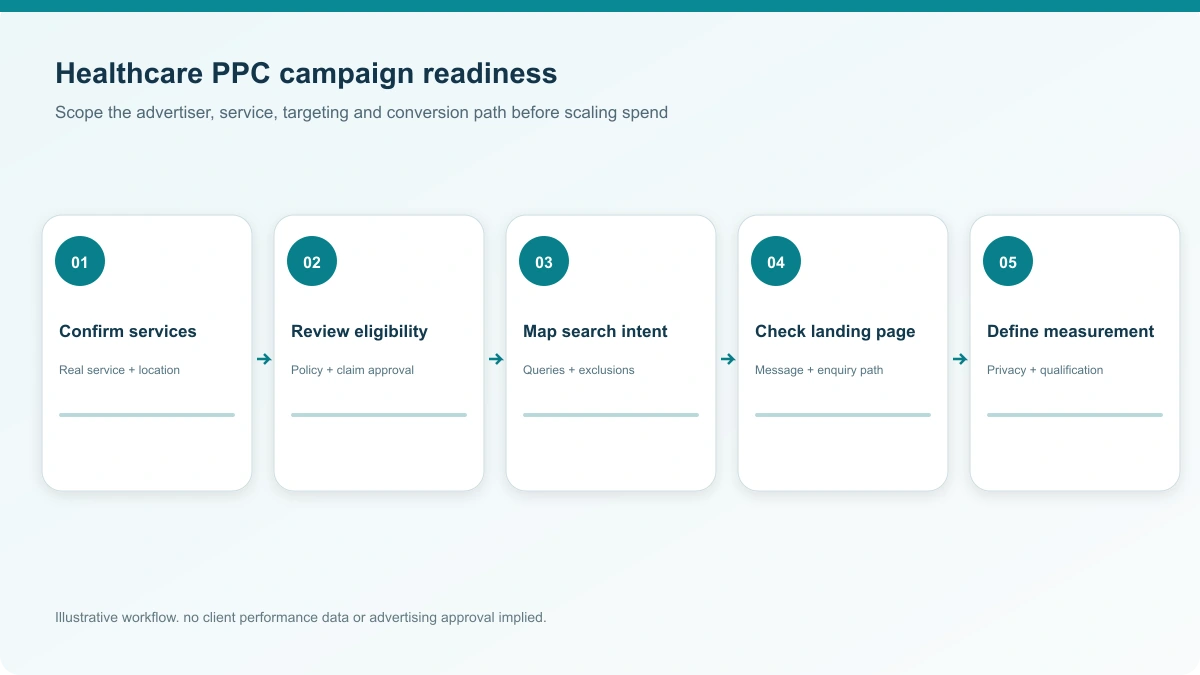
Before expanding spend, DigiTaTop can scope a healthcare PPC audit that identifies account constraints, missing evidence and the first decisions to make. The review connects the advertising account to the services your practice offers, its landing pages and its ability to respond to enquiries. Its written scope is agreed before work begins.
Service and location eligibility
What we review: Offered services, responsible providers, supported locations and relevant Google Ads restrictions
Useful output or decision: Verified campaign scope and items requiring clinical or policy approval
Google Ads account and search terms
What we review: Account access, campaign structure, location settings, search-query relevance, negatives and current disapprovals
Useful output or decision: Prioritized account corrections and search-intent/exclusion recommendations
Landing-page readiness
What we review: Provider credibility, treatment information, mobile usability, location details and visible contact path
Useful output or decision: Landing-page issues, ranked by impact and implementation responsibility
Google Ads conversion tracking
What we review: Whether clicks, form starts, completed enquiries and calls are distinct; whether data collection is appropriate
Useful output or decision: Draft measurement specification and privacy-review questions
Budget and management limits
What we review: Ad spend, campaign/service-line caps, account ownership and any additional setup needs
Useful output or decision: Proposed tier fit, initial budget guardrails and scoped exclusions
Practice lead handling
What we review: Call coverage, response process, duplicate/spam definition and service availability
Useful output or decision: Agreed qualified-enquiry definition and follow-up improvements
Example: Diagnosing a doctor's underperforming campaign
Illustrative scenario. A private eye specialist receives paid clicks but few consultation requests. A review finds broad informational searches, weak mobile contact visibility and missed calls outside office hours. Instead of simply raising bids, the priorities become separating eligible consultation intent from educational queries, improving the relevant doctor/service page, checking completed-enquiry events and aligning call routing with staff availability. Subsequent optimization depends on what the account and practice can reliably measure.
The outcome of the assessment is a prioritized decision, not a guaranteed number of patients or appointments. Any additional campaign build, page development or specialist tracking work is defined in the written proposal.
Build a Better Ad-to-Appointment Journey
A medical Google Ads management program can purchase relevant visits, but the patient experience continues after the click. The page must answer the questions that brought the person there, and the organization must be able to respond.
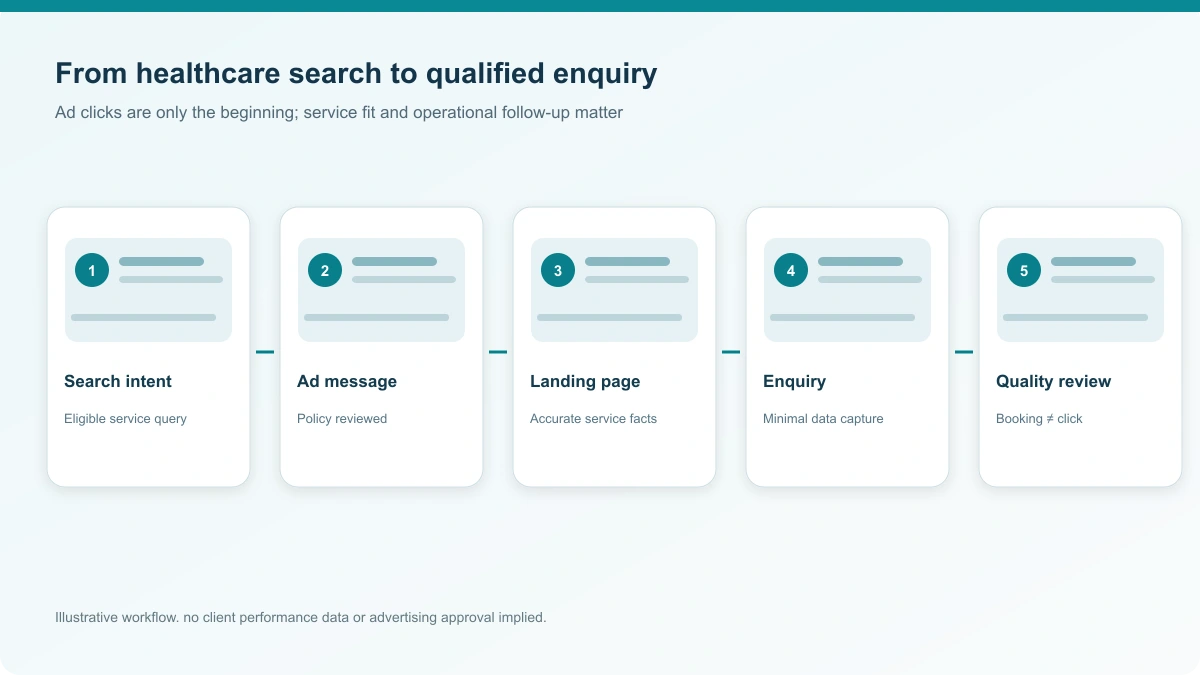
An effective journey connects six parts:
- Intent: a person searches for a service the organization actually offers.
- Eligible message: the ad describes the service accurately, within platform and local rules.
- Relevant landing page: service details, location, clinician information where appropriate, and practical next steps are clear.
- Enquiry action: the contact path works on mobile and avoids unnecessary sensitive data collection.
- Human follow-up: the organization handles enquiries promptly and confirms suitability and availability.
- Responsible feedback: performance reports distinguish qualified enquiries from bookings and from the ad platform’s modeled events.
Example landing-page brief: diagnostic appointment campaign
Illustrative example. The paid ad targets an eligible, location-specific diagnostic appointment query. The page should state which location offers the test, booking or referral requirements when verified, who to contact, practical preparation information only when clinically approved, and a clearly labelled enquiry button.
The ad should not imply a same-day slot, guaranteed diagnosis, clinically superior equipment or a specific treatment outcome without documented support. An analytics event can record an appropriate contact-action completion without copying symptoms, medical history or sensitive free-text details into general advertising tools.
US and UK Healthcare Advertising Considerations
The USA and UK share the need for accurate ads and appropriate measurement, but they do not use the same healthcare advertising framework.
United States: policy restrictions and sensitive data
Google’s healthcare policies may affect medical services, prescription-related categories, fertility services, clinical trials and other areas. Separately, US healthcare organizations need to assess how website tags, tracking technologies and disclosures interact with their circumstances, including any applicable HIPAA obligations. The US Department of Health and Human Services has published guidance on tracking technologies; part of that guidance was vacated by a federal court, so organizations should not rely on blanket or outdated summaries of the rules.
DigiTaTop does not claim that any tag or campaign is automatically HIPAA compliant. We define required measurements with the organization and request specialist review of potentially sensitive data flows.
United Kingdom: advertising claims and privacy
UK healthcare advertisers should check relevant CAP/ASA rules for medical treatments and substantiation, platform-specific eligibility and the applicable UK data protection and consent requirements. The ICO’s guidance on online advertising covers cookies, tracking pixels and related storage/access technologies; UK campaigns should not assume that an analytics or marketing pixel is exempt from review because its goal is lead generation.
Where claims require clinical or legal input, the healthcare organization must approve the final language. Our process includes a documented approval owner for clinical claims and a separate privacy review when sensitive tracking or data sharing may be involved.
Healthcare PPC Packages and Management Pricing
DigiTaTop publishes three medical PPC management tiers. In every tier, the monthly management charge is the higher of the stated minimum or 12% of managed advertising spend. This is a single management fee calculated using a maximum, not the minimum plus 12%. Media spend is billed separately and stays under the advertiser’s agreed account arrangements.
Paid Search
Essential
Monthly management minimum
$950/month
Or 12% of managed ad spend, whichever is higher.
One-time setup
$750
- One location
- One paid platform
- Up to 3 active campaigns
- Up to 2 service lines
- Search ad-text work
- Campaign architecture
- Ongoing optimization within agreed scope
- Performance report
Paid Acquisition
Growth
Monthly management minimum
$1,500/month
Or 12% of managed ad spend, whichever is higher.
One-time setup
$1,250
- One location
- Up to 2 paid platforms
- Up to 6 active campaigns
- Up to 4 service lines
- Ad text and up to 4 relevant static designs
- Campaign architecture
- Ongoing optimization within agreed scope
- Performance report
Multi-location
PPC
Monthly management minimum
$2,250/month
Or 12% of managed ad spend, whichever is higher.
One-time setup
From $2,000
- Up to 3 locations
- Up to 2 paid platforms
- Up to 10 active campaigns
- Up to 6 service lines
- Ad text and up to 8 relevant static designs
- Campaign architecture
- Ongoing optimization within agreed scope
- Performance report
The management fee is a single amount: the greater of the tier minimum or 12% of managed ad spend. Advertising spend and setup are separate.
Management scope: campaign architecture, ad-text work, optimization and a report within the tier’s agreed allowance. Ads, platform access, account eligibility and suitable landing pages must be agreed during onboarding. Additional campaign builds, expanded geographic scope, new creative formats and specialist measurement work may require separate approval. Ad spend, newly developed landing pages, video production, tracking licences, third-party charges and applicable taxes are excluded unless expressly quoted.
Which PPC package is right for a doctor or clinic?
Essential is the starting point for a doctor-led practice advertising one or two appropriate service lines in a single location. Growth is for a more established practice with more campaign breadth or an additional approved platform. Multi-location supports group-level budgeting across several verified sites. A larger tier does not imply a guarantee of more patients or lower acquisition cost.
Illustrative management-fee calculation: with the Essential package and $5,000 in managed monthly media spend, 12% equals $600, so the $950 minimum applies. At $10,000 in spend, the 12% calculation equals $1,200 and becomes the management fee. The one-time setup and media spend are separate in both examples. The examples explain the fee formula; they are not recommended advertising budgets.
Explore the full healthcare marketing pricing and packages or request an account-specific proposal.
What the First 90 Days Can Include
Timelines depend on account access, advertising eligibility, approvals, landing-page condition, agreed scope and the actual campaign budget. The following is a planning sequence, not a promise of ads being approved or appointments booked by a specific date.
Days 1–30: validate and prepare
Agree target services, markets, budgets, account permissions and enquiry criteria. Review or build campaign structure, check applicable advertising restrictions and review landing-page and tracking gaps. Launch only after the required sign-offs and eligibility conditions are met.
Days 31–60: observe and refine
Review search terms, eligible reach, lead relevance, ad and landing-page performance, and any policy disapprovals. Prioritize changes that remove wasted spend or improve the fit between query, service, location and patient enquiry.
Days 61–90: review quality and next investment
Compare recorded enquiries with agreed qualification criteria and operational follow-up, within privacy limits. Evaluate which services merit additional budget, which landing pages need work and whether SEO should support the same high-intent searches longer term.
PPC Performance Reporting: From Clicks to Qualified Appointments
Healthcare PPC success is not the same as a low cost per click. For meaningful decisions, a healthcare organization needs to understand the relationship between spend, appropriate enquiries and its ability to handle those enquiries.
Clicks and spend
Meaning: Ad activity and platform media cost
Interpretation limit: Not evidence of patient acquisition
Relevant search terms
Meaning: Fit between queries and approved services
Interpretation limit: Not proof all searchers are suitable
Form/call actions
Meaning: Recorded interaction events
Interpretation limit: Can include unqualified or repeated actions
Qualified enquiries
Meaning: Enquiries that meet an agreed service/location/intent definition
Interpretation limit: Qualification depends on data responsibly collected and reviewed
Appointment requests
Meaning: People asking for a booking, when measurable
Interpretation limit: Not necessarily confirmed visits
Booked appointments
Meaning: Confirmed bookings, if safely and reliably reported
Interpretation limit: Influenced by operations, capacity and follow-up
An agreed reporting definition might be: qualified enquiry = a genuine contact expressing interest in an offered service within a supported location, excluding spam, duplicates and irrelevant requests. This is an example definition that the client should adjust to its intake process.
A useful monthly performance review should list changes made, search-term and landing-page findings, spend and recorded enquiries, known lead-quality feedback, and the next action. When appointment data is unavailable or cannot be shared appropriately, the report should state that limitation instead of treating every contact event as a booked patient.
When PPC Is Not the Right First Investment
We may recommend delaying paid advertising when the service itself is not confirmed, the campaign is not eligible, the website provides confusing or misleading information, appointment capacity is unavailable, or the organization cannot process enquiries. In these cases, the better first step can be a targeted website improvement, healthcare marketing strategy, or healthcare SEO work.
Healthcare SEO can build lasting discoverability through useful service pages and technical improvements; PPC pays for eligible visibility within an allocated budget. Both may support the same commercial priorities, but they use different economics, timelines and measurement assumptions.
Why Choose DigitaTop Agency for Healthcare Google Ads?
DigiTaTop connects healthcare lead generation with the actual patient-enquiry journey: eligible demand, verified services, relevant pages, responsible measurement and the practice team’s follow-up capacity. That means a PPC discussion can include a website problem or a tracking problem, not just bids and ad copy.
Clients retain visibility into their advertising accounts, the agreed campaign limits and management charges. A written scope can identify who approves clinical claims, who owns billing, how performance will be reported and whether new landing pages or additional advertising platforms are included.
For related needs, explore our healthcare digital marketing services, About DigiTaTop Agency and healthcare marketing pricing. To discuss a specific account, request a healthcare PPC consultation.
Frequently Asked Questions About Healthcare PPC
What does a healthcare PPC agency do?
A healthcare PPC agency helps eligible clinics and healthcare organizations plan, build, manage and assess paid advertising. Work may include search-intent research, campaign structure, platform-policy checks, ad copy, budget oversight, landing-page recommendations and enquiry measurement. Your contract should specify the included tasks and responsibilities.
Is healthcare PPC the same as medical Google Ads management?
The terms overlap. Healthcare PPC can describe paid advertising across suitable platforms, while medical Google Ads management refers specifically to Google Ads for healthcare or medical-practice searches. DigiTaTop evaluates platform suitability and does not assume every paid format is appropriate for every specialty.
How much do healthcare PPC management services cost?
There are three published packages. Paid Search Essential starts at the higher of $950/month or 12% of managed ad spend, plus a $750 one-time setup; Growth starts at the higher of $1,500 or 12%, plus $1,250 setup; and Multi-location starts at the higher of $2,250 or 12%, plus setup from $2,000. Advertising spend, landing-page builds and other excluded costs are separate. The written agreement defines exact scope.
Do you manage Google Ads for individual doctors and private medical practices?
Yes. DigiTaTop scopes Google Ads for doctors, physicians, private consultants and medical specialists around verified offered services, supported practice locations, eligible patient search intent and usable consultation paths. The Essential tier can suit one eligible location and up to two service lines, subject to campaign readiness, review and the signed scope. Enquiry numbers and appointment volumes are not guaranteed.
Can you advertise fertility, cosmetic, mental-health or other sensitive services?
Some healthcare topics are restricted or prohibited for particular locations, formats or targeting methods, and certification may be required. We assess the specific service and country using current platform policies, then identify what approvals or changes are necessary. We cannot promise that a restricted campaign will be accepted.
Do you create dedicated PPC landing pages?
We can assess and brief service-specific landing pages, and can scope design, content or development work where appropriate. New landing-page production is not automatically included in the base PPC management fee; any allowance or separate project cost must be stated in the proposal.
How will you measure lead quality without sharing patients' health information?
We first agree what constitutes a useful enquiry, then specify appropriate events and reports with the healthcare organization’s privacy and compliance owners. Sensitive information should not be placed into general advertising measurement tools without a separate documented assessment and lawful basis. We distinguish recorded interactions, qualified enquiries and confirmed bookings.
Should our clinic invest in PPC or SEO first?
PPC may suit an eligible, defined service with a useful landing page, media budget and capacity to handle leads. SEO is often a stronger foundation when important service pages, local information or technical accessibility need work. Some organizations use both. A discovery review should establish which constraint matters most before committing to spending.
Request a Healthcare PPC Account Review & Proposal
Tell us which medical services you want to promote, your country and practice locations, whether you have an existing Google Ads account, your approximate advertising budget and how your team handles enquiries. We can then discuss an appropriate account-readiness review and a defined campaign-management proposal covering eligibility, scope, fees, landing-page needs and measurement.
Campaign outcomes depend on eligibility, competition, budget, demand, approvals and operational follow-up. Specific placements, patient numbers and returns cannot be guaranteed.