
Healthcare Website Design for Doctors, Clinics & Hospitals
Healthcare website design and development built around clinical credibility, clear services and easier patient enquiries.
A doctor’s professional website should make it easy to understand their specialty, verified credentials, available treatments, practice locations and consultation options. The same principle scales to clinics and hospitals: visitors need to find the right service, identify the practitioner who provides it and choose an appropriate next step.
DigiTaTop Agency provides healthcare website design, website design for doctors and medical practice website design for individual physicians, private consultants, specialist practices, clinics, hospitals, diagnostic laboratories and healthcare groups. We connect information architecture, medical content planning, responsive design, content management, technical SEO and conversion measurement into one defined project scope. New websites, redesigns and migrations are evaluated differently, because they carry different operational and search risks.

What is healthcare website design and development?
Medical web design combines clear information, accessible layouts and practical enquiry routes. Our medical website development work helps people navigate your services and take an informed next step. It includes more than choosing a theme or producing attractive screens. Useful work covers the page hierarchy, service and provider information, mobile interactions, accessible content, development, booking connections where appropriate, launch safeguards and ongoing ownership.
Website design for physicians may begin with a verified profile, selected service pages, clear practice locations and a straightforward consultation request. For a clinic, that may extend to multiple practitioner profiles and service journeys. A multi-location medical group may instead need shared templates, doctor-to-location relationships, department pages, editorial workflows and structured updates across many services.
The central question is not “How many pages can we build?” It is “What information must each visitor understand before they can take an informed next step?”
Website design for doctors and medical specialists
A personal website for a doctor has a different job from a hospital website. People may already know a physician’s name but need to confirm expertise and where the doctor practises. Others begin with a treatment or condition question and want to understand which qualified practitioner offers that service. Doctor website design should support both journeys without presenting promotional claims as clinical evidence.
DigiTaTop approaches web design for doctors through an agreed information architecture: verified qualifications and professional registration where applicable, specialty and service descriptions, practice locations, consultation routes, accessible mobile layouts and a content system the doctor or practice manager can update. We do not invent credentials, medical claims, patient reviews or appointment availability.
What should a professional doctor website include?
Professional doctor profile
What it helps a patient verify or do: Understand the practitioner’s identity, role, specialty and experience
Content the doctor must confirm: Legal/professional name, credentials, registrations and biography
Specialty and treatment pages
What it helps a patient verify or do: Find the services and procedures the doctor genuinely provides
Content the doctor must confirm: Treatments, indications, limitations and clinical review
Practice locations and visiting details
What it helps a patient verify or do: Know where each consultation or procedure is actually available
Content the doctor must confirm: Addresses, schedules, accessibility and location arrangements
Appointment and contact pathways
What it helps a patient verify or do: Call, enquire or use an approved external booking service
Content the doctor must confirm: Whether an enquiry is a request or a confirmed booking
Mobile and accessible interface
What it helps a patient verify or do: Read service information and contact the practice across devices
Content the doctor must confirm: Approved copy, key contact routes and accessibility goals
Practical payment information
What it helps a patient verify or do: Understand relevant self-pay or insurer information where appropriate
Content the doctor must confirm: Fees, insurers, exclusions and any required disclosures
Patient education content
What it helps a patient verify or do: Research options before speaking to a clinician
Content the doctor must confirm: Accuracy, author/reviewer and review cycle
Technical SEO foundations
What it helps a patient verify or do: Help search systems distinguish doctor, service and practice location
Content the doctor must confirm: Verified names, relationships and permitted structured data
This is an example scope, not a statement that all features are included in the published starting price. The proposal defines page quantities, systems, clinical review responsibilities, booking feasibility and ongoing updates.
Example: a single specialist's website architecture
Illustrative blueprint , not a DigiTaTop client project: Imagine an independent ophthalmologist who offers consultations at two verified locations. The site could include a homepage, factual biography, pages for the actual clinical services provided, two distinct practice-location pages and a prominent enquiry route. Each service page links to the doctor profile and the relevant location rather than claiming every service is available everywhere.
A visitor might follow search for a service → reviewed treatment explanation → specialist credentials → chosen location → consultation request. A patient searching the doctor’s name might instead go directly to the profile, then confirm location and booking arrangements. The accompanying diagram is a conceptual information-design example; it does not depict a real DigiTaTop customer, live booking system or measured patient outcome.
Conceptual single-doctor website blueprint. This illustration is not a DigiTaTop client project or a measured patient outcome.
Medical practice website design for US physicians and UK private consultants
For the United States, physician website design may need accurate provider names, insurance participation, office locations, phone and appointment options, and terminology suited to the physician’s actual practice. For the United Kingdom, private practice website design for a consultant may need clarity on clinic locations, referral routes, private fees or insurers where relevant, and verified professional information. These are project-planning considerations, not a claim that all doctors accept insurance, require referrals or offer online booking.
Whether the buyer searches for website design for physicians, a private consultant website or a doctor website design agency, the proposed scope should distinguish a personal specialist site from a multi-provider practice and define who approves medical information.
Website design for medical specialties
Specialty-specific website requirements are not interchangeable. The right content structure depends on clinical services, patient decision journeys and the information the healthcare client can verify. Examples of planning priorities include:
Websites for dentists and dental practices
Dental website design may organize preventive, restorative and elective treatments into distinct patient journeys, with factual clinician biographies, practice locations, cost/financing information when approved and appropriate consultation pathways. Clinical before-and-after imagery, if used, requires genuine permission, accuracy and appropriate context.
Websites for ophthalmologists and eye surgeons
An eye specialist website may need a doctor profile connected to consultation locations, diagnostic services and reviewed treatment information. Vision correction, cataract and retinal services should not be presented as interchangeable; the page should state only those procedures the practice actually offers and have clinical statements reviewed.
Websites for dermatologists and cosmetic surgeons
Dermatology and cosmetic practice sites may require distinct medical and aesthetic service journeys, careful claims review, eligibility or risk explanations and clear practitioner credentials. Photographs, testimonials and outcome claims should never be fabricated or used without authorization.
Websites for IVF and fertility specialists
A fertility specialist’s website should support research-heavy, emotionally sensitive decision journeys with accurate service information, transparent contact options and appropriate clinical review. Success-rate statements or treatment eligibility must not be invented or generalized from other providers.
Websites for private GPs and medical consultants
A GP or private consultant website may prioritize service scope, clinic or consulting locations, booking or referral pathways and practical patient information. UK and US terminology should be localized to the practice rather than mechanically swapped across duplicated country pages.
These examples describe the website design for medical specialists approach; they do not imply experience with every procedure or service listed. DigiTaTop’s proposal should specify the actual specialties, pages and workflows being commissioned.
Websites for clinics and healthcare groups
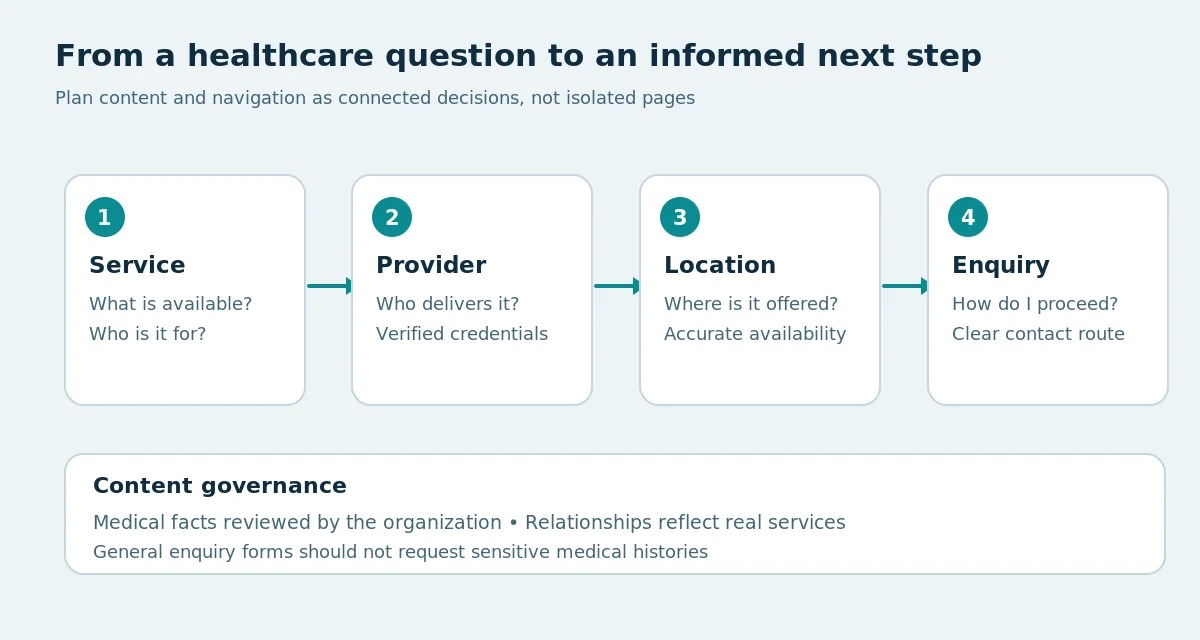
A healthcare web design agency needs to understand the distinctions between a service, a provider, a location and a treatment. Those are not interchangeable content types. If they are mixed together, visitors can struggle to determine where a service is actually offered or who delivers it.
DigiTaTop plans clinic website design, hospital information architecture and multi-provider experiences around the information visitors need and the administrative workflow the organization can sustain. A single doctor’s website can be concise; a multi-site hospital group needs more extensive governance and reusable templates.
Independent doctor or specialist
Typical website priorities: Expertise, services, practical appointment information, practice location
Example next step: Request a consultation
Dental or aesthetic clinic
Typical website priorities: Treatment navigation, practitioner information, eligibility caveats, clear contact channels
Example next step: Discuss a treatment
Fertility / IVF clinic
Typical website priorities: Sensitive treatment information, transparent care pathways, clinical review and reassurance
Example next step: Speak with the clinic
Hospital or medical group
Typical website priorities: Departments, physicians, facilities, locations and governance across teams
Example next step: Find a service or specialist
Diagnostic center or laboratory
Typical website priorities: Test and scan information, preparation instructions, branch availability
Example next step: Ask about a test or location
The page architecture is designed for the services you genuinely offer. A medical specialty should not appear on the website simply because it is searched frequently. Provider credentials, clinical statements, fees and treatment information require an authorized client-side reviewer.
What should visitors find quickly?
A useful healthcare website makes its most important information easy to locate: what the organization does; who the service is for; where it is available; the qualifications and role of real practitioners; how an appointment or enquiry works; and what happens after the visitor contacts the team. It should also make important policies, accessibility options and contact alternatives easy to find.
A fast appointment button is valuable, but it cannot compensate for missing treatment information or a confusing provider-location relationship.
See relevant website work , and what to check in a proposal
A decision about medical website design should be based on relevant delivery evidence, not generic website screenshots. Ask to see live pages, desktop/mobile examples, the actual project scope, and what the agency was responsible for. A website redesign case study should distinguish design, development, content, SEO, migrations and later marketing work instead of attributing every outcome to the build.
Illustrative multi-provider example , not a DigiTaTop client case study: A specialty practice has five treatments, three clinicians and two locations. On its existing website, every doctor appears to offer every treatment at both branches. A better content model would give each treatment a defined service page, each doctor a factual profile and each location a distinct page, with visible links showing which clinicians and services belong at each branch. On desktop and mobile, the visitor can move from treatment to appropriate specialist to location to enquiry without guessing.
That example demonstrates an architectural decision, not a proven commercial result. The conceptual screen and annotation supplied with this page are design illustrations; they must not be labeled as completed client work.
Before publishing client-work claims: obtain permission for the logo or screenshot, confirm the URL and delivery role, disclose the reporting dates for any outcome metrics, and preserve the original evidence. If genuine portfolio evidence is unavailable, retain the conceptual illustration and explain the deliverable instead of inventing a testimonial.
For broader digital growth planning, the healthcare marketing services hub explains how a website project fits alongside acquisition channels.
Conceptual website evaluation illustration, not completed client work.
Plan user journeys and content before visual design
The most important wireframes may be the ones nobody sees after launch. They determine whether visitors can find an answer in one or two meaningful steps, whether search engines can understand the page topic, and whether internal teams can keep information accurate.
We begin with a discovery exercise that separates what is known, what requires client confirmation and what cannot be inferred from existing content. Typical inputs include the services offered, active practitioners, verified locations, existing URLs, current enquiry process, brand materials and a sample of real visitor questions.
Map doctors, services, departments and locations
The structure depends on the organization. Consider these examples:
- Single doctor: Doctor biography → reviewed service page → actual consulting location → consultation request.
- Clinic: Specialty → treatment page → practitioner → clinic location → consultation request.
- Hospital: Department → condition or procedure → relevant specialist → hospital location → contact or booking information.
- Laboratory: Test or scan → preparation information → branch availability → enquiry or appointment route.
- Healthcare group: Brand → location → local service availability → provider → enquiry.
Each important intent needs a clear page owner. A treatment page should not compete with three near-identical location pages solely because they repeat the same keyword. Service, location and provider pages should complement one another and link contextually. This helps conventional search and makes the underlying facts easier for AI-driven information systems to interpret.
Write content for decisions, not just keywords
Medical website development benefits from early content planning. A typical treatment page may need a plain-English overview, candidacy and eligibility caveats that have been clinically reviewed, a description of the process, who provides it, location availability, realistic limitations and the next contact step. A doctor profile may require the confirmed name, qualifications, relevant interests, practice locations, approval date and links to the actual treatments that physician offers. Appropriate structured data can express verified practitioner/practice relationships, but a marketing agency service page must not falsely mark itself up as a medical provider.
The client controls clinical accuracy. DigiTaTop can structure, edit and optimize content within the agreed project; the responsible healthcare professional must review medical claims and practitioner details before they are published. Content writing, translation, photography and clinical-review fees should be explicitly included or excluded in the agreement.
Design conversion paths without overcollecting personal data
A user may want to call, ask a non-clinical question, request an appointment, view opening hours or continue researching. The site should support appropriate options instead of pushing every visitor into a long form. Unless the service has a separately approved secure clinical workflow, general marketing enquiries should avoid asking visitors to describe diagnoses, medications or sensitive medical histories.
Example microcopy for a general enquiry form: “Tell us which service or location you are interested in. Please do not submit private medical information in this form.” Actual collection fields, consent text, retention and transfer practices require the healthcare organization’s privacy and legal review.
Design and develop your CMS website
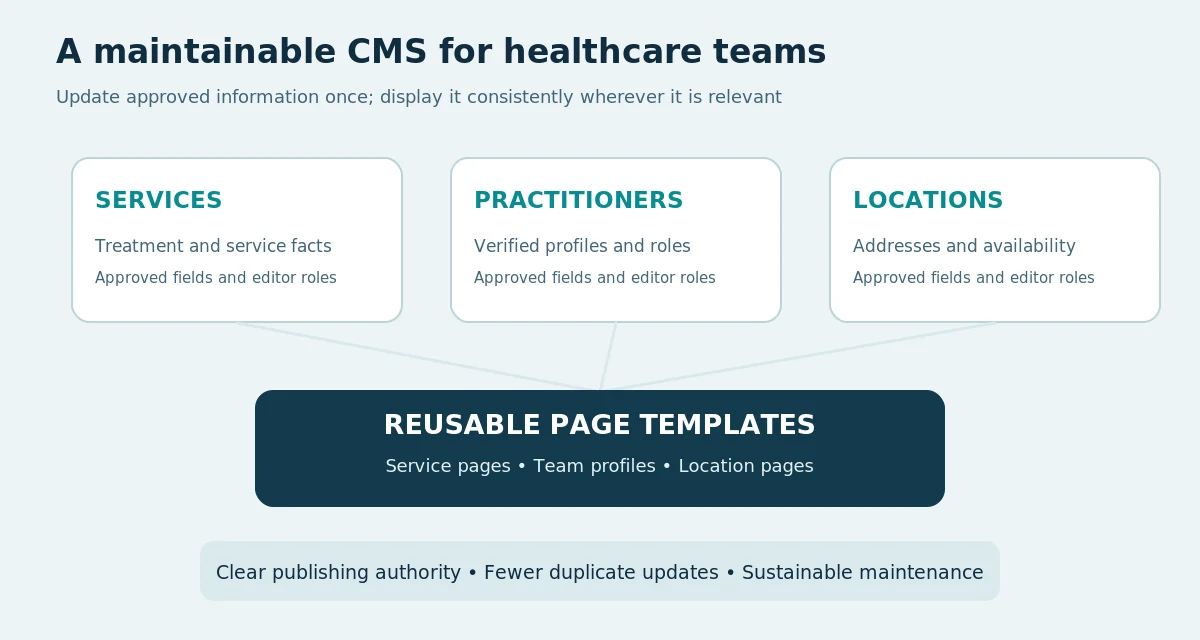
Once the structure and content requirements are agreed, design turns them into repeatable components. Healthcare web design should not depend on manually building each doctor, service and location page from scratch. A sensible CMS setup allows authorized editors to update approved fields consistently without disturbing the overall design.
What is included in a typical healthcare website development scope?
Discovery and architecture
Possible deliverables: Website brief, navigation tree, URL inventory, templates and content inventory
Boundary to confirm: Number of workshops and content types
UX and visual design
Possible deliverables: Desktop/mobile wireframes, design system, accessible components
Boundary to confirm: Number of unique page designs and revision rounds
CMS and development
Possible deliverables: Responsive templates, editable modules, roles and content structures
Boundary to confirm: Platform, custom functions, plugins and licenses
Service/provider/location pages
Possible deliverables: Reusable page types and populated approved content
Boundary to confirm: Number of pages and who supplies content
Forms and integrations
Possible deliverables: Contact paths and agreed third-party interfaces
Boundary to confirm: API permissions, subscriptions, booking ownership
SEO and launch support
Possible deliverables: Redirect map, metadata foundations, sitemaps and launch QA
Boundary to confirm: Complete SEO campaigns and ongoing content outside build
Handover
Possible deliverables: Admin training, documented access and agreed warranty/support
Boundary to confirm: Long-term maintenance and hosting commitments
All quantities, external costs and exclusions belong in the final proposal. This table describes potential scope, not a promise that every activity is included in the advertised starting price.
Mobile layouts and accessibility
Healthcare sites need to work when someone is looking for information on a small screen, with limited time, poor connectivity or assistive technology. That means sensible typography, visible focus, readable labels, clear validation messages, keyboard access, appropriate contrast, responsive tables and tap targets that can be operated without precision.
Accessibility is a design and testing responsibility, not a badge created by an overlay plugin. For applicable public-sector UK work, the NHS service manual sets out WCAG 2.2 AA requirements; private organizations should evaluate their own relevant obligations and accessibility goals. We can plan and test against agreed WCAG criteria, but do not promise universal compliance without an independently defined audit and remediation scope.
The website should be evaluated on actual phones and assistive-technology workflows, not just a screenshot of a desktop design resized in a browser.
Booking integration boundaries
A healthcare website can display availability, link to a booking portal, collect general appointment requests or integrate with a patient-management system, depending on the approved workflow. Those are materially different products.
Before agreeing to an integration, confirm the system owner, API access, supported authentication, what information may pass between systems, hosting region, error handling, responsible data controller, vendor contractual terms and who will maintain it. Where a third-party system controls appointment confirmation, the website should not imply that submitting a marketing form automatically books care.
Explicit boundary: A healthcare marketing website is not automatically a patient portal, electronic medical record system, telehealth platform or compliant health-record repository. Such functionality needs separate technical, security and legal scoping.
Performance, technical SEO and search understanding
The development plan includes appropriate heading hierarchy, crawlable text, descriptive internal links, image alt text, sensible page templates, page-level metadata, canonical decisions and structured data that reflects genuine visible entities. These are foundations for organic search and AI-assisted discovery, not guarantees of first-page rankings or AI citations.
Core Web Vitals provide useful measurable goals for loading, responsiveness and layout stability. Google describes good thresholds of LCP at or under 2.5 seconds, INP at or under 200 milliseconds, and CLS at or under 0.1 for real users. Results depend on hosting, scripts, content assets, measurement conditions and ongoing site changes; the proposal should distinguish design and implementation work from performance guarantees.
For medical practice website design and redesign projects, technical setup should also help people distinguish a named physician from a clinic brand and show which locations and services are associated with the physician. Medical website redesign requires careful URL and entity continuity.
SEO-ready development is not an ongoing healthcare SEO campaign. Research, content production, link acquisition and sustained optimization can be scoped through our healthcare SEO service.
WordPress, hosting and ownership
WordPress can be appropriate for editorially managed healthcare websites needing reusable templates, staff roles and familiar content tools. It is not automatically the correct choice for a complex clinical application. Platform selection follows the security, integration, workflow, accessibility and maintenance requirements rather than a default technology preference.
We agree who owns the domain, hosting account, source assets, administrator access, paid extensions and integrations. The handover must list third-party subscriptions and renewal obligations so a client is not surprised by costs or locked out of its own website.
Migrate, test and launch without losing what already works
A new website should not erase established visibility or break patient-facing information through careless URL changes. For redesigns, we start by inventorying useful existing pages and their search destinations. Then we decide which URLs remain, which consolidate and which truly need to change. Every change needs a documented reason.
See our process for the wider discovery, approval and delivery stages.
A practical migration sequence
- Inventory: Capture current URLs, page types, status, key internal links, relevant assets and available search-performance baselines.
- Map: Keep valuable URLs where possible; prepare one-to-one or closely relevant redirects where URL changes are approved.
- Build and test: Work in a protected review environment while validating templates, forms, accessibility, responsive views and content accuracy.
- Check data and permissions: Confirm analytics configuration, consent choices, third-party scripts, access controls and vendor responsibilities.
- Launch deliberately: Verify DNS and HTTPS as applicable, redirects, canonicals, robots directives, sitemaps, metadata and important page routes.
- Monitor and hand over: Review crawl errors, 404s, form submissions, key journeys and any unexpected change in visibility.
A redesign is not an opportunity to rename every existing URL. Google’s migration documentation recommends mapping old URLs to their replacements, implementing relevant redirects and updating internal links and canonical annotations. Where a site is intentionally noindexed for pre-launch testing, removing that restriction must be part of the separately approved launch procedure, not an incidental design edit.
Launch QA checklist
Content
Verification before sign-off: Approved service facts, practitioners, location details and contact routes
UX and accessibility
Verification before sign-off: Mobile navigation, keyboard behavior, labels, errors and page hierarchy
Development
Verification before sign-off: HTTPS, asset loading, responsive layouts, error pages and backup plan
SEO
Verification before sign-off: Canonicals, redirects, page titles, indexability at the approved launch stage, sitemap and schema
Conversion
Verification before sign-off: Contact, call, appointment and relevant source-tracking journeys verified end to end
Handover
Verification before sign-off: Named administrators, editable templates, subscription list and support ownership
Any unverified requirement should be labeled pending, not silently marked complete.
Ownership, maintenance and support after launch
The most useful healthcare website is one the organization can keep accurate. A strong handover includes administrator access held by the client, documented content types, a repeatable process for updating clinical information, basic editor training and a named point of contact for post-launch issues.
Security updates, backups, uptime monitoring, hosting, content revisions, performance monitoring, accessibility rechecks and integration maintenance should have clear ownership. Some activities may be available as ongoing services; they should not be implied to be covered indefinitely by a one-time design fee.
For medical organizations, publishing authority matters. Define who can draft content, who clinically reviews it, who approves its public release and who can change provider details or treatment eligibility statements. A workflow that works for a three-person clinic may need a different approval structure for a hospital group.
Healthcare website design pricing and timelines
Healthcare website project
From $6,500
One-time project starting fee, USD
A defined scope for your doctor, clinic or healthcare organization.
Your proposal defines
- Unique designs and populated page quantities
- Content writing and clinical approval responsibilities
- Languages, templates and approved booking connections
- Accessibility, security and migration testing
- Hosting, licenses and external costs
- Handover, account ownership and ongoing support
The published DigiTaTop services offering currently advertises healthcare website design from $6,500 as a one-time project starting fee. The final amount is determined by the agreed templates, content quantity, multilingual requirements, accessibility and security testing, integrations, migration complexity and handover support. Paid hosting, domains, licenses, external APIs, photography, ongoing content and maintenance should be separately disclosed where they are outside scope.
A realistic project schedule depends on the readiness of service information, stakeholder approvals and technical dependencies. A small site with approved content is materially different from a multi-location migration or integration-heavy program. We define milestones in the proposal rather than guaranteeing a standard launch date for every healthcare organization.
Share your current URL, organization type, markets, priority services, rough page count and required functionality. We will define a suitable scope and project milestones.
How we measure whether the website is working
Launch is a milestone, not the business outcome. After release, measurement should separate operational checks, discoverability, visitor behavior, enquiries and confirmed business results.
Technical readiness
Example indicators: Valid page responses, indexability after launch, mobile rendering, LCP/INP/CLS
Interpretation: Website health, not leads
Discovery
Example indicators: Relevant organic landing-page impressions and clicks
Interpretation: Search interest and visibility, not conversions
Engagement
Example indicators: Useful page paths, content interactions, navigation use
Interpretation: Behavioral signals; context required
Enquiry
Example indicators: Successful calls or forms, appointment-request events
Interpretation: Enquiry intent, not confirmed bookings
Business outcomes
Example indicators: Qualified enquiries, booked consultations or accepted cases where measurable
Interpretation: Depends on follow-up and offline process
If a visitor completes a booking in an external system, reporting must distinguish the initial website event from the actual booking confirmation. Tracking and CRM integrations require consent, privacy and contractual review, and must not disclose private patient information to general advertising tools.
Who should request a website project , and when not to
A new build or redesign is useful when the current site cannot represent your services accurately, visitors struggle to find clinicians or locations, mobile journeys are poor, the content system is too difficult to maintain, or a migration is already necessary for technical reasons.
For a doctor starting a private practice, a new website can be worthwhile when there is no credible professional presence or existing service and appointment information is unreliable. For established clinics and medical groups, a narrower redesign may be enough.
It may not be your first investment when an existing website is fundamentally sound but your primary problem is low search demand capture or an underperforming paid campaign. In those situations, a targeted healthcare SEO engagement, paid search program or narrower conversion audit may be more appropriate.
If the visual identity, messaging or naming is still unsettled, resolve those decisions early. Our healthcare branding service can help define the direction so the website is not redesigned twice.
Frequently asked questions about healthcare website design
Do you create websites for individual doctors and medical specialists?
Yes. DigiTaTop scopes website design for doctors, physicians, private consultants and specialist practices as well as clinics and hospitals. A single-doctor project might include a professional biography, verified services, practice locations, mobile layouts and an enquiry route. The exact page count, content responsibilities and integrations are agreed in the proposal.
What should a professional doctor's website include?
A professional doctor website should make the practitioner’s identity and credentials clear, explain the services they genuinely offer, show where consultations take place and provide a practical contact or appointment route. Medical content needs clinical review. Responsive design, accessible navigation and SEO-ready page structure help visitors understand this information, but do not guarantee search rankings or bookings.
How much does website design for doctors cost?
DigiTaTop’s currently advertised healthcare website design starting fee is $6,500 for a one-time project. This is a starting price, not a fixed quote for every individual doctor or clinic. The final fee depends on templates, content, languages, booking connections, accessibility tests, migration and handover. Hosting, licenses and continuing maintenance may be additional.
Can you redesign my medical practice website without losing SEO rankings?
A doctor or clinic website redesign can preserve existing search value when the team audits URLs, keeps appropriate pages, maps necessary redirects, checks canonicals and internal links and monitors launch issues. However, no agency can guarantee unchanged rankings. A complex migration needs explicit scope, testing and an agreed launch procedure.
Can you integrate online appointment booking into a doctor website?
Depending on the booking vendor’s supported options, the project may link to an approved booking service, accept general appointment requests or explore a separately scoped technical integration. A form submission is not automatically a confirmed appointment. Any handling of patient information, API access, security and privacy responsibilities must be reviewed before implementation.
How is medical website design different from general web design?
Medical website design must accurately represent practitioners, treatments, locations and sensitive patient journeys. Content can require clinical sign-off; forms should avoid unnecessary medical data; and the site needs credible service information, accessibility-conscious layouts and clear booking boundaries. A standard brochure template often needs additional architecture and governance to meet these requirements.
Do you build doctor and clinic websites for the USA and UK?
DigiTaTop works with organizations targeting the United States and United Kingdom from Dokki, Giza, Egypt. US physician sites and UK private consultant sites may need different terminology, professional details, insurance or referral information and local patient journeys. The client verifies practice information and applicable legal requirements; we do not claim local offices or blanket compliance certification.
Who owns my doctor website after launch, and can I update it?
The project agreement should identify ownership of the domain, hosting, content, design assets, custom code and third-party accounts. It should also define administrator access, editable templates, handover training, documentation and ongoing support. The aim is for the doctor or practice team to manage approved updates without being locked out of its website.
Request a healthcare website proposal
Whether you are an individual physician launching a professional website, a specialist expanding private practice, a clinic replacing a difficult-to-manage CMS or a healthcare group redesigning a complex site, the first useful step is defining the service architecture and ownership responsibilities, not choosing a design template.
Tell DigiTaTop Agency: whether you are an individual doctor, consultant, clinic or healthcare group; which specialty and services you genuinely offer; where you practise; whether you already have a website; and which contact, booking or integration functions you need. We can then outline the recommended work, what your team must supply, and where the proposed scope begins and ends.
Plan your website alongside medical SEO, a consistent healthcare brand identity and your social media presence. Review our pricing and packages before requesting a proposal.