
DigiTaTop Agency · Healthcare marketing knowledge center
Healthcare Marketing Resources, Guides and Checklists
Marketing a medical service calls for more than choosing a channel. A clinic needs accurate service information, a clear route to the right clinician, working inquiry processes and sensible ways to measure what happens next. Use these resources to find the issue worth solving first, whether you lead a single practice or a multi-location healthcare organization.

Start with a practical tool or reference
If you are unsure which marketing activity deserves attention, begin with a short self-assessment. If you already know your question, use the published reference pages below. Use the in-page resources now, download the checklist for your team, or explore the published references below.
On-page tool · Practical self-review
Review 18 questions covering medical service accuracy, search visibility, mobile usability, inquiry handling, measurement and content governance.
Published editorial reference
Understand the importance of accurate medical service information, accountable reviews and responsible healthcare communication.
Published specialty overview
Compare the business and communication considerations of different medical disciplines rather than applying one generic growth plan.
Featured resources by topic
Choose a topic to explore a published guide or practical resource. The collection includes educational answers, a visual reference, an interactive checklist and downloadable planning tools.
Search visibility essentials
Compare healthcare SEO retainers, scope and six-month budget examples, with a printable proposal worksheet.
Make practice information verifiable
Learn which provider, service and location facts support clearer AI-assisted discovery, without promises of citations.
Before increasing your Google Ads budget
Check service availability, mobile landing pages and inquiry routing before paying for more clicks.
Trace the patient inquiry journey
Use the five-stage visual to find where discovery, service clarity, contact and follow-up become disconnected.
Test your mobile inquiry experience
Use the interactive readiness checklist to inspect mobile usability, contact routes and reception capacity.
Separate clicks, inquiries and appointments
Use the measurement reference and downloadable decision template to define useful evidence at each stage.
Find guidance for your healthcare organization
Service mix, patient decision patterns and internal ownership change what good marketing looks like. Use the relevant published audience page as context for the general checklists in this center.
Make clinician identity, credentials, affiliations and real consultation locations easy to verify.
Connect priority services to local discovery, reception capacity and workable inquiry paths.
Coordinate departments, specialties and multiple locations with clear content ownership.
Specialty examples include dental practices, eye clinics and fertility centers. Each requires its own appropriate clinical-claims review and service information.
Healthcare marketing readiness checklist
This 18-point self-assessment helps practice owners and marketing teams find practical obstacles before commissioning a campaign or a redesign. For each statement, mark it only if you have checked the actual website, team process or approved source. Unchecked items are questions to investigate, not evidence of failure.
Service and provider information
Findability and discovery
Website and mobile experience
Inquiry handling and capacity
Measurement and marketing decisions
Trust, content and AI-assisted discovery
Turn the checklist into a useful next decision
- Identify the most consequential unchecked item for one real service and market.
- Confirm the cause with a person who owns the information or process.
- Choose one repair, assign an owner and define what you will verify after the change.
Do not share patient records or sensitive personal health information in a general marketing review. This checklist is for operational prioritization, not clinical or legal compliance certification.
Quick answers to common healthcare marketing decisions
What should a clinic fix before increasing its Google Ads budget?
Start by confirming the promoted service is available, the landing page accurately describes it, and call or booking routes work on a mobile phone. If inquiries cannot reach the right team or the page attracts people outside the available service area, buying more clicks may amplify the wrong problem. Review campaign eligibility and lead quality before increasing spend.
How do healthcare organizations choose between SEO and paid search?
SEO is a longer-term investment in accessible, useful pages for relevant search tasks. Paid search can provide controlled visibility for eligible services with suitable landing pages and budgets. They are not substitutes. A practice with broken contact routes should address that weakness before scaling either; a group with stable conversion paths can test a focused mix based on service priorities.
Which healthcare marketing metrics actually matter?
Start with service-relevant discovery, completed contacts and qualified inquiries. Separate each stage: an impression is not a visit, a click on a phone number is not necessarily a connected call, and a form submission is not necessarily an appointment. Make sure staff agree on what a qualified inquiry means and report limitations alongside the numbers.
How can a medical practice be easier to understand in AI-assisted search?
Publish verifiable information about its real services, named clinicians, locations, eligibility and contact options in accessible text. Keep those facts consistent with trusted profiles and make claims easy to support. Google says its AI search features use foundational SEO practices rather than a separate mandatory AI markup format. Appearance in any particular answer is not guaranteed.
What belongs in a healthcare marketing audit?
A useful review combines technical access, service and clinician accuracy, local presence, landing-page usability, qualified inquiry routing, measurement quality and the team's ability to implement changes. It should identify the most important constraint, its evidence, who owns the fix and how to verify progress—not simply generate a long list of SEO warnings.
Follow the patient inquiry journey before choosing a channel
A person may first find a medical service in search, then compare a clinician, check location availability and only then decide whether to inquire. Marketing teams need to understand where this process becomes unclear or difficult. For a hospital, the path may also cross department pages and different booking teams.
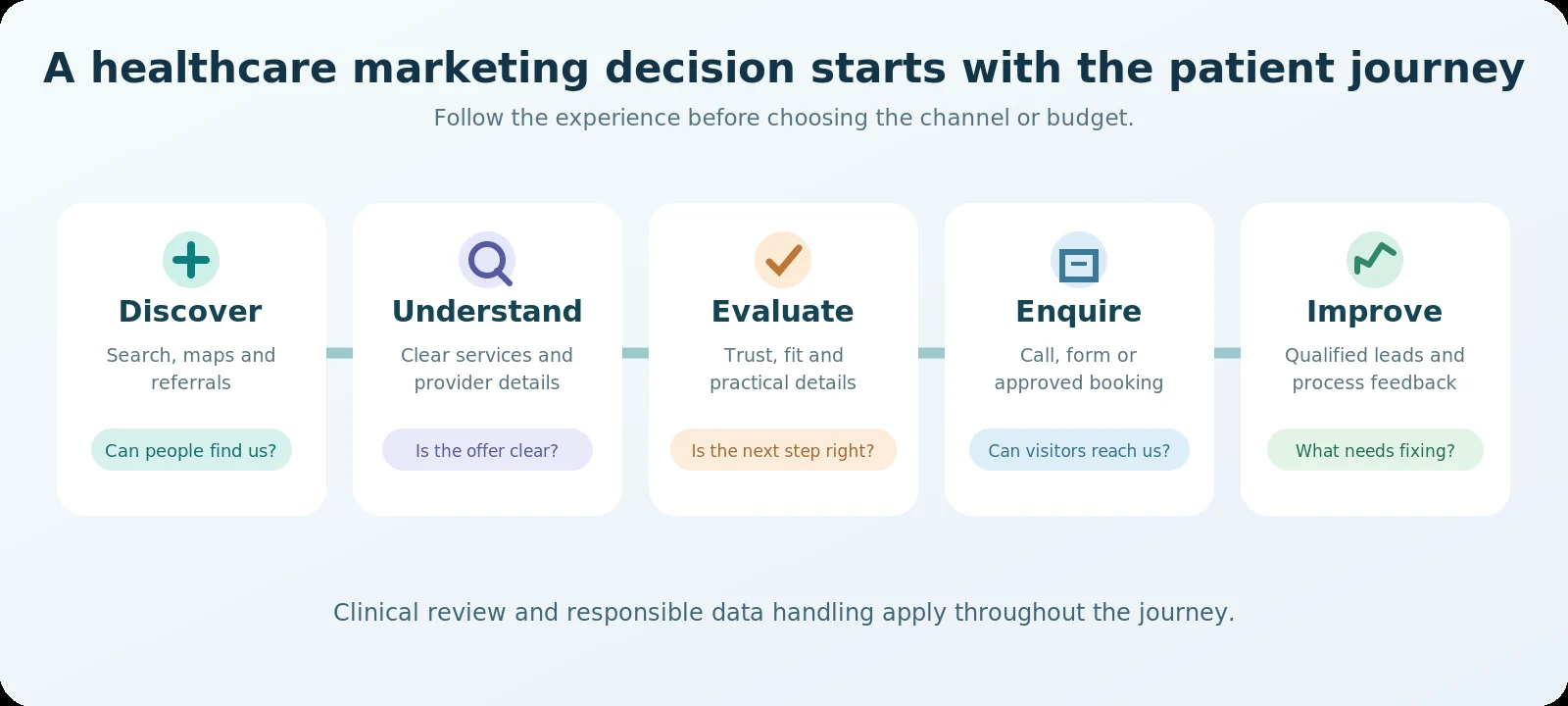
For instance, an ophthalmology clinic considering more advertising might discover that its website does not clearly distinguish consultation locations. Correcting that information may be a better immediate use of time than increasing bids. This is a hypothetical example, not a reported client outcome.
Measure progress without confusing activity and results
Decide what each metric can actually tell you. A dashboard can show more clicks even when the organization receives no additional relevant inquiries.
| Stage | Useful evidence | What it does not establish |
|---|---|---|
| Discovery | Relevant service searches, local visibility and impressions | That the visitor is eligible for or interested in the actual service |
| Engagement | Visits to verified provider, service and location pages | That someone understood the details or intends to book |
| Contact | Connected calls where measurable, completed inquiries and approved booking starts | That the inquiry is unique, qualified or converted to an appointment |
| Qualification | Service-appropriate inquiries reviewed through a permitted process | That the inquiry became a completed appointment or sale |
| Improvement | Documented fixes, assigned owners and subsequent observations | That any single marketing change alone caused the outcome |
Healthcare organizations should obtain appropriate privacy advice before sending sensitive details into analytics, tracking pixels, advertising systems or general marketing tools. Requirements depend on jurisdiction and circumstances, and some US guidance has been affected by litigation.
A simple marketing decision template
Use one row for each service or location you are reviewing. Record an observation, choose an owner and agree how you will check the result. Keep patient details and other sensitive personal information out of this worksheet.
| Record | What to write |
|---|---|
| Service and market | The real service, location and review period. |
| Observed issue and evidence | What happened, where it was checked and the current baseline. |
| Action and owner | One specific improvement and the person responsible. |
| Success measure and review date | How and when you will check progress, including any reporting limitations. |
How to judge the credibility of marketing recommendations
A useful recommendation states what was observed, which service and geography were assessed, what remains uncertain and what change the team should test. Treat illustrative examples, published performance summaries and independently validated case studies as different kinds of evidence.
You can review DigiTaTop's agency background and our published medical editorial standards. Where clinical, legal or advertising approval is required, the relevant healthcare organization and its qualified advisers remain responsible for that sign-off.
For platform guidance, consult Google's people-first content documentation, its guidance on AI features in Search, and US HHS guidance on online tracking technologies where the rules apply. These sources support the approach; they do not validate any particular agency result.
Want help choosing the next practical improvement?
Tell us about your organization, market, priority services and the marketing obstacle you are trying to solve. We can discuss whether a focused review or another scope makes sense. Please do not include personal medical information in your inquiry.