
Healthcare SEO Pricing: Costs, Retainers and What Your Clinic Should Expect

Healthcare SEO · Budget planning
Healthcare SEO pricing makes more sense when you can see the work behind the monthly fee. A single-location clinic trying to improve a few important service pages needs a different program from a hospital group managing dozens of specialists, locations and clinical reviewers. When comparing quotes, look at the scope, who owns each task and how progress will be measured. For a dental practice, a useful way to assess dental marketing agency cost is to ask which procedures and locations the monthly fee covers.
Quick answer: DigiTaTop Agency currently lists healthcare SEO programs at $1,750/month, $2,750/month, and from $3,500/month for a broader multi-location scope. These are DigiTaTop’s published prices, not an industry average or a promise that every site will qualify for a given tier. A fee should be evaluated against the contracted work, not against an assumed market average. The right budget depends on the starting condition of your website, service and location coverage, content-review needs and the work your team can handle internally. See DigiTaTop’s current packages and inclusions for the authoritative offer.
Summarize with AI
Opens an external AI platform with a summary request. AI summaries may miss details. Check this article for prices, scope and qualifications.
In this guide
- Published prices
- What changes the cost
- What a retainer covers
- Retainer or project
- Six-month budget examples
- Evaluate a proposal
- Measure value
- Common questions
- Evidence and review
What does healthcare SEO cost per month?
There is no universal healthcare SEO price. A proposal that includes one clinic’s Google Business Profile, a small group of service pages and a monthly review is not equivalent to a program that also covers technical engineering, multiple locations, clinical content governance and conversion measurement.
For a concrete point of reference, DigiTaTop publishes the following US-dollar prices on its pricing and packages page:
| Monthly fee | Example scope shown publicly | Best question to ask |
|---|---|---|
| $1,750 | One location, up to three service lines, two content units, three existing-page improvements, up to three technical hours, one eligible Google Business Profile and monthly reporting/review. | Which service pages will we prioritize first? |
| $2,750 | One location, up to five service lines, four content units, five existing-page improvements, up to five technical hours and one eligible profile. | What extra work does the larger content and technical allowance fund? |
| From $3,500 | One brand and website, up to three locations, six content units, eight existing-page improvements, up to six technical hours and up to three eligible profiles. | How will location-specific work and group reporting be coordinated? |
Those are published tier descriptions, not personalised quotations. Check the current page before committing: site condition, approval requirements, major development, third-party tools and other exclusions can affect a signed scope. A multi-location hospital network may need a custom specification beyond the advertised examples.
According to the current published scope, a content unit is an agreed page or article of up to 1,500 words. The initial audit and keyword/URL map replace new-content production in the first month. Major migrations, redesigns, external placements and clinician review are outside the standard SEO allowances; the signed proposal confirms the final scope.
What makes one SEO quote different from another?
Compare written scopes, not fees in isolation. A lower monthly amount may reflect fewer supported locations, less implementation time or a smaller clinical editorial allowance. A higher quote should explain the additional work rather than simply promise more traffic. There is no responsible way to turn a handful of publicly advertised prices into a universal medical SEO cost benchmark.
| Check | What to request in writing | Why it matters for a healthcare buyer |
|---|---|---|
| Monthly allocation | Named URLs, technical hours, content units and local profiles | Shows what your clinic actually receives |
| Clinical review | Reviewer responsibilities, revision cycles and approvals | Prevents inaccurate treatment, credential or eligibility claims |
| Implementation | Who makes WordPress changes and who pays for work beyond the allowance | A list of recommendations alone does not fix the website |
| Measurement | Search Console, inquiry event definitions, operational verification and privacy review | Separates visibility from actual patient communication |
| Contract terms | Setup fees, payment terms, cancellation, intellectual property and access ownership | Reveals the full cost and long-term responsibilities |
Use the proposal review framework below to record inclusions and exclusions. For DigiTaTop’s exact services and up-to-date terms, the published pricing and packages page remains authoritative.
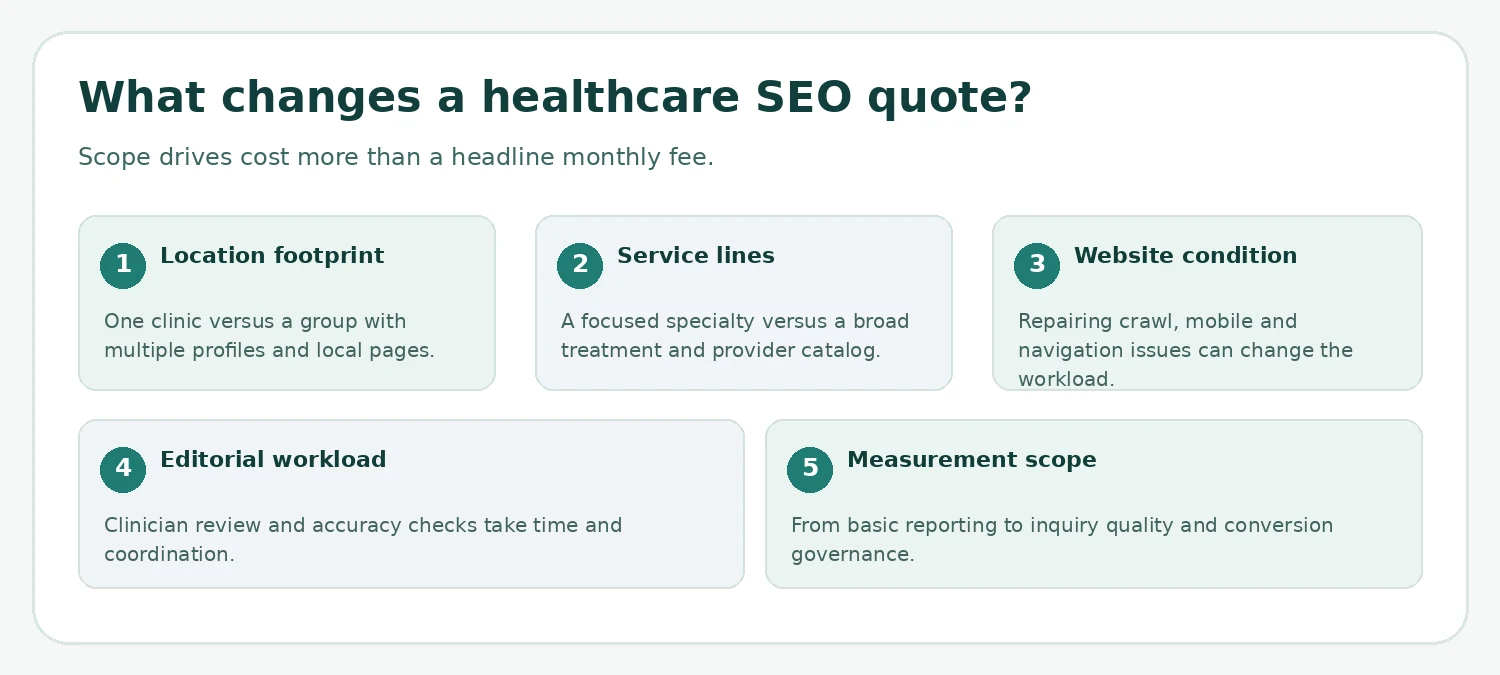
Five things that change a medical SEO quote
1. Locations and the complexity of local search
For a single-location medical clinic, this might mean one accurate business profile, clear location details and a few priority treatment pages. When scoping digital marketing services for hospitals, account for multiple sites, clinical departments, specialist profiles, distinct service availability, and operational approvals. The work should reflect real operating locations, not mass-produced city pages.
2. The number and sensitivity of services
An ophthalmology clinic focusing on cataract consultations has a more concentrated initial information architecture than a multispecialty center offering retina, cornea, refractive surgery and pediatric eye care. More service lines can mean more distinct pages, medical subject-matter review, internal navigation and maintenance. It should not mean writing a separate weak page for every synonym.
3. Technical debt and website access
Technical problems can absorb the first month’s budget: indexability mistakes, broken links, slow or inaccessible mobile pages, duplicate URL patterns, migration errors and incomplete structured data. Ask which fixes are included in the retainer and which require a separate developer. A technical audit is valuable only when someone is responsible for acting on its findings.
4. Content creation and clinical approval
Healthcare content often needs a different review path from a retail blog. A responsible program identifies the business question, drafts accurate content, verifies provider claims and involves the appropriate clinical reviewer when medical accuracy is at stake. Specify whether the fee includes new articles, substantive rewrites, image work, citations, clinical review and later updates.
5. Measurement and the appointment journey
SEO can increase useful discovery while the front desk misses calls, booking forms fail or the website sends visitors to the wrong location. A broader engagement may assess contact pathways and measure agreed inquiry events, whereas a narrowly scoped SEO program may report only search visibility and clicks. These outcomes are related but should not be treated as interchangeable.
What should a healthcare SEO retainer actually include?
Instead of asking only how many keywords the agency will “rank,” ask what you will be able to inspect at the end of each month. A useful statement of work describes concrete outputs and identifies the people responsible for approvals.
| Workstream | A meaningful deliverable | Important exclusion to clarify |
|---|---|---|
| Technical SEO | Prioritised crawl/indexing findings and a record of completed fixes | Developer hours, hosting changes and rebuilds |
| Service-page SEO | Named URLs to improve, search task, content changes and internal links | New page design, translations and clinician review |
| Local visibility | Eligible business-profile work, location accuracy and location-page improvements | New branch verification, review responses and multi-location expansion |
| Healthcare content | Number and type of new or substantially rewritten pieces with review workflow | Specialist medical approvals and future content maintenance |
| Measurement | Search Console trends, agreed inquiry events, changes and next actions | Call tracking, booking-system integrations and sensitive-data handling |
For an independent baseline, Google’s SEO Starter Guide describes the fundamentals of discoverability, helpful content and site organization. Google also provides guidance on evaluating an SEO provider. Neither document endorses a fixed monthly fee or a ranking guarantee.
How should the first 90 days be organised?
First month: establish access, confirm technical blockers, choose the primary service/location priorities, review existing search data and agree how inquiries will be defined. An existing site migration problem may justify resolving indexability before producing more articles.
Second month: complete the most valuable fixes and upgrades, publish or improve a manageable number of reviewed pages, and check that location and contact information is consistent. Document what changed, not just what was recommended.
Third month: review which priority pages and queries are gaining visibility, look for inquiry-path friction, reallocate the following month’s work and decide what should stop. Some organic changes require longer to assess; a 90-day review is a decision checkpoint, not a guaranteed ranking deadline.
For organizations building a broader acquisition plan, the healthcare marketing strategy service explains how channel priorities, budgets and operational readiness should be considered together. A large SEO scope cannot compensate for unanswered calls, unclear clinician availability or a booking process that breaks on mobile.
Monthly retainer, one-time project or internal team?
A monthly retainer is useful when a practice needs continuous page improvements, medical content maintenance, technical oversight and local presence management. A one-off project fits a clearly defined task such as a migration review, an indexability repair or a limited SEO audit. An in-house marketer may provide faster coordination with clinicians and reception teams, while an external specialist can bring technical depth or additional production capacity.
For a small clinic with a functioning site, a scoped audit or foundation project may be the sensible first purchase. For a growing multi-provider group, recurring cross-team work can be easier to manage under a retainer. Ask whether a proposal contains work that should happen once, work that must recur, and work your team already handles. Buying the same work twice does not make the program stronger.
How much should a medical practice budget for six months of SEO?
Start with the contracted monthly fee and build a six-month budget that separately lists any approved one-time work, clinical review and internal staff effort. Do not assume an SEO package automatically includes a website rebuild, appointment-system integration or an outside clinical reviewer. Confirm each allowance and exclusion in the signed scope.
| Budget line | Single-location clinic | Up to three-location group |
|---|---|---|
| DigiTaTop published fee used in example | $1,750/month | From $3,500/month |
| Six-month agency fee | $10,500 (6 × $1,750) | From $21,000 (6 × $3,500) |
| Additional site development, if excluded | $800 hypothetical | $2,400 hypothetical |
| External clinical review, if excluded | $1,200 hypothetical | $1,800 hypothetical |
| Illustrative total of the listed costs | $12,500 | From $25,200 |
These are calculations, not quotes, forecasts, or charges that DigiTaTop says it will apply. Only the three monthly package amounts come from DigiTaTop’s public price list. All extra amounts in the table are invented strictly to demonstrate budgeting arithmetic, are not market benchmarks and apply only if separately required and approved. Internal review time, tools, taxes or additional scope could change the total. The multi-location tier starts at $3,500; the actual quoted fee could be higher. Compare each line with your written proposal.
A clinic budgeting for its first six months should also ask a practical question: if more people contact us, can reception answer, qualify and book those inquiries? A larger content allowance is a poor first investment if the practice’s enquiry process is already losing patients.
Which costs may sit outside a medical SEO retainer?
Common points to clarify include extensive development or migrations beyond included technical hours; paid clinical reviewers; translations; new site or landing-page builds; third-party subscriptions; booking-system or call-tracking integration; photography and video; and the internal time needed to approve healthcare content. None of these is automatically excluded or included—the signed scope governs.
Download the printable healthcare SEO budget and proposal worksheet to record actual fees and inclusions before comparing an offer.
How should you compare medical SEO proposals fairly?
Ask each provider to complete the same one-page scope description. Then check five questions, in this order:
- What problem will the work solve first? For example: blocked indexing, incorrect clinic location data, weak service pages or a broken inquiry path.
- What will be delivered and implemented? Record specific URLs, clinical content units, approved business profiles, allocated technical hours and the person responsible for making changes.
- Who approves health-related claims? Assign responsibility for treatment descriptions, clinicians’ credentials, patient-information accuracy and jurisdiction-specific advertising rules.
- What does the clinic own? Confirm access to the site, analytics, Search Console, editable content and reporting; identify any setup or termination charges.
- What evidence will be reviewed? Look for completed work, relevant search metrics, appropriately qualified inquiry measures and clearly stated uncertainty—not a promised Google position or patient count.
Google’s SEO hiring guidance recommends checking past work, understanding proposed changes and rejecting guaranteed number-one rankings. Treat the signed deliverables as the basis for accountability, not an agency’s projections.
How do you know whether your healthcare SEO spend is worthwhile?
Measure progress at several levels. Search visibility shows whether people are encountering the right pages. Website engagement helps explain whether they find what they need. Qualified inquiries help the practice understand whether potential patients are reaching the right service and location. Appointments require confirmation from the organization’s own scheduling workflow, not an assumption made from a form click.
| Measure | Useful interpretation | What it cannot prove alone |
|---|---|---|
| Non-branded clicks to eligible pages | Organic discovery beyond the clinic’s name | That the clicks became patients |
| Relevant query and page trends | Whether priority information is becoming easier to find | That a particular SEO change caused the whole trend |
| Calls and form inquiry events | Whether visitors attempt to contact the organization | That every event was qualified or resulted in a booking |
| Confirmed eligible appointments | A more useful operational outcome when recorded lawfully and accurately | That SEO alone caused the booking |
Google Search Console’s Performance report supports analysis of clicks, impressions, click-through rate and average position. It does not by itself tell a hospital how many appointment requests became completed visits. A responsible report should make this distinction explicit.
A worked example: from organic inquiry to attended appointment
Consider a hypothetical single-location practice paying $1,750 a month for six months, or $10,500 in agency fees. Suppose its privacy-reviewed operational reporting records the following totals during that period:
| Stage | Illustrative count | What the clinic must verify |
|---|---|---|
| Contact attempts from organic landing journeys | 140 | Deduplicated calls or form submissions recorded through approved systems |
| Relevant, qualified inquiries | 90 | Service, location and eligibility verified by authorized staff |
| Appointments booked | 54 | Confirmed appointment records, not button clicks |
| Appointments attended | 36 | Appropriately aggregated appointment data, avoiding unnecessary patient details |
On those assumptions, $10,500 ÷ 36 ≈ $292 in SEO fees per recorded attended appointment associated with an organic website journey. This is not an incremental patient acquisition cost, a causal attribution estimate, revenue or ROI. Some bookings might have happened without SEO; some visits may originate from branded searches, referrals or other marketing. The calculation also excludes staff time, tools, extra services and any costs beyond the retainer.
To evaluate return more responsibly, compare suitable baseline and later periods, account for seasonality, practice capacity, changes to the website and concurrent campaigns, and use finance-approved contribution figures rather than gross treatment revenue. If the data are incomplete or cannot be collected safely, report that limitation instead of manufacturing precision.
Tracking and attribution in healthcare also need privacy review. In the United States, the Department of Health and Human Services has published guidance on online tracking technologies, including legal developments affecting part of that guidance. Healthcare organizations should have their privacy and legal teams assess which data may be collected or disclosed; an SEO vendor’s claim of being “compliant” is not a substitute for that review.
Questions healthcare decision-makers ask before signing
Is $1,750 a month enough for healthcare SEO?
It can support a defined, limited program—the published DigiTaTop example covers one location and specified page, content and technical allowances. It is not automatically enough for a hospital network, a large website migration or extensive clinical copy review. Match the scope to the site’s condition and the services that matter most.
Does healthcare SEO pricing include Google Business Profile work?
Sometimes. DigiTaTop’s published tiers include eligible profiles within stated limits, but other agencies may sell local SEO separately. Ask how many real locations and profiles are covered and whether verification, review management and local page changes are included.
Does a retainer cover SEO and ChatGPT or AI-search visibility?
Not necessarily. SEO fundamentals can contribute to discoverability across different search experiences, but a quoted AI-search audit, monitoring program or content activity should be itemized. Review DigiTaTop’s AI-search service for that separate scope, and avoid any promise of guaranteed citations or placement in AI-generated answers.
Should a new clinic buy SEO before Google Ads?
That depends on launch timing, demand, available budget, landing-page readiness and the clinic’s ability to respond to inquiries. SEO usually supports durable discovery and information quality; ads may be used for eligible, more immediate campaigns. The appropriate sequence should be decided from the clinic’s service priorities, not a universal rule.
How long should a clinic keep an SEO agency?
Agree on a sensible review period, scope and contract terms before starting. Some technical repairs can be assessed quickly, while content discovery and competitive searches often take longer to interpret. Review documented work and relevant trends at regular decision points, without treating a calendar date as a guarantee of results.
How much should a single-location medical practice budget for its first six months?
At DigiTaTop’s published $1,750/month entry tier, six months of agency fees would equal $10,500. A clinic should add only the separately approved development, clinical review, tools and operational costs relevant to its scope. The six-month budget table shows how to build this without mistaking an example for a custom quotation.
Which costs are usually not guaranteed inside a medical SEO retainer?
Unless expressly included, don’t assume full website redevelopment, paid clinical review, appointment-system integrations, translations or third-party tools are covered. Review the proposal’s deliverables, technical allowances and exclusions. The retainer checklist explains what to request in writing.
What supports the pricing and recommendations in this guide?
The monthly prices are taken from DigiTaTop Agency’s public package descriptions. The budget and appointment examples above are labeled illustrations, not client outcomes. Search practice advice is grounded in the public Google SEO Starter Guide and guidance on hiring an SEO professional. Healthcare data collection requires separate privacy review in the relevant market.
Before relying on any published case study, a healthcare buyer should look for a verified time period, a clear starting point, permission to describe the work, appropriate medical/editorial review and limitations on attribution. DigiTaTop describes its approach to review and accuracy in its healthcare content and medical editorial standards. No unidentified clinic results are presented as evidence here.
For information about the team and its healthcare focus, see About DigiTaTop.
Need a healthcare SEO scope you can evaluate?
If you manage a medical practice, clinic or healthcare group, start with the pages and locations that should contribute most to useful inquiries. DigiTaTop can discuss the priorities, available evidence, review responsibilities and a defined scope before you commit to an ongoing program.
Discuss your healthcare SEO requirements Explore our medical SEO service