
Healthcare Google Ads Cost: How to Plan a Clinic Advertising Budget

By Kim Alexandra
Healthcare marketing / Paid search budgeting
Healthcare Google Ads cost has two different budgets: media spend paid to Google and management fees paid to the agency, plus any agreed setup or website work. All dollar examples in this guide use US dollars (USD). DigiTaTop Agency publicly lists entry PPC management at the higher of $950 per month or 12% of managed ad spend; its entry package lists a $750 one time setup fee. Media spend is separate. There is no reliable single media budget for every clinic: the right allowance depends on local auction costs, approved services, appointment capacity and the practice’s inquiry to visit rates.
For example, with $5,000 in monthly media spend, the published entry fee rule gives $950 for management; adding an applicable $750 setup produces a $6,700 illustrative first month total before any additional work or taxes. The fee arithmetic is based on a published entry offer, but the chosen media allowance is hypothetical; this is not an actual quotation, campaign result, acquisition benchmark or ROI forecast. Confirm current package terms on DigiTaTop’s published pricing page.
About these figures: Only the stated DigiTaTop fee terms are published offer figures. The media budget, CPC, funnel percentages and resulting appointment costs are illustrative assumptions, not typical results, client results or an ROI forecast.
The planning method applies to doctors, clinics and hospital marketing teams. Dollar values use USD and are not US or UK market averages. Country specific policy, advertising eligibility, actual local auction costs, patient capacity and signed service terms must be checked separately.

In this guide
- What the budget covers
- Management fees and cost examples
- Why costs differ
- Build your monthly budget
- Measure patient inquiries correctly
- Healthcare policy and privacy
- Frequently asked questions
- Sources and assumptions
What does healthcare Google Ads actually cost?
A clinic budget should show media charges, management, and any additional launch or operational work on separate lines. Compare the complete scope rather than focusing on CPC or a monthly fee alone. The terms below explain what each line pays for.
| Budget component | What it pays for | What to confirm before approval |
|---|---|---|
| Advertising spend | Clicks or other chargeable ad interactions paid to Google. | Campaign budgets, locations, schedule, payment owner, spending limits. |
| Management fee | Research, structure, creative, monitoring, reporting and ongoing optimization. | Campaign and service line allowances, optimization cadence, account ownership. |
| Setup and adjacent work | Initial configuration, landing page changes, conversion tracking, clinical reviews or CRM work where needed. | One off charges, exclusions, who approves content and who maintains tracking. |
The cheapest quoted management fee may not be the lowest total cost if the clinic still needs a usable appointment page or working conversion measurement. Conversely, a larger retainer is not automatically justified if the practice has one location, a small group of approved services and an established booking process.
How much does DigiTaTop charge to manage healthcare Google Ads?
DigiTaTop Agency’s published starting fee for healthcare PPC management is the higher of $950 per month or 12% of managed ad spend, with the advertising budget paid separately. Its published entry paid search package also lists a $750 one time setup fee. Other scopes and packages have different minimums, setup charges and deliverable limits. The current healthcare marketing pricing and packages page is the authoritative reference when requesting a proposal.
To understand “the higher of,” use the fee rule rather than adding the two numbers together. If 12% of the approved ad spend is below $950, the minimum fee applies. If 12% exceeds the minimum, the percentage based amount applies, subject to the signed package terms.

Illustrative budget: a single location clinic
Suppose a clinic approves $5,000 in Google Ads spend per month and chooses an entry management scope that remains suitable for its campaigns. Twelve percent of $5,000 is $600, so the $950 management minimum applies. If the published $750 entry setup fee is applicable, the simplified budget looks like this:
| Item | Month 1 | Months 2 and 3 combined | First 3 months |
|---|---|---|---|
| Google Ads media | $5,000 | $10,000 | $15,000 |
| Management | $950 | $1,900 | $2,850 |
| One time setup | $750 | $0 | $750 |
| Illustrative total | $6,700 | $11,900 | $18,600 |
Scope note: The example holds media spend constant and excludes additional development, software, clinical review and taxes. Confirm the package and applicable fees in writing.
When a percentage fee becomes larger than the minimum
At a hypothetical $10,000 monthly ad budget, 12% is $1,200. Under the published starting fee rule, that percentage exceeds the $950 minimum. Whether an entry package can support the required locations, campaigns and services is a separate scope decision; do not assume a higher ad budget comes with unlimited management work.
What makes Google Ads more expensive for doctors, clinics and hospitals?
Ad costs vary partly because Google’s auctions consider bids, competing advertisers, search context and the relevance and quality of ads and landing pages. A bid is not a guaranteed price or position. Google’s explanation of Ad Rank and auction factors is useful when reviewing CPC changes.
| Driver | Practical implication | Budget response |
|---|---|---|
| Service and intent | Broad symptoms, provider names, urgent care requests and elective procedures represent different inquiries. | Separate services by intent and expected operational value; do not combine everything into one undifferentiated campaign. |
| Geographic coverage | One neighborhood, a metropolitan area and multiple cities have different levels of demand and operational coverage. | Start with eligible service areas and provider availability; review location reports. |
| Clinic capacity | A campaign cannot solve a shortage of appointment slots or unanswered calls. | Match advertising intensity to reception hours, booking capacity and available clinicians. |
| Landing page quality | Patients need clear services, clinician credentials, locations, costs where appropriate and usable contact options. | Resolve major usability and trust gaps before scaling. |
| Review and approval | Clinical claims, ad wording and specialist requirements may need medical, legal and compliance review. | Assign a responsible reviewer and plan for approval time. |
| Measurement maturity | Call clicks, real calls, qualified inquiries and attended visits are not the same outcomes. | Fix event definitions and reporting before interpreting cost per acquisition. |
For example, an ophthalmology clinic may want separate budgets for general eye examinations and elective vision correction, while a hospital system may require department level goals. The right distinction is the service’s approved advertising scope and the patient’s information need, rather than its presumed profit margin. Learn how these activities fit into a broader healthcare marketing strategy.
How should a clinic set a starting Google Ads budget?
Start with a realistic appointment target, not a generic industry spend figure. Define the number of additional attended appointments the clinic can accommodate, then estimate the conversion losses between a click and an attended visit. Compare the required click volume with actual local demand and current auction estimates before deciding the budget is feasible.
Before committing, check whether eligible local search demand and the clinic’s booking team can support the calculated click and inquiry volume. More spend cannot compensate for an unanswered phone or unavailable appointment slot.
- Select approved services and locations. Choose treatments the practice can advertise lawfully and deliver consistently; confirm hours, clinician availability and service eligibility.
- Define one primary business outcome. A qualified appointment request or attended consultation is often more actionable than a button click, but may need a privacy safe internal review process.
- Review search demand and auction estimates. Use location specific keyword and campaign planning information. Do not treat public CPC averages as a substitute for current account data.
- Separate media from service costs. Budget for ad spend, the actual management proposal and agreed setup or landing page work.
- Set a review cadence. Inspect search terms, policy status, website inquiries and booking quality weekly; assess larger allocation decisions over a useful observation window.
Work backwards from the appointment target
For a medical Google Ads budget, first define click to inquiry, inquiry qualification, qualified inquiry to booking and booking to attendance rates. These must use consistent denominators. With decimal rates, the planning formula is:
Required clicks = target attended appointments ÷ (inquiry rate × qualification rate × booking rate × attendance rate)
Required media spend = required clicks × estimated average CPC
Suppose a clinic has room for 10 additional attended visits in a month. For illustration only, use a $10 CPC, 6% click to inquiry rate, 60% qualified inquiry rate, 60% booking rate, and 80% attendance rate. The combined rate is 1.728% of clicks. About 579 clicks would be needed at these assumed rates, requiring approximately $5,787 in media. This does not include agency fees or prove that local search demand will support the clicks. With an assumed 80% attendance rate, reaching 10 expected attended visits requires 12.5 modeled booked appointments. Appointment slots should be checked against that modeled booking volume as well as the attended visit target; 12.5 is an expected value, not half an actual booking. If capacity is too limited, lower the target.
Minimum feasible test: there is no universally responsible $500, $1,000 or $3,000 minimum. A hypothetical $1,000 allowance at a $20 CPC yields only 50 clicks; with the 1.728% combined example rate, that means less than one expected attended visit. It may be too little information to evaluate performance. Change the service focus, observation period or goal rather than promising results from an arbitrary minimum.
Budget calculation to remember:
For most campaigns, Google Ads uses an average daily budget. A rough monthly spending limit is the campaign’s average daily budget multiplied by 30.4; on individual days, spend may be up to twice the average daily budget within Google’s applicable limits. See Google’s daily budget guidance for exceptions and change effects.
| Illustrative monthly media allowance | Average daily budget, approximately | What it tells you |
|---|---|---|
| $1,520 | $50 | Spending guardrail, not a prediction of click volume. |
| $3,040 | $100 | Requires actual CPC and inquiry quality data to judge viability. |
| $6,080 | $200 | A larger allowance, not evidence that returns will double. |
What if click costs or conversion rates change?
The same hypothetical $5,000 media allowance produces different expected outcomes when CPC and funnel rates change. The low/base/high scenarios are mathematical comparisons, not actual campaigns or market benchmarks. The first month totals include the stated entry fee assumptions and exclude other possible charges.
| Assumption | Conservative | Base | Optimistic |
|---|---|---|---|
| Cost per click | $14 | $10 | $8 |
| Click to inquiry | 4% | 6% | 8% |
| Inquiry qualification | 50% | 60% | 70% |
| Qualified inquiry to booking | 50% | 60% | 70% |
| Booking attendance | 75% | 80% | 85% |
| Expected attended appointments | 2.68 | 8.64 | 20.83 |
| First month stated costs per modeled attended appointment | $2,501 | $775 | $322 |
Test the model against current local CPC estimates, actual inquiry handling and available appointments before selecting a budget.
Use the tools: Explore the healthcare Google Ads budget calculator to experiment with assumptions (not forecast ROI), or download the printable clinic budget worksheet (PDF).
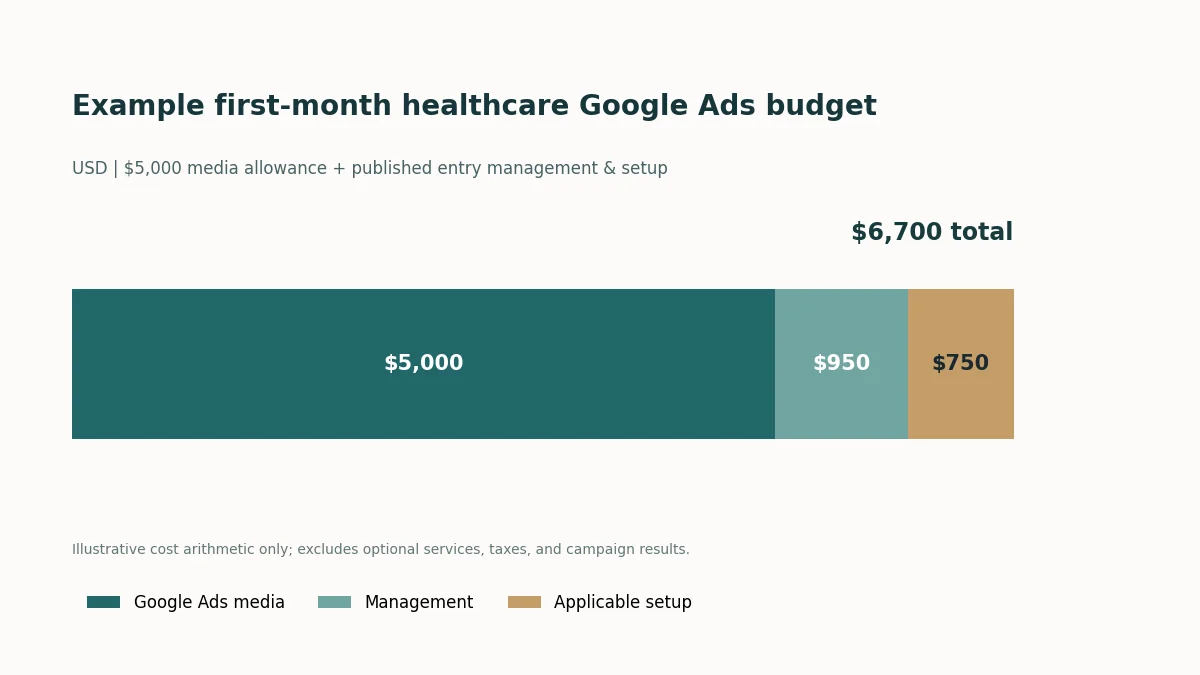
Cost basis: Daily budget figures show media only. The three month totals, sensitivity table and $6,700 graphic also include stated management and applicable setup fees, but not taxes or extra work. A modeled appointment cost is not ROI.
How can a medical practice measure whether its Google Ads budget is working?
Start with outcomes the clinic can verify: ad interactions → inquiries → qualified inquiries → bookings → attended appointments. Each step has a different denominator. A website call button click does not prove that a conversation took place, and a submitted form does not prove that the patient booked or attended.
Measurement sequence: Ad clicks → inquiries → qualified inquiries → booked appointments → attended visits.
Use separate conversion actions for different behaviors where supported and appropriate. Google documents distinct approaches for website and phone call conversions. Keep click only events or weak proxies from dominating automated bidding decisions unless they are truly the best lawful, measurable goals available.
A transparent illustrative measurement exercise
Definitions matter: inquiry cost uses all meaningful inquiries; qualified inquiry cost excludes irrelevant/unserviceable requests; booking cost uses confirmed appointments; attended appointment cost uses visits that actually occurred. Avoid counting form clicks as submitted inquiries or booked visits. When assessing performance, maintain approved aggregate records without passing sensitive patient details into ad platforms.
Illustrative example, not historical campaign data: Imagine a $5,000 monthly media budget at an assumed $10 average CPC: 500 clicks. At 6% click to inquiry, that yields 30 inquiries. At 60% qualification, 18 are qualified. At 60% of qualified inquiries booking, that is 10.8 modeled bookings; at 80% attendance, it is 8.64 expected attended appointments. Retaining decimal values avoids calculation errors caused by rounding intermediate counts. Actual visits, of course, are whole numbers.
The model therefore yields $166.67 media cost per inquiry, $277.78 per qualified inquiry, $462.96 per modeled booking, and $578.70 in media per modeled attended appointment. Including the stated $950 management fee and applicable $750 setup produces a $6,700 illustrative first month total, or $775.46 per modeled attended appointment. Extra development, software and taxes would increase that figure. These denominators are expected values, not observed incremental patients.
Does a lower cost per appointment mean positive ROI?
No. The $775.46 modeled cost per expected attended visit is not ROI or profit. A real ROI calculation requires verified incremental patient activity, contribution after the costs of delivering care, and the complete attributable marketing investment. Ad platform conversions and model projections alone cannot establish those inputs.
ROI, only when inputs are verified = (incremental contribution before marketing investment − total attributable marketing investment) ÷ total attributable marketing investment × 100.
Contribution here means attributable incremental revenue minus the incremental costs of delivering care, before the marketing investment is deducted. Do not subtract those care delivery costs again in the ROI numerator. If all 8.64 modeled visits were incremental and the entire attributable investment were $6,700, break even would require $775.46 contribution per modeled attended visit. This is conditional arithmetic, not a patient value benchmark or forecast.
Clinics can maintain a privacy conscious monthly scorecard: media spend, meaningful calls, qualified inquiries, booked appointments, attended appointments and reasons an inquiry could not be scheduled. Look for bottlenecks before simply raising bids or expanding geography.
What healthcare advertising rules can change a campaign budget?
Healthcare advertising restrictions are part of the economics because policy eligibility can affect which services, messages and targeting methods a clinic may use. Before approving spend, check Google’s healthcare and medicines policy for the service and target country. Some products and services require certification or cannot be advertised in certain jurisdictions.
Healthcare content may also fall within Google’s sensitive interest restrictions for personalized advertising. Do not assume remarketing, customer match lists or condition based audience selection are acceptable simply because they are technically available.
For US covered entities and business associates, evaluate whether website trackers and connected services receive protected health information. The US Department of Health and Human Services’ online tracking guidance includes important qualifications following a June 20, 2024 court order; it should not be reduced to a universal “all health page visits are PHI” rule. UK and other markets require their own privacy, clinical advertising and consent review.
A practical approval process includes a medical/content owner, an advertising policy owner and a privacy or legal reviewer when needed. DigiTaTop describes its approach to accuracy and review in its healthcare editorial standards.
Six budgeting mistakes that waste clinic ad spend
- Using an unexplained CPC average. Without location, services, dates and match types, a cost per click figure says little about your likely auction.
- Counting every call click as a patient lead. Separate clicks, real conversations and actionable inquiries.
- Running every service into one landing page. A dental implant consultation and a routine cleaning require different context, eligibility and answers.
- Advertising outside available capacity. Unanswered calls, wrong clinic hours or a long booking delay can squander qualified demand.
- Comparing fees without deliverables. One quote may include conversion setup and landing page reviews while another excludes them.
- Ignoring policy restrictions until launch. Claims, targeting and certifications may need review before an ad becomes eligible to serve.
For practices still fixing weak appointment journeys, it may be better to resolve usability and inquiry handling first. DigiTaTop’s healthcare website design service addresses the site experience that paid visitors depend on.
What should be included in a healthcare PPC proposal?
Before signing, request a short written scope that answers these questions: Which services and locations are included? How many campaigns and landing pages will be managed? Who writes and approves clinical claims? Who owns the advertising account and performance data? Which conversion actions are tested? How are appointment quality and policy disapprovals reviewed? Which setup, creative, tracking and development activities are excluded?
For a small clinic, concentrate on a few approved service lines and a dependable booking path. For a hospital group, ask how location level budgets, departments and governance will be separated without fragmenting the measurement. You can compare the approach with DigiTaTop’s healthcare PPC management service and its published package terms.
How should hospitals and multi location clinics allocate budgets?
Set budget proposals by approved service line and reachable location before pooling them into a single account total. A hospital could separate an elective specialty department from routine outpatient services, then compare meaningful inquiries and available appointment capacity within each unit. Allow for department level clinical approval, service line eligibility and shared tracking governance. This is an allocation method, not a claim that any department should receive a fixed percentage of spending.
Healthcare Google Ads budgeting: common questions
How much should a small medical clinic spend on Google Ads?
There is no single responsible amount. Set a preliminary media allowance from the available service capacity, eligible local search demand, actual CPC estimates and the practice’s ability to handle calls. Add management, setup and any landing page expenses separately; review the budget against qualified inquiries and real appointments.
Is Google Ads management included in the advertising budget?
Usually not. The advertising platform charges for ad interactions; management is a distinct professional service. DigiTaTop’s published starting management fee is the higher of $950 per month or 12% of managed ad spend, with ad spend separate and setup billed according to scope.
Why can Google Ads spend more than my daily budget?
For most campaigns, Google treats the setting as an average daily budget and may spend up to twice that amount on a given day. Its typical monthly spending limit is the daily budget multiplied by 30.4, subject to applicable conditions and changes.
Should clinics optimize for form submissions or booked appointments?
Use the most meaningful outcome that can be measured accurately and lawfully. Form submissions are useful leading indicators but do not prove appointment quality. Where feasible, evaluate qualified inquiries and aggregate booked or attended appointments alongside platform conversions.
Do dental, IVF, dermatology and ophthalmology ads follow the same rules?
No. Advertising eligibility, claims, audience restrictions and required approvals vary by service and jurisdiction. Review each campaign’s services and targeting before launch rather than reusing one healthcare advertising template for every specialty.
Can a Google Ads budget guarantee a certain number of patients?
No. Click costs, demand, landing page experience, provider availability and appointment conversion all vary. A responsible proposal defines measurable assumptions and review milestones, not guaranteed patient numbers.
How do I calculate cost per booked appointment versus cost per attended visit?
Divide the same attributable cost basis by the number of confirmed bookings to calculate cost per booked appointment; divide it by attended visits to calculate cost per attended visit. Specify whether costs include only media or also management and setup. These measures are not automatically equivalent to incremental cost per acquired patient.
What costs can sit outside a healthcare PPC retainer?
Depending on the signed scope, costs may include media spend, initial setup, new landing pages, conversion tracking work, call systems, creative production, third party software, specialist reviews and tax. Ask for a written inclusion and exclusion list before approval.
How to interpret the examples and sources in this guide
The published entry management and setup amounts come from DigiTaTop’s pricing page; verify them again when requesting a current proposal. Google’s own documentation explains daily and monthly budget limits, auction factors, and healthcare advertising eligibility. The $5,000 media allowance, $10 CPC and conversion rates are illustrative, not observed results. Reliable budget and ROI estimates require dated local campaign and appointment data, valid incremental attribution, contribution margins and complete actual expenses. For US healthcare privacy considerations, consult HHS tracking guidance and professional advice where required.
Get a healthcare advertising plan grounded in your clinic’s capacity
Tell us which services and locations you want to promote, the appointment capacity you can support and how inquiries are handled today. We can review the budget structure and the measurement work needed before you commit to a larger campaign.
feel free to contact us. Share your business goals, location and available appointment capacity. Do not include personal patient information.




[…] Budget planning belongs at campaign level only where independent control is necessary. The spending required for a useful test depends on actual local search demand, auction prices and the quality of the appointment funnel. There is no reliable universal daily budget or guaranteed cost per booked patient. For the full budgeting method, see DigiTaTop’s healthcare Google Ads cost guide. […]