
What Is Healthcare SEO and How Does It Work?
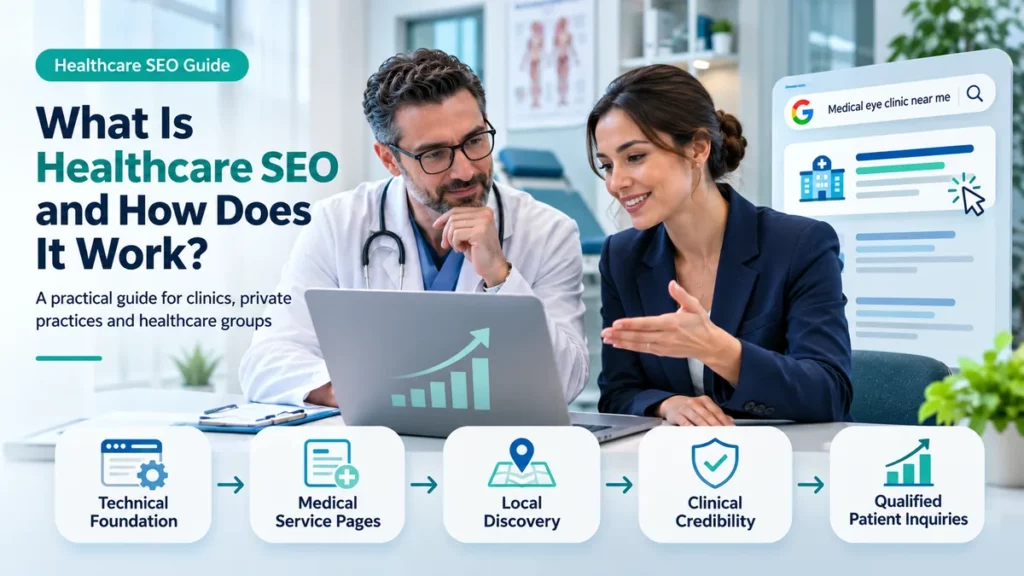
Healthcare SEO is the process of helping patients and healthcare buyers find trustworthy, relevant information about a provider through unpaid search results. It connects technical website access, clinically accurate service information, local discovery, reputation signals and measurement. For a medical practice, success is not simply more impressions: it is helping the right people understand available services and complete an appropriate next step.
A patient searching for a local ophthalmologist, a parent researching pediatric services, and a hospital procurement manager comparing providers have different questions. Effective medical SEO makes the correct page understandable to people and search engines at each stage, without exaggerating clinical outcomes or collecting unnecessary health information.
Table of contents
- Healthcare SEO in one minute
- How search engines find and evaluate medical website pages
- How patient search intent shapes service pages
- Why healthcare SEO requires stronger information standards
- Where local SEO fits for doctors, clinics and hospitals
- The technical foundations medical websites often overlook
- How a medical practice should measure SEO outcomes
- Worked example: a fictional multi-service clinic
- A practical first 30 days for a healthcare SEO project
- Does healthcare SEO also matter for AI search?
- Common healthcare SEO mistakes and what to do instead
- Frequently asked questions about healthcare SEO
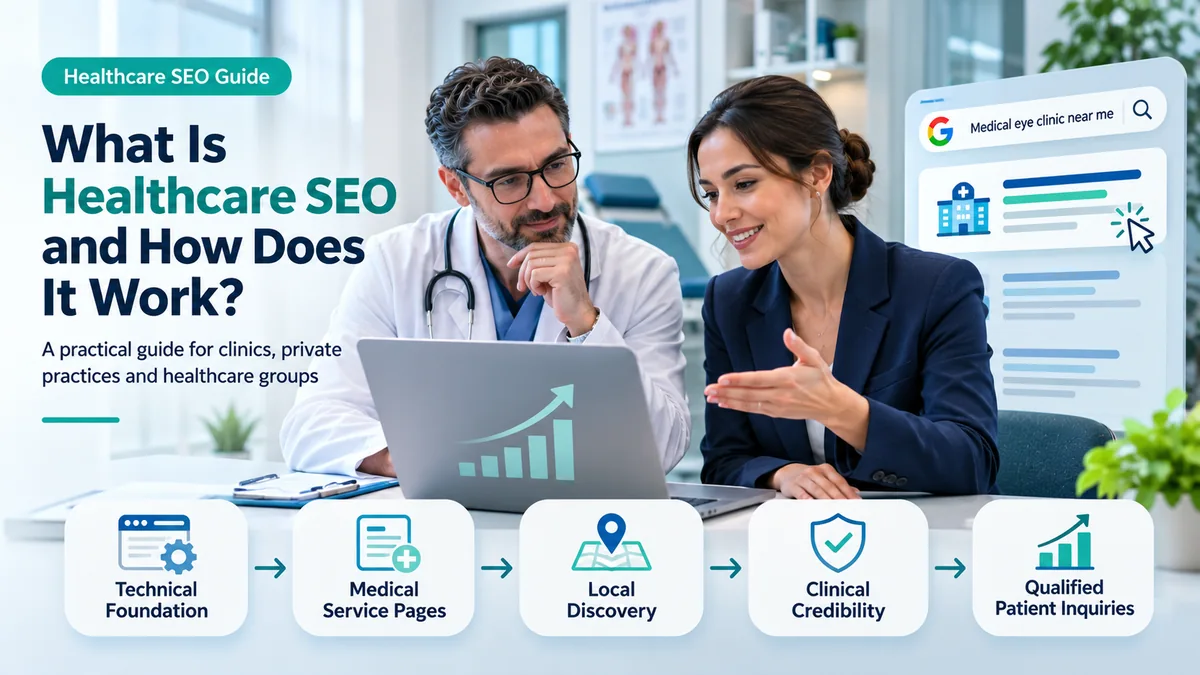
This is a practical explanation for clinic owners, medical directors, practice managers and hospital marketing leads. For implementation and deliverables, see DigiTaTop’s healthcare SEO services.
Healthcare SEO in one minute
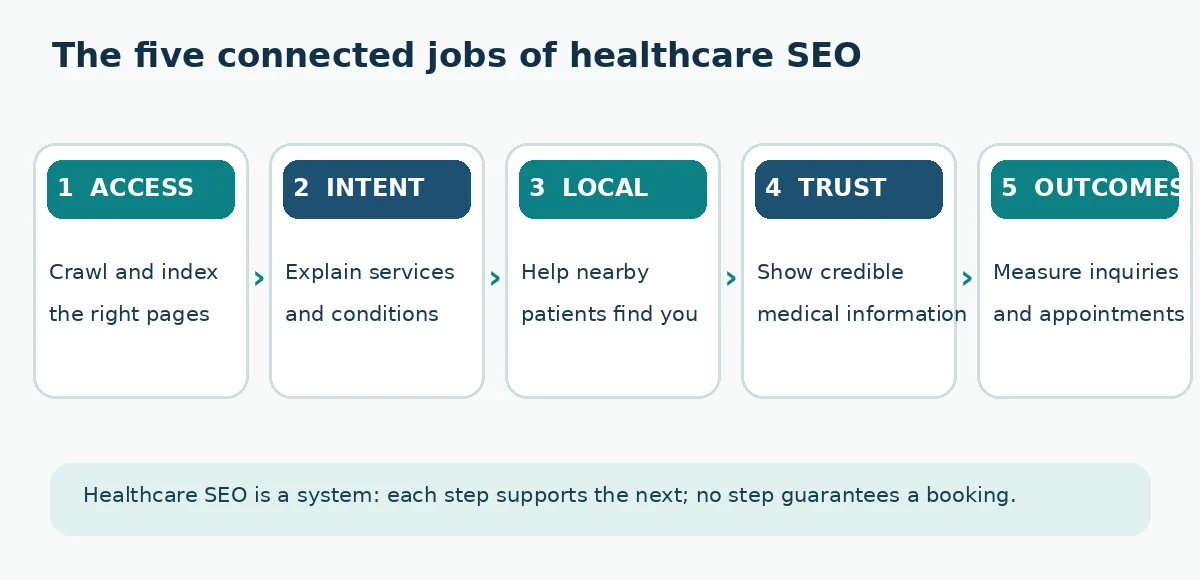
Think of healthcare SEO as answering five questions in sequence: Can a search engine access the page? Does the page match the patient’s question? Is the service actually offered in the relevant location? Can the reader evaluate the information and provider? And can the practice tell whether the visit led to a useful inquiry?
| Part | What a healthcare team should verify | Common failure |
|---|---|---|
| Technical access | Important service pages can be crawled and indexed | A valuable page is blocked, redirected, duplicated or omitted |
| Search intent | Each page addresses one clear patient or buyer task | One vague homepage is expected to rank for every service |
| Local discovery | Accurate location, services, hours and eligible business information | Different addresses or incomplete location signals |
| Clinical credibility | Clear provider information, accurate claims and appropriate references | Unattributed advice or outdated service descriptions |
| Useful outcomes | Inquiry routes, qualification and bookings are measurable | The team reports traffic without knowing whether inquiries were relevant |
How search engines find and evaluate medical website pages
Search engines discover pages through links and other signals, fetch accessible content, process what they can understand, and may include eligible pages in an index. A sitemap helps discovery, but submitting one does not guarantee indexing. A page can be indexable and still not appear for a particular search.
For a clinic, the first technical priorities are plain: use one preferred URL for each important service, avoid accidentally blocking it, publish understandable HTML, keep internal links crawlable, and make the page work well on mobile devices. Google’s SEO Starter Guide explains the underlying fundamentals.
- Check whether the main service page returns a successful response and is allowed to be indexed.
- Inspect canonical signals and redirects when duplicate or old service URLs exist.
- Confirm that a clear navigation path reaches important clinic and specialty pages.
- Keep visible service details and contact routes readable without requiring complex interactions.
- Use Search Console’s indexing reports and URL Inspection for the actual site rather than assuming a sitemap equals visibility.
Example: a dermatologist may have a strong acne-treatment explanation, but if every link to it points through an outdated campaign URL or its canonical references another page, search discovery becomes harder. The correction is technical. Writing more text will not fix the wrong canonical.
How patient search intent shapes service pages
A medical practice must distinguish searches for a provider, a service, a symptom explanation and an appointment. Those intentions overlap, but they do not always belong on the same page. A useful service page answers what is offered, who provides it, where it is available, how an assessment works and how to contact the practice, without guaranteeing suitability or results.
| Search task | Helpful page type | What to avoid |
|---|---|---|
| “Eye specialist near me” | Location and provider information | Claiming every neighborhood from an unrelated page |
| “Retina consultation” | Specific service page with responsible clinical scope | Invented outcomes or an unverified treatment promise |
| “What causes blurred vision?” | Clinically reviewed educational explanation | Turning generalized symptoms into a self-diagnosis |
| “Clinic opening hours” | Accurate location and contact information | Contradictory hours across the website and profile |
The distinction matters to rankings, AI answers and patient trust. Educational material can explain options and encourage appropriate professional assessment, while a service page can show the actual services and scheduling route. Avoid dozens of near-identical doorway pages for each city or keyword variation.
DigiTaTop’s guidance for medical clinics and private practices provides a separate commercial audience pathway. This article explains the underlying search system rather than replacing that service discussion.
Why healthcare SEO requires stronger information standards
Health information can affect decisions about diagnosis, treatment and safety. Content therefore needs a higher degree of care than an ordinary consumer product description. The relevant goal is not to claim a secret ranking signal: it is to publish medically responsible information that people can understand and verify.
- Identify the real provider, organization or accountable source behind relevant claims.
- Distinguish general education from personalized diagnosis or treatment advice.
- Check clinical terminology, availability and treatment descriptions against current practice.
- Use legitimate, relevant sources for medical statements that require evidence.
- Keep approval dates and review notes internally; show a genuine byline or update date where supported.
- Avoid fabricated patient testimonials, invented case studies and unrealistic before-and-after promises.
Google’s guidance on useful content asks whether content offers original value, accurate sourcing and a satisfying answer. A practitioner-informed explanation of a service workflow can add value; repeating generic definitions across dozens of pages usually cannot.
Consider an IVF clinic. A question about consultation preparation, an explanation of an offered treatment, and a booking request should not be conflated. The information can be related through clear links while each page retains its own purpose. Medical appropriateness must be determined by qualified clinicians, not by SEO copy.
Where local SEO fits for doctors, clinics and hospitals
A practice may appear through organic website results, map-based listings and other search surfaces. These are related but distinct. Local visibility depends in part on the relevance, distance and prominence of the business; there is no paid shortcut to a better local ranking. Google describes these factors in its Google Business Profile local-ranking guidance.
- Maintain accurate business names, services, contact details and location information on the website and eligible profiles.
- Create useful, distinct location pages only for real, verifiable facilities; include hours, services and responsible contact routes.
- Check whether a hospital department has its own legitimate public presence before making additional listings.
- Help people understand physical access, accessibility, appointment procedures and availability.
- Monitor reviews ethically; never manufacture patient reviews or disclose private patient information in replies.
For a two-branch ophthalmology practice, one branch may offer diagnostic imaging while the other offers consultations only. The site should not imply both locations provide the same procedure. Location-specific content must reflect actual operations; that accuracy is more useful than copying the same city paragraph 20 times.
The technical foundations medical websites often overlook
Medical organizations often have complex platforms: appointment widgets, location directories, translated pages, old treatment URLs and multiple tracking systems. An effective technical review establishes which URLs matter, whether they are accessible and how users move between them.
| Area | Verification question | Responsible next action |
|---|---|---|
| Indexing | Are the intended pages eligible for indexing? | Resolve noindex, canonical or server-response problems |
| Navigation | Can visitors reach services in a few understandable steps? | Improve descriptive contextual links and menus |
| Mobile usability | Can a visitor read treatment details and contact the clinic easily? | Fix layout and interaction issues on narrow screens |
| Performance | Are important page elements slow or unstable? | Review real-user and lab performance evidence |
| International pages | Do language and market versions have genuinely distinct purposes? | Implement consistent localization and hreflang only where appropriate |
| Structured data | Does the markup describe visible, truthful facts? | Validate schema without fake reviews or credentials |
Technical hygiene is necessary but not sufficient. Fixing an indexing error can restore eligibility; it cannot make weak or duplicated content the best answer in its market.
How a medical practice should measure SEO outcomes
A clinic needs a measurement chain that reflects how inquiries are handled. An organic session is not necessarily a lead; a click-to-call event is not necessarily a conversation; and an inquiry is not necessarily an attended appointment. Keep these stages separate in reporting.
| Stage | Metric | What it does not prove |
|---|---|---|
| Discovery | Relevant non-brand queries, impressions, indexed landing pages | That the visitor needs an appointment |
| Engagement | Service-page views and relevant interactions | That a medical service is clinically appropriate |
| Contact | Valid calls, forms or scheduling-start events | That the contact was qualified or completed |
| Qualification | Appropriate service and location, contactability and intent | That the patient booked |
| Appointment | Confirmed and attended appointments where lawfully measurable | That all results were caused by SEO |
A simple example: 120 organic service page visits lead to 12 contact actions, seven valid inquiries and four appointments. Those are hypothetical teaching numbers, not DigiTaTop client data. The numbers illustrate why a dashboard showing 12 “conversions” may not represent 12 patients.
Use Google Search Console for search visibility, suitable analytics for site behavior and only appropriately governed booking or CRM data for downstream outcomes. Avoid transmitting sensitive patient information to advertising or general analytics systems. Establish a compliant measurement design for the relevant jurisdiction before linking health-related data.
If the practice wants an investment perspective, the published healthcare SEO pricing guide explains retainers and scope; this educational guide does not quote a universal SEO ROI or ranking timeline.
Worked example: a fictional multi-service clinic
Consider a hypothetical outpatient center with dermatology, ophthalmology and laboratory services. It has a website and a Google Business Profile but cannot explain which service pages generate relevant inquiries. A responsible SEO plan would proceed in sequence rather than publishing 50 generic blog posts immediately.
- Inventory each actual service and the locations where it is delivered. Confirm clinically approved names and descriptions.
- Inspect accessibility, indexing and navigation for each important service URL.
- Map common questions to one primary page per task; use supporting educational articles where a distinct need exists.
- Make the real booking, call and directions options easy to find on mobile.
- Check location and provider information for consistency and accuracy.
- Set a baseline for non-brand search visibility and valid inquiries, then reassess after implementation.
The example does not assume a fixed monthly traffic increase. If a branch cannot accept a service or has no available appointments, that issue may matter more to the business than a temporary change in keyword positions.
What this example demonstrates: effective healthcare SEO is a coordinated operating process, not a one time metadata edit. The correct sequence depends on the site’s actual constraints.
A practical first 30 days for a healthcare SEO project
| Period | Primary task | Evidence to keep |
|---|---|---|
| Days 1-5 | Confirm service inventory, locations, audiences and baseline | Service-location matrix, GSC baseline, booking routes |
| Days 6-12 | Review crawl/index issues and critical templates | URL sample, indexing decisions, mobile findings |
| Days 13-20 | Improve highest-value service and location pages | Approved copy, internal-link map, clinical facts |
| Days 21-30 | Validate journeys and establish reporting cadence | Contact tests, qualified inquiry definitions, next-priority list |
These are planning windows, not promises of search ranking outcomes. A hospital’s clinical, compliance and technical approvals can require a longer sequence. The purpose is to create a transparent order of work that avoids spending effort on cosmetic optimizations while foundational problems remain.
Download the Healthcare SEO first 30 days worksheet (PDF) or use the editable tracker (CSV). Both resources are intended for planning, not performance forecasting.
Does healthcare SEO also matter for AI search?
Yes, because AI-assisted search still depends on accessible, relevant and reliable information. Google says its AI search experiences do not require special SEO markup; familiar foundations such as indexing eligibility, internal links and people-first content remain important. Read Google’s AI search guidance for the official limitations.
- Write clear, standalone answers to genuine provider or patient questions.
- Keep medical facts attributable and consistent across relevant pages.
- Make service availability, locations and provider information easy to verify.
- Publish useful charts, workflows or first-party evidence only when the underlying facts are real.
- Track AI-related referrals and sampled mentions separately from ordinary organic metrics.
No healthcare agency can guarantee a citation in ChatGPT, Google AI Overviews or another assistant. AI-generated answers are variable; citation inclusion is not a direct or universal measure of care quality.
Common healthcare SEO mistakes and what to do instead
| Mistake | Why it underperforms | Better approach |
|---|---|---|
| One page for every keyword synonym | Duplicates the same search task | Use one strong canonical owner with natural variants |
| Thousands of generic condition pages | Creates thin or risky medical guidance | Publish only topics with genuine patient value and appropriate review |
| Location names on pages for nonexistent branches | Misleads visitors and duplicates content | Describe only genuine service locations |
| Treating rankings as patient outcomes | Ignores contact and scheduling losses | Measure the full inquiry pathway |
| Guaranteeing fast SEO results | Overstates control of search systems | Use evidence based priorities and clear reporting limitations |
Start with an internal audit if your team has the technical and clinical capacity. For practices needing help with site architecture, local presence and measurement, review the scope of healthcare SEO services and discuss your healthcare search priorities.
Frequently asked questions about healthcare SEO
1. What is healthcare SEO in simple terms?
It means making a healthcare provider’s website easy to discover, understand and trust for relevant unpaid searches, while helping visitors find the right service and contact route.
2. Is medical SEO different from ordinary SEO?
The technical principles are similar, but medical information requires heightened accuracy, clear provider credibility, appropriate evidence, local service detail and careful handling of privacy and clinical claims.
3. Does SEO bring patients immediately?
It can improve discovery and inquiries over time, but there is no fixed period or guaranteed number of patients. Results depend on existing site conditions, competition, demand and the practice’s ability to handle inquiries.
4. Should every medical treatment have its own page?
Only if it represents a genuine, distinct user task and an actually offered service. Avoid duplicate pages for minor keyword variants or services the organization does not provide.
5. Is Google Business Profile part of healthcare SEO?
It is an important part of local discovery for eligible healthcare businesses, while organic website optimization serves related but distinct search results and questions.
6. How do clinics measure whether SEO works?
Review meaningful non-brand visibility, service page engagement, valid contacts, qualified inquiries and, where lawfully available, bookings and attended appointments. Do not equate clicks with patients.
7. Can healthcare SEO improve visibility in AI answers?
Clear, accurate, accessible content may help search systems find and use information, but no page can be guaranteed an AI citation. Ordinary technical eligibility and content quality remain foundational.
8. What should a clinic do before hiring a healthcare SEO agency?
Clarify service priorities, geographic coverage, website access, measurable inquiry definitions and internal clinical approval arrangements. Compare an agency’s actual deliverables and accountability, not promised rankings.
Build a stronger healthcare search foundation
Explore healthcare marketing resources or discuss your healthcare search priorities to clarify the right priorities for your clinic, hospital or medical group.




[…] to the subject? Start with what healthcare SEO means. This guide gives practice owners, administrators and healthcare marketers a practical scorecard. […]