
How Long Does Healthcare SEO Take? A Practical Timeline for Clinics

How long does healthcare SEO take? A technical change can be deployed quickly, but deployment is different from sustained visibility. Google may take days or weeks to recrawl an updated page, and its general processing guidance does not predict when a clinic will earn competitive rankings or qualified appointments. There is no reliable number of days or months that guarantees rankings or new patients. A useful plan tracks the work completed, whether Google can access it, what search demand responds, and whether that discovery leads to a suitable inquiry.
For a medical clinic, the right question is not simply, “When will our SEO work?” It is: Which signals should we expect to check first, which outcomes need more evidence, and when should we investigate rather than keep waiting? This guide explains a practical timeline for clinic owners, practice managers, hospitals and medical marketers. It deliberately separates operational checkpoints from performance promises.

Table of contents
- The short answer: healthcare SEO has four different clocks
- What should a clinic expect in the first 30, 60 and 90 days?
- What makes medical SEO timelines different?
- New clinic versus established practice: two illustrative situations
- Which SEO activities can show earlier evidence?
- How should a practice measure SEO progress without overstating ROI?
- Why might healthcare SEO seem to be taking too long?
- How do local SEO and organic SEO timelines differ?
- Can a clinic speed up healthcare SEO?
- A practical first-90-days timeline for clinic teams
- What should a clinic ask an SEO provider about timing?
- Frequently asked questions about medical SEO timelines
- When to wait, investigate or change course
- What to review at six and twelve months
- Sources and methodology
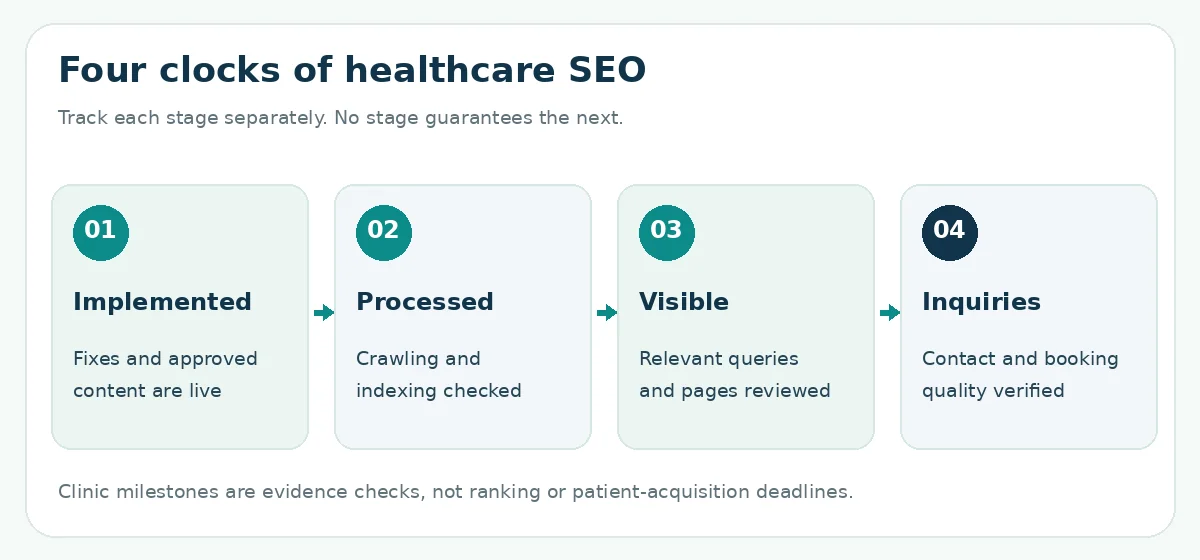
The short answer: healthcare SEO has four different clocks
SEO is not one event. The clinic can complete work before search engines process it, and search engines can show a page before the practice receives a qualified inquiry. Each stage therefore needs a different measure.
| Clock | What changes | What to verify | What it does not prove |
|---|---|---|---|
| 1. Implementation | A problem is corrected or a useful page is improved | Deployment record, URL test, content approval | Google has processed the change |
| 2. Discovery and indexing | A crawler reaches a URL and systems decide whether to index it | Google Search Console URL Inspection, page indexing reports | The page ranks prominently |
| 3. Search visibility | A page earns impressions or clicks for relevant searches | Search Console query, page, country and date comparisons | Contacts are qualified patients |
| 4. Patient inquiry and appointment | A visitor calls, enquires, books or attends | Consent-appropriate analytics and clinic booking records | Every outcome was caused by SEO |
Google notes that some search-related changes may be reflected within hours, while others take several months. Its separate guidance on recrawling states that crawling can take a few days to a few weeks; requesting a crawl does not guarantee indexing. These statements describe how systems work, not a forecast for a particular medical website. See Google’s SEO Starter Guide and recrawling guidance.
What should a clinic expect in the first 30, 60 and 90 days?
A 30/60/90-day framework is useful for managing and reviewing the work. It is not a promise that rankings will appear on day 30, traffic will grow on day 60 or appointments will increase on day 90. A newly launched practice and an established clinic with historical search data have very different starting conditions.
| Review point | Reasonable work and evidence | Decision to make | Avoid assuming |
|---|---|---|---|
| Days 1-30 | Verify Search Console and analytics access; test indexability of important service pages; record baseline queries and booking routes; correct major technical blockers | Is the website discoverable and is demand measurement reliable? | Publishing a page means it is indexed |
| Days 31-60 | Improve priority service pages, clinician and location details, internal links and mobile contact routes; monitor crawling and initial query coverage | Are improvements live and are appropriate pages starting to receive relevant impressions? | More impressions automatically mean more patients |
| Days 61-90 | Compare like-for-like non-brand queries, landing pages and qualified inquiries; check unresolved exclusions and clinic follow-up processes | Which service line needs refinement, more evidence or a different priority? | Three months is an SEO success deadline |
| After 90 days | Continue measuring page-level visibility and lead quality; revisit strategy as evidence accumulates | Continue, correct or reprioritize based on observed data | All clinics should reach the same milestone at the same time |
If the website has a serious noindex, canonical, redirect or server-access problem, addressing it may be the highest-value first action. If the website is accessible but its treatment pages are vague or inaccurate, content and clinical review may matter more than another crawl request.
Downloadable tool: Clinic SEO timeline and evidence worksheet (PDF) helps a practice record its baseline, milestones, owners and decisions without inventing target rankings.
Use the editable CSV evidence tracker to record progress and review decisions.
What makes medical SEO timelines different?
Medical websites serve people making decisions about care. A search result may influence what a person expects from a procedure or whether they contact a provider. Useful progress therefore depends not only on crawlability, but also on accurate service scope, credible expertise, local access and clear patient next steps.
Clinical review takes real coordination
A service page may need input from a clinician or practice manager before it can accurately describe indications, limitations, referral rules and appointment pathways. That is worthwhile editorial work, not unnecessary delay. Unsupported claims, generic treatment pages and made-up clinician credentials are not acceptable shortcuts.
The relevant location is often smaller than the search market
For a one-location practice, a promising nationwide keyword may be less useful than a service search in the area patients actually travel from. Google says local results depend mainly on relevance, distance and prominence. Updating a complete, accurate Business Profile can support local discovery, but no clinic can buy or request a particular Maps ranking. See Google’s local ranking guidance.
A patient inquiry is not the same as an attended appointment
Even when an SEO page earns visits, the clinic may be fully booked, miss calls, require referral documents or have a form that fails on mobile. A clinic should check the booking process and appointment capacity before attributing poor or strong commercial results to SEO alone.
Competitive demand differs by service
A routine appointment page for an established single-location clinic, a specialist surgical service in a competitive metropolitan area and a newly opened multispecialty group should not share an identical timetable. Geographic competition, previous site history, search intent, practitioner reputation and the quality of existing content all change the evidence needed to judge progress.
New clinic versus established practice: two illustrative situations
The following scenarios are fictional planning examples, not DigiTaTop client case studies or forecasts.
Scenario A: A new ophthalmology clinic launching its first website. The practice has no useful historical Search Console data. It must verify its live pages are accessible, publish confirmed consultation and location details, establish its Business Profile eligibility, and make telephone and appointment routes work. The early review focuses on whether essential pages can be indexed and whether patient search tasks are represented. Expecting reliable month-on-month organic conversion growth before enough baseline data exists would be premature.
Scenario B: An established dermatology clinic with visible pages but weak enquiries. Search Console already shows relevant impressions. Some pages mention services but do not explain which clinicians provide them or how to book. Here the first tasks may be improving service-page usefulness, fixing mobile friction and validating calls or forms. More page creation is not necessarily the right next investment. Existing visibility makes the enquiry journey measurable sooner, but a performance improvement is still not guaranteed.
| Diagnostic question | New clinic | Established clinic |
|---|---|---|
| Is there a usable baseline? | Often limited or absent | Usually some historical query data |
| Is Google discovering essential URLs? | Verify before interpreting rankings | Compare new changes with prior patterns |
| What should be prioritized? | Accurate service/location pages and booking readiness | Existing high-intent pages, technical issues and conversion friction |
| What indicates useful progress? | Accessible, indexed pages and relevant impressions | Relevant query movement plus verified qualified inquiries |
| What remains uncertain? | Search demand and competitive response | Attribution, seasonality and incremental effect |
Which SEO activities can show earlier evidence?
Some changes are straightforward to check soon after deployment. That does not mean their commercial impact will be immediate.
| Activity | Earliest verifiable evidence | Longer-term outcome to evaluate |
|---|---|---|
| Fix a blocked service page | Correct status, robots/canonical result, successful fetch | Indexing and relevant impressions |
| Repair a broken appointment link | Link works on desktop and mobile | Qualified contacts and booking completion |
| Improve medical service-page structure | Clear heading, treatment scope, clinician details and internal links | Search-task coverage and engagement |
| Correct Business Profile information | Public profile shows accurate hours, category and booking details | Appropriate local discovery and contact activity |
| Add a new educational guide | Page is useful, linked, discoverable and medically accurate | Its contribution to relevant information searches over time |
| Add structured data where applicable | Valid markup matches visible content | Eligibility for relevant search features, not guaranteed appearance |
Prioritize fixes that remove known barriers over work that simply creates more output. For example, resolving a mobile booking error is a real improvement even before a ranking change can be detected.
How should a practice measure SEO progress without overstating ROI?
Choose a small, repeatable dashboard rather than one headline ranking. Record at least a baseline date, the relevant service pages, the target market, the data source and the definition of a qualified inquiry.
- Indexability: Which important URLs are eligible and actually indexed? Investigate exclusions individually rather than treating every unindexed URL as a fault.
- Search visibility: Separate brand from non-brand queries. Review relevant impressions, clicks and search terms by page and country in Search Console.
- Local discovery: Review Business Profile metrics separately from organic Search, because Maps visibility and website rankings are not identical systems.
- Website actions: Measure accessible booking clicks, calls or form submissions without sending sensitive patient details to analytics services.
- Qualified inquiries: Where practical, record enquiries that match the clinic’s location, services and availability; avoid collecting or exposing sensitive medical details unnecessarily.
- Appointments: Compare scheduled and attended visits when the clinic has a lawful, reliable way to measure them; account for cancellations and existing-patient follow-up.
A reporting example can be accurate without inventing numbers: “Three priority consultation pages were corrected and indexed; two began earning relevant non-brand impressions; the booking form was retested; inquiry quality remains unverified.” That is a clearer decision record than “SEO is working because traffic went up.”
For ROI, the clinic must know which expenses were included, what outcomes were incremental, the contribution generated by those outcomes and the limits of attribution. Clicks, impressions and modelled appointments are not financial ROI.
Why might healthcare SEO seem to be taking too long?
The right response depends on the failed stage. Avoid treating every delay as a reason to publish more posts.
| Symptom | Check first | Recommended response |
|---|---|---|
| New service pages are not in Google | HTTP status, noindex, canonical, robots access, URL Inspection | Correct a confirmed blocker; request recrawling where appropriate |
| Pages are indexed but have almost no relevant impressions | Search intent, service demand, differentiation, headings and internal links | Improve the target page and observe it across a meaningful comparison period |
| Impressions grow but clicks remain weak | Query relevance, snippets, title clarity, competition, search features | Refine the page’s answer and title for the actual search task |
| Visits grow but contacts do not | Mobile experience, contact routes, service eligibility, appointment capacity | Test the complete patient inquiry journey |
| Some keywords rise while others fall | Country, device, seasonality, algorithm changes and query mix | Evaluate groups rather than isolated position snapshots |
| Local Maps results stay inconsistent | Profile relevance, proximity, business information and prominence | Correct verifiable profile gaps; do not promise rankings |
If a change has not produced visible improvement after some time, revisit the diagnosis. Google’s core update guidance also explains that certain quality improvements can take time to be reflected and that there are no guarantees.
How do local SEO and organic SEO timelines differ?
A clinic can appear in traditional web search results, local Maps results or both. The systems overlap but are not interchangeable. A complete Business Profile can make important factual information available to patients, while service pages need to be accessible, useful and relevant to searches. Local proximity matters; a practice may be highly relevant to nearby searchers but not to people across a city.
Track the two paths separately. For a verified location, examine profile views and contact actions where data is available. For organic SEO, examine relevant page and query visibility. Use the clinic’s own booking data cautiously to understand whether either path contributes to the right enquiries, without overstating attribution.
Do not create dozens of near-identical location pages to accelerate rankings. Each location needs genuinely distinct verified information and a reason for its page to exist.
Can a clinic speed up healthcare SEO?
A practice can often speed up the work, but it cannot force an organic search result or a patient decision. The most useful actions are operational:
- Give the marketing and website teams access to verified Search Console data and the right publishing permissions.
- Appoint a responsible contact who can verify clinical services, credentials, working hours and referral requirements.
- Prioritize essential pages that serve real patient tasks and can be linked from appropriate navigation.
- Resolve indexability, redirect, canonical and booking problems before expanding the content calendar.
- Ensure contact options work on smaller screens and during published opening hours.
- Agree on definitions for qualified inquiries and keep private health information out of inappropriate tracking tools.
- Review results at a consistent cadence and document what actually changed.
Buying ads does not speed organic ranking. A practice may choose paid search to address a separate short-term discovery need, but it should evaluate it as a different channel with its own eligibility rules and budget. For that decision, read Medical PPC vs SEO: Which Produces Patient Leads Faster?.
A practical first-90-days timeline for clinic teams
Rather than asking for a predicted ranking position, assign an owner, proof of completion and a next decision to each period.
Use the earlier 30/60/90-day table as the single review schedule. The planner below records task-specific evidence, actual deployment dates and next decisions.
The interactive timeline planner provides an offline record of these checks. It does not score SEO performance or project rankings.
What should a clinic ask an SEO provider about timing?
A credible proposal should explain what will be delivered, what evidence is needed and which outcomes cannot be guaranteed. Questions worth asking include: Which service pages are first priority? How will indexing and qualified enquiries be measured separately? Who confirms clinical accuracy? What happens if relevant impressions rise but bookings do not? And how will you distinguish technical work from content creation and local profile maintenance?
For practical delivery scope, see DigiTaTop’s Healthcare SEO services. For budget questions rather than timing, the healthcare SEO pricing guide explains the difference between retainers, deliverables and excluded costs. This article is an educational planning guide, not an offer of specific results.
Frequently asked questions about medical SEO timelines
How many months does healthcare SEO take to work?
There is no universal number. Implementation may be checked quickly, crawling can take days to weeks, and visible changes in Google Search can take hours to several months. Useful patient inquiries depend on search intent, website quality, local competition and booking readiness. Evaluate evidence at agreed checkpoints rather than promising a fixed month.
Can a new medical clinic rank on Google in 30 days?
A new clinic may get pages discovered or indexed within that period, but a first-page ranking cannot be promised. Its immediate priorities are accessible pages, accurate service information, legitimate local presence and a functioning contact route.
Why are my clinic’s pages indexed but not getting appointments?
Indexing only means pages are in the search index. Check whether they appear for relevant searches, whether visitors understand the service, and whether calls or booking routes work. A clinic may need to fix inquiry handling rather than create additional content.
Does Google Business Profile SEO work faster than website SEO?
They use different systems and depend on different factors. Accurate profile information can become visible without waiting for every website page to change, but this does not guarantee higher Maps rankings. Assess profile performance and organic web search separately.
Should a practice pause SEO if there is no traffic growth after 90 days?
Not solely because of that date. Review whether technical work was completed, whether pages were indexed, which relevant queries changed and whether data is reliable. A 90-day review is a management checkpoint, not an expiration date for SEO.
Will publishing more medical articles make SEO results faster?
Not necessarily. A useful and clinically accurate page that solves a real patient question is more valuable than many repetitive posts. Fix major access problems, service-page gaps and contact friction before expanding a content calendar.
Can Google Ads improve my clinic’s organic rankings?
No. Paid advertising is a separate channel. Ads may address some immediate discovery needs if eligible, but they do not buy better organic ranking positions. Compare each channel against its own costs and patient inquiry outcomes.
When should a hospital or multi-location clinic expect results?
A group needs a location- and service-line baseline first. Different sites, departments, local markets and technical systems may progress at different rates. Agree on verifiable milestones for individual services and locations instead of applying one group-wide deadline.
When to wait, investigate or change course
Start the observation record from the actual deployment date, not the contract start or invoice date. Keep separate dates for approval, deployment, technical verification and later outcome reviews. A change awaiting clinical approval has not begun producing search evidence.
| Evidence today | Next decision | What to record |
|---|---|---|
| The agreed change is not live | Resolve delivery or approval dependencies. Waiting for search effects is premature. | Blocker, owner and revised deployment date |
| A priority page has a confirmed access or indexing exclusion | Investigate the specific cause now. Not every excluded URL should be indexed. | Intended page role, test result and retest date |
| Relevant visits exist but calls or forms fail | Repair the contact path immediately rather than waiting for rankings. | Synthetic test, correct destination and receipt confirmation |
| The sample is small or reporting is immature | Continue collecting evidence and confirm measurement. Do not declare success or failure from a handful of events. | Data window, counts, reporting delay and next review |
| Comparable mature data shows persistent mismatch | Reassess query intent, page usefulness, competitors, clinic capacity or the investment priority. | Alternative explanations and the change being tested |
These are diagnostic decisions, not universal waiting periods. Escalate active privacy exposure, false service information and broken appointment routes when discovered. Reserve P0 for material urgent failures; routine measurement and content reviews normally belong in a planned P1 or P2 backlog.
What to review at six and twelve months
At a six-month review, ask whether the agreed work was delivered, whether priority pages are being processed, which relevant non-brand searches now reach them and whether inquiries match the services offered. Compare like-for-like periods and note seasonality, changes in demand, clinic hours, tracking and appointment capacity. Six months is a review date, not an expected ranking milestone.
At twelve months, use year-over-year comparisons where suitable data exists. Check whether improvements are durable across important services, whether ongoing costs remain justified and what uncertainty remains in appointment attribution. A new practice may not have a comparable prior year. Use documented baselines and acknowledge that limitation instead of manufacturing a growth percentage.
Limited publishing capacity, delayed technical access or clinical approval can move deployment dates. Reduce the scope to a deliverable the team can verify, assign an owner and update the review plan. More elapsed contract time does not substitute for completed implementation.
Sources and methodology
This guide is based on publicly documented search-engine processes and a clinic operations framework; the 30/60/90-day stages are planning checkpoints, not observed outcomes or industry averages. The fictional clinic scenarios are teaching examples, not case studies. Key sources include Google SEO Starter Guide, Google recrawling documentation, Google local ranking guidance, Google people-first content guidance and Google AI Search guidance.
Explore more practical guidance in DigiTaTop’s Healthcare Marketing Resources hub.




[…] bookings and attendance. This is a measurement sequence, not a promise about ranking speed. See how long healthcare SEO takes for outcome […]