
Medical Practice SEO KPIs: 12 Metrics to Track and Report

On this page
- The clinic SEO scorecard at a glance
- Define what counts as a meaningful patient enquiry
- The 12 medical practice SEO KPIs to track
- KPI formulas and comparable cohorts
- Measure search visibility without mistaking it for patient growth
- Separate Google Business Profile actions from website SEO
- Track website enquiries and GA4 key events carefully
- A medical practice SEO report template: worked example
- What a useful monthly clinic SEO report looks like
- Segment the report without exposing patient details
- Check tracking quality before interpreting results
- Turn the monthly report into a decision
- Frequently asked questions
- Build a report your practice can act on
A medical practice should measure SEO through a connected set of indicators: whether patients can find the right services, whether they visit useful pages, whether they contact the practice, and whether those enquiries become appropriate appointments. Search rankings and traffic can help diagnose progress, but neither tells a clinic how many suitable patients it is reaching.
The most useful monthly SEO report answers three questions: What changed in search? What changed in patient enquiries? What should the team do next? It also separates data that is directly measured from outcomes that need confirmation by reception, scheduling or a practice-management system.
New to the subject? Start with what healthcare SEO means. This guide gives practice owners, administrators and healthcare marketers a practical scorecard. It uses Google Search Console, Google Analytics 4 (GA4), Google Business Profile and internal appointment records without assuming those systems will produce matching totals.
The clinic SEO scorecard at a glance
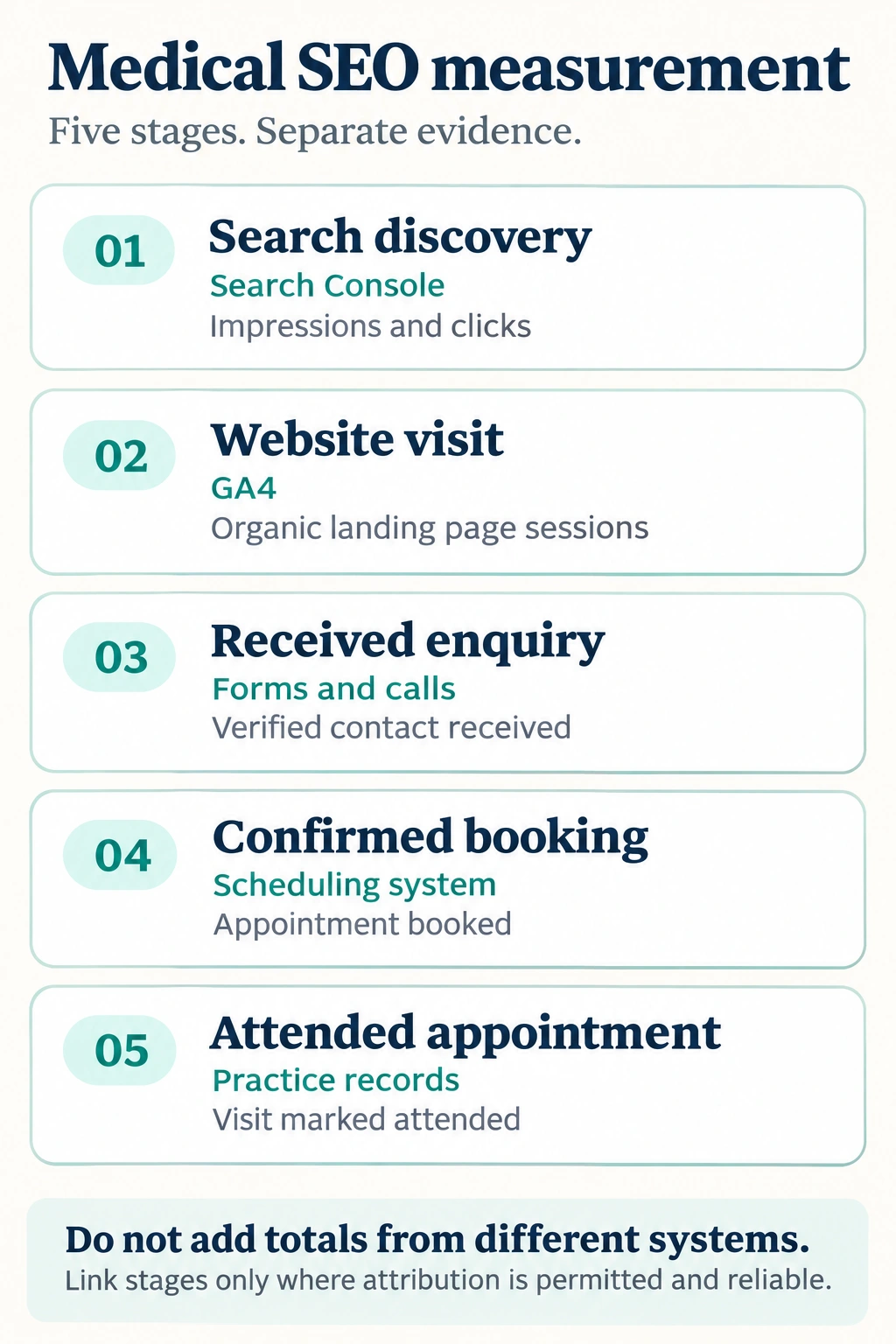
Track five stages separately: search discovery, website visits, received enquiries, confirmed bookings and attended appointments. Each needs its own source, owner and limitation. These are distinct measures of discovery and operations; do not add their totals together or treat them as a joined funnel without supporting evidence.
Define what counts as a meaningful patient enquiry
Before opening a dashboard, write down which services and locations the practice wants to prioritize. A two-location eye clinic may wish to report cataract assessment enquiries separately from general eye examinations. A dental practice may need to distinguish emergency appointment calls from routine hygiene enquiries. A hospital marketing team may need to separate private-patient enquiries from referrals that follow a different route.
Agree the minimum definitions with reception and marketing:
- Contact attempt: a call-button click, form start or booking-button click. This is a digital interaction, not necessarily a completed conversation.
- Received enquiry: a form delivered, a call answered or a booking request received. Deduplicate repeat contacts where possible.
- Qualified enquiry: a real prospective patient whose requested service, service area and practical requirements fit the organization, assessed without placing sensitive patient details in marketing reports.
- Booked appointment: a scheduling-system entry confirmed according to the practice’s booking policy.
- Attended appointment: a visit marked as attended in the approved operations system. Its marketing source may be known, uncertain or unavailable.
A practice can choose different definitions, but it should retain them consistently from one reporting period to the next. Otherwise a rise in “leads” might reflect a tracking change rather than stronger demand.

The 12 medical practice SEO KPIs to track
Use this metric dictionary as a starting point. The downloadable planner is a manual monthly review tool, not a live analytics dashboard.
| KPI | Where to check | Practical interpretation and caveat |
|---|---|---|
| 1. Non-branded organic search clicks | Search Console performance, using eligible branded/non-branded segmentation or a documented query method | Closer to new-service discovery than brand searches; query data is incomplete and segmentation may be unavailable |
| 2. Priority service-page impressions | Search Console, page and search-type filters | Shows potential discovery; broad informational impressions can be less commercial |
| 3. Search click-through rate (CTR) | Search Console clicks ÷ impressions | Useful for a stable query/page cohort; changes in query mix can distort comparison |
| 4. Priority-page average position | Search Console for selected queries/pages | Contextual diagnostic only; not a site-wide business KPI |
| 5. Organic landing-page sessions | GA4, defined channel and landing-page scope | Not equal to Search Console clicks; consent, filtering and attribution differ |
| 6. Engaged service-page visits | GA4 engagement measures, with page and channel scope | Engagement signals attention, not suitability for care |
| 7. Verified organic enquiries | Form delivery, call logs and appropriate attribution records | Needs deduplication and a clear source-confidence label |
| 8. Qualified enquiry rate | Qualified verified organic enquiries / received verified organic enquiries | Requires consistent reception qualification rules |
| 9. Booking rate from qualified enquiries | Booked appointments ÷ qualified enquiries | Changes with scheduling capacity, pricing and call handling |
| 10. Attendance rate for attributed bookings | Attended appointments ÷ booked appointments in a comparable cohort | Allow enough time for booked appointments to occur |
| 11. Local profile actions | Google Business Profile performance, by verified location | Calls are call-button clicks; directions are requests, not completed visits |
| 12. Priority URL eligibility | Search Console indexing, manual URL checks and site monitoring | Report eligible priority URLs divided by reviewed priority URLs; list blockers separately |
Avoid summing all these numbers into a single score. A medical practice might see lower unqualified traffic but better booking suitability after correcting an overly broad service page. That can be progress even when the headline traffic chart is flat.
KPI formulas and comparable cohorts
Use the same service, branch, channel definition and observation window in each numerator and denominator. Allow bookings time to occur before measuring attendance. A month’s new enquiries and that month’s appointments are not automatically the same cohort.
| Metric | Numerator / denominator | Unit and boundary |
|---|---|---|
| Search CTR | Clicks / impressions | Percent; same Search Console filters |
| Qualified enquiry rate | Qualified verified organic enquiries / received verified organic enquiries | Percent; same deduplicated enquiry cohort |
| Enquiry-to-booking rate | Confirmed bookings / qualified verified organic enquiries | Percent; agreed follow-up window |
| Attendance rate | Attended bookings / confirmed bookings | Percent; matured attributed booking cohort |
| Priority URL eligibility | Eligible priority URLs / reviewed priority URLs | Percent; record crawl, indexability and canonical checks; eligibility does not guarantee indexing |
| Source-confidence coverage | All received enquiries with verified channel / all received enquiries | Percent; agreed services and locations, across channels; not SEO’s share |
Multiply ratios by 100. Show N/A for missing inputs, a zero denominator or an unmatched cohort, and state the reason. A measured zero numerator with a positive denominator is a valid 0%. An increase from 20% to 25% is 5 percentage points, or 25% relative growth. Relative growth from a zero baseline is undefined.
Supporting diagnostics include median time to a first meaningful response, answered calls divided by relevant incoming call attempts, and source-confidence coverage. Define business hours, exclusions and the call platform’s counting rules. These help explain missed opportunities; they are not additional proof that SEO produced a patient.
For commercial context, divide the full agreed SEO cost by verified organic enquiries or attended attributed visits from a defensible comparable period. State currency, agency fees, content, technical work, tools and any allocated internal costs. Missing costs, zero outcomes or unreliable attribution mean N/A. Cost per outcome is not profit or incremental ROI. The healthcare SEO pricing guide covers buying scope rather than KPI definitions.
Measure search visibility without mistaking it for patient growth
In Google Search Console, compare actual service and location pages over like-for-like periods. Inspect query intent and relevant country, device and search-type filters.
Report branded and non-branded discovery separately where supported. Branded segmentation depends on property eligibility and the interface; missing query rows are not zero demand.
Review clicks, impressions, CTR, intent and indexability together. A CTR decline alone does not establish a penalty.
Search Console also has reporting and aggregation limitations. It may omit anonymized query details, and page-grouped totals can differ from property totals. Document the filters and export method used rather than forcing every table to reconcile. Google’s Search Console Performance guide and data-grouping documentation explain those differences.
How should a clinic report visibility in AI-assisted Google Search?
Google announced dedicated generative-AI performance reports on 3 June 2026 and notes a worldwide rollout by 31 August. The report describes impressions with page, country, device and date views. Check the property’s available report and its definitions before interpreting a change. Visibility is not a count of booked patients or an independent audit of LLM citations.
The 16 November Search Analytics API update covers branded classification, multimodal search and multiple-country/device filtering. It does not establish generative-AI click or patient-acquisition reporting. Keep referrals from other assistants separate where analytics can identify them; ordinary organic impressions cannot reveal their citation totals.
Separate Google Business Profile actions from website SEO
For physical medical practices, local discovery has its own evidence trail. Monitor each verified Google Business Profile rather than combining every branch into a single unlabeled number.
A profile can show calls, website clicks, direction requests and certain booking interactions. A call metric generally counts clicks on the profile’s call button, not a completed or qualified phone conversation. A directions request does not prove someone visited the clinic. Booking figures depend on supported booking integrations. Google’s Business Profile performance documentation defines these actions.
Keep GBP interactions distinct from GA4 website sessions and Search Console clicks. They occur in different products and can represent overlapping patient journeys. Adding the three together produces a misleading “patient visits” total.
Track website enquiries and GA4 key events carefully
GA4 can help explain what visitors do after reaching a clinic website. Configure distinct events for meaningful contact actions, such as a successfully submitted enquiry form or a completed appointment request. Mark the appropriate events as key events, then test them with real but privacy-safe submissions. Google recommends the generate_lead event for a suitable lead action where applicable; see the GA4 key-event setup guidance.
A click on a telephone link is useful for user-experience diagnosis, but it cannot prove the call connected, was answered, or concerned a new patient. If phone tracking is available and legally appropriate, reconcile marketing summaries against call-platform and reception records using aggregate counts. Record a “source unknown” group instead of attributing every unanswered or untagged call to SEO.
For forms, measure the successful receipt of an enquiry rather than merely clicking “Submit.” Failed requests and validation errors are not leads. For booking portals, distinguish clicking “Book” from a confirmed appointment in the clinic’s scheduling system.
Privacy boundary: do not send patient names, treatment details, appointment reasons, symptoms or other sensitive health information into ordinary marketing analytics events or dashboards. Review automatic page URLs, page-referrer values and query strings as well as custom event parameters: sensitive information can leak through either route. Exclude test leads and check duplicate events. The responsible privacy and technical teams should approve consent, recordings and tracking services for the relevant jurisdiction; this guide is not a compliance certification.
A medical practice SEO report template: worked example
An SEO report becomes more useful when the clinic can see where potential enquiries disappear. This is a hypothetical teaching example, not DigiTaTop client data, an industry benchmark, a forecast or proof of SEO effectiveness.
| Illustrative monthly step | Count | Calculation or interpretation |
|---|---|---|
| Organic landing-page visits in an agreed GA4 cohort | 240 | Defined site visits, not equivalent to GSC clicks |
| Received, source-attributed enquiries | 18 | Form/call contacts reconciled to that cohort |
| Qualified enquiries | 12 | 12 ÷ 18 = 66.7% qualification rate |
| Confirmed bookings | 8 | 8 ÷ 12 = 66.7% booking rate |
| Attended appointments | 6 | 6 ÷ 8 = 75% attendance rate |
Under these illustrative assumptions, six attended appointments from the same attributable cohort represent 2.5% of the 240 visits. That is a scenario calculation, not an actual organic-to-patient conversion rate. In real practice records, patients may call more than once, book later, use different devices or arrive through other referral channels. The clinic must establish attribution quality before making the calculation.
What if the business is not permitted to join web data with patient records?
Use aggregated counts and quality indicators rather than patient-level joins. Report web enquiries on one line and reception-confirmed appointment outcomes on another. Flag the attribution boundary explicitly. A cautious, partial report is better than a seemingly precise funnel constructed from sensitive or mismatched data.
What a useful monthly clinic SEO report looks like
A one-page executive section should show what matters, the confidence of the data and the next decision. Additional pages can explain queries, affected landing pages and technical issues. This example is a reporting format, not real performance data:
| Report component | What to present | Decision for the owner |
|---|---|---|
| Executive outcome | Qualified enquiries, confirmed bookings and attendance, each with attribution confidence | Are relevant patient enquiries improving? |
| Search discovery | Non-branded service-page clicks and priority query trends | Which clinical service needs stronger search coverage? |
| Local presence | Profile actions by real practice location | Is the correct branch discoverable and contactable? |
| Site experience | Mobile contact completion, confirmed form delivery, failed-call patterns | Are patients struggling to reach the team? |
| Technical priorities | Indexing of priority service URLs and known blockers | What must be fixed before more content is published? |
| Next actions | Two or three named owners, expected evidence and review date | What should change next month? |
Report month over month for operational monitoring, with a longer comparison for seasonal services. Label changes in tracking, booking policies, opening hours or clinic capacity. If a metric cannot be reliably measured, show “not available” and name the next validation step; do not replace it with zero.
Segment the report without exposing patient details
Separate real branches and service lines where demand, reception routes or appointment capacity differ. Record whether an enquiry concerns a new prospective patient, existing-patient administration, or an unknown relationship. Do not classify everyone who searches without the brand name as a new patient.
Agree a repeat-contact window inside the approved operations system. One person calling twice about the same request should not automatically become two prospective patients. Report deduplicated aggregate counts; keep names, identifiers and clinical details out of the downloadable templates.
Use three attribution labels consistently:
- Verified: approved evidence connects the received enquiry to the agreed channel and cohort. Record the method and an aggregate evidence reference.
- Inferred: timing, self-report or incomplete source evidence suggests a channel but does not establish a reliable connection.
- Unknown: source evidence is absent, conflicting or cannot appropriately be joined.
Show these groups separately. Do not promote inferred enquiries into the verified organic total. Where patient records cannot be linked to web data, report aggregate appointment outcomes separately and omit channel conversion rates.

Check tracking quality before interpreting results
Before presenting SEO results at a management meeting, perform a short measurement audit:
- Confirm property scope. Are the relevant domain, subdomains and booking systems included or intentionally excluded?
- Check dates and comparisons. Are the date range, time zone, country and device filters consistent?
- Review service-page coverage. Can Search Console index the actual priority pages? Are redirects and canonicals correct?
- Test a form. Does a valid test submission reach the correct destination without passing sensitive details to marketing tools?
- Test phone paths. Are call links usable on mobile, and is the reception team receiving the calls?
- Check event duplication. Can one form submission accidentally fire two GA4 key events?
- Validate booked outcomes. Is “booked” defined consistently and checked against an appropriate appointment system?
- Record uncertainty. Flag missing source tags, consent gaps and untracked phone conversations instead of inventing attribution.
For a wider technical diagnosis, use the healthcare SEO audit checklist. Keep the full audit on that page and the measurement definitions here.
Turn the monthly report into a decision
Start with agreed definitions and privacy boundaries, then establish a baseline. In the next review, resolve missing delivery evidence and duplicate events before interpreting growth. Once a comparable cohort has matured, review enquiry quality, bookings and attendance. This is a measurement sequence, not a promise about ranking speed. See how long healthcare SEO takes for outcome expectations.
Synthetic reporting walkthrough: suppose the analytics report records 24 form key events but reception confirms 18 received enquiries. A controlled test finds that a confirmation-page refresh fires the event again. The technical owner corrects the trigger and verifies that one successful test enquiry produces one event and reaches reception. Exclude that test from the next report, annotate the change and establish a clean baseline. Do not call the fall from 24 to 18 a loss of demand. These figures illustrate a diagnostic process; they are not a client result.
Assign each decision an owner, evidence requirement and review date. Check operational failures weekly; use monthly reviews for decisions and longer comparisons for seasonal demand. Changes in opening hours, capacity, attribution rules or tracking belong alongside the chart.
Frequently asked questions
Why do Google Search Console clicks and GA4 sessions differ?
They count different events under different rules. Search Console records Google Search result clicks; GA4 reports site sessions and user activity subject to tagging, consent and channel attribution. Compare trends and diagnose anomalies rather than forcing one-to-one totals.
Can an SEO report prove ROI or guarantee future patient growth?
Not by itself. ROI requires verified incremental financial contribution and the full relevant investment, with defensible attribution. Search visibility and hypothetical funnel calculations do not demonstrate profit or guarantee patient acquisition.
Build a report your practice can act on
A good SEO report does not end with a chart. It tells the clinic which service and location to prioritize, where prospective patients experience friction, and who will correct the next problem.
Download the printable KPI worksheet, monthly CSV tracker or interactive review planner. The planner accepts aggregate figures, calculates selected ratios only after you confirm comparability, and supports CSV export plus JSON backup and restore. It has no live analytics connection. Keep a backup before closing it; entries stay in memory until exported.
To discuss a reporting approach for your practice, feel free to contact us. Our medical SEO service explains the wider engagement.
Open the monthly review planner
Monthly medical SEO review planner
Manual aggregate-data planner. No live analytics connection. No patient names, identifiers, symptoms or appointment reasons. Data stays in memory; export before closing. JSON backup restores editable entries. CSV export uses the supplied tracker’s columns; CSV import is not supported.
Confirm matching cohorts, full cost scope and currency before calculating. Missing inputs, zero denominators, unconfirmed cohorts and impossible percentage ratios show N/A. A valid zero numerator produces zero. Baseline values are manual and must use the same unit. Do not compare immature appointment cohorts.
Entries are not saved automatically.
Currency rows: include currency and allocated cost scope in the evidence reference. Percentage change and percentage points are different; no automatic growth forecast is calculated.