
Healthcare SEO Audit Checklist for Clinics: 30 Checks That Matter

A healthcare SEO audit checks whether patients and search engines can find the right clinic information, trust what they read, and complete an appointment inquiry without unnecessary friction. It is not simply a list of missing keywords. A useful audit connects technical access, medical service content, clinical credibility, local discovery, patient experience, and measurement to specific corrective actions.
For a clinic owner or marketing lead, the practical question is: Which preventable problem should we fix first? This 30-point healthcare SEO audit checklist provides a way to answer it. Each check specifies where to inspect, what evidence to collect, what a reasonable pass looks like, and who should own the fix. Download the printable checklist or use the editable audit tracker as you work.
This is a practice management and digital visibility framework, not a clinical, legal, privacy or regulatory certification. Clinic specific decisions require the responsible professionals and applicable local rules. The illustrative examples below do not describe DigiTaTop client results.
Table of contents
- Start with a 20-minute clinic SEO health check
- What a healthcare SEO audit should include
- The 30-point healthcare SEO audit checklist
- Worked example: a two-location dermatology clinic
- How to prioritize and close an SEO audit
- Which healthcare SEO metrics should a clinic measure?
- Healthcare SEO audit FAQs
- Build the next step from verified findings
- Sources and methodology

Start with a 20-minute clinic SEO health check
Before commissioning a large crawl, select five representative pages: your homepage, the highest-demand service page, a second distinct service page, the main location or contact page, and a physician profile if relevant. For a multi-location group, add a second branch page. Record their canonical URLs and note the business purpose of each page.
- Confirm discovery. Inspect the highest-value service URL in Google Search Console and compare the indexed record with the live test; a valid live test does not guarantee indexing.
- Check the patient’s next step. On a phone, find the clinic number, appointment route, branch, and actual service availability. Complete a controlled test inquiry.
- Check clinical accuracy. Verify the responsible clinician’s public credentials, the service description, and any material treatment claims with the clinic’s source of truth.
- Check branch information. Confirm that the correct name, address, hours and links appear on the website and the relevant Google Business Profile.
- Check what is measured. Find one non-brand search query, its landing page and what happened after an inquiry, without exposing personal patient data.
If any step reveals a serious indexing exclusion, false medical claim, incorrect location, broken appointment route or privacy risk, address it before polishing meta descriptions. Otherwise, continue through the full checklist. Use P0 for urgent patient, trust or accessibility failures; P1 for substantive discovery and service-route problems; and P2 for iterative optimization. These labels are a practical triage convention, not Google’s ranking weights.
What a healthcare SEO audit should include
Most general SEO checklists stop at site errors, title tags and links. A clinic needs a broader view: a technically accessible page can still describe a service unavailable at that branch, send people to the wrong appointment desk, or use content that lacks appropriate medical accountability. Conversely, a perfectly accurate medical page can remain difficult to find if it is excluded from indexing or poorly linked.
The six connected checks below form the backbone of the audit. The resulting report should identify each issue, evidence, severity, patient impact, owner, fix, and retest date, not merely display a red-yellow-green SEO score.
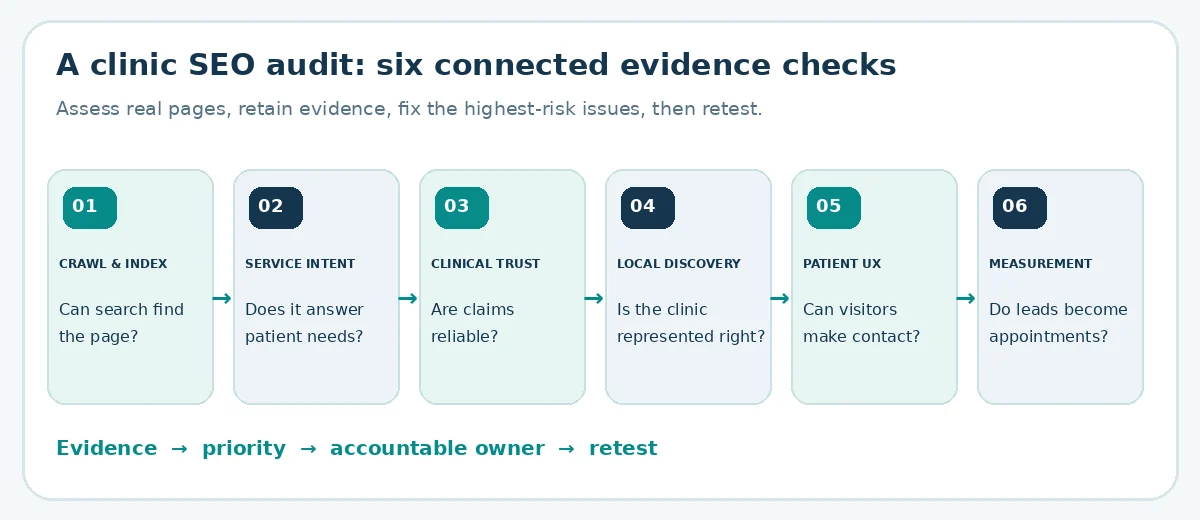
| Audit area | Core question | Typical evidence |
|---|---|---|
| Crawl and indexability | Can the intended page be found and indexed? | URL Inspection, HTTP status, canonical, sitemap, page crawl |
| Medical service intent | Does the right page answer the right service question? | Service matrix, page copy, search queries, link paths |
| Clinical credibility | Are medical claims and credentials accurate? | Approved service facts, credentials, cited clinical sources |
| Local visibility | Does each real branch appear accurately? | Verified business profiles, site addresses, branch links |
| Patient experience | Can people make contact successfully? | Mobile tests, booking confirmations, form/phone routing |
| Measurement | Can the clinic distinguish visits from outcomes? | GSC exports, consent-aware analytics, aggregate CRM stages |
The 30-point healthcare SEO audit checklist
The checks are grouped so the person who can fix an issue is clear. Use Pass / Fail / Not applicable / Not tested, and retain evidence with the check ID. A failed test is not proof that Google penalized the site; it is an operational observation requiring investigation.
Crawl & index: Can patients and search engines reach the right medical pages?
A crawler can only work with the pages it can reach. Start with the clinic’s money pages, not every low-value archive. Use Search Console’s indexed record and live inspection for different questions: indexed status describes Google’s stored view; the live test checks current accessibility but cannot promise selection for the index. See Google’s URL Inspection guidance.
T01: Key service pages are accessible
Where to verify: GSC URL Inspection (indexed report and live test); HTTP response. Pass condition: intended pages return content, are not blocked, and are eligible for indexing; record indexed and live status. Evidence: save a dated screenshot/export or approved redacted test record tagged T01. Priority / owner: P0; SEO / developer.
A page that cannot be crawled or indexed cannot reliably earn organic discovery.
T02: Robots, noindex and canonical agree
Where to verify: Source HTML; response headers; robots.txt; GSC Google-selected canonical. Pass condition: important canonical pages do not accidentally carry noindex or conflicting canonical instructions. Evidence: save a dated screenshot/export or approved redacted test record tagged T02. Priority / owner: P0; Technical SEO.
An unintended exclusion or wrong representative page can suppress the right service URL.
T03: XML sitemap reflects intended pages
Where to verify: Sitemap index; individual XML sitemaps; GSC Sitemaps report. Pass condition: important canonical 200-status URLs appear; redirects, noindex and errors are excluded where practical. Evidence: save a dated screenshot/export or approved redacted test record tagged T03. Priority / owner: P1; SEO / developer.
Sitemaps aid discovery and diagnosis but do not guarantee indexing.
T04: Internal links and redirects work
Where to verify: Crawl key templates and all clinic service pages; inspect 3xx chains and 4xx. Pass condition: no important navigation or contextual link ends in a broken page or avoidable chain. Evidence: save a dated screenshot/export or approved redacted test record tagged T04. Priority / owner: P1; SEO / developer.
Patients and crawlers need reliable pathways to relevant care information.
T05: Google can render critical page content
Where to verify: GSC URL Inspection > Test live URL > View tested page; compare rendered DOM. Pass condition: services, locations, CTA labels and page copy are visible without essential blocked scripts. Evidence: save a dated screenshot/export or approved redacted test record tagged T05. Priority / owner: P1; Developer / SEO.
A browser-only feature may not be reliably available in every search crawler.
Service intent & on-page: Do service pages reflect real patient needs, and can visitors navigate them?
Review the actual service-to-location inventory with operations before writing more content. “Dermatology consultation” and “mole assessment” may represent separate tasks for patients, but only separate them into canonical pages when the clinic can supply meaningful distinct information. An impressive H1 or long page does not compensate for inaccurate availability.
S06: Each priority service answers one distinct search task
Where to verify: Service-page inventory; title, H1 and page body; Search Console landing queries. Pass condition: each important medical service has a useful, differentiated canonical page. Evidence: save a dated screenshot/export or approved redacted test record tagged S06. Priority / owner: P1; SEO / clinic lead.
Duplicating thin service pages dilutes clarity and creates avoidable overlap.
S07: Service pages explain real care decisions
Where to verify: Priority service pages; clinic-approved service and process descriptions. Pass condition: pages accurately cover who the service is for, how contact works, and real availability without medical overclaims. Evidence: save a dated screenshot/export or approved redacted test record tagged S07. Priority / owner: P1; Clinical content owner.
Patients need clear next steps, not only keywords and generic marketing copy.
S08: Locations and service availability match reality
Where to verify: Service-location matrix; clinic operations; site location pages. Pass condition: only services genuinely available at each location are presented as available there. Evidence: save a dated screenshot/export or approved redacted test record tagged S08. Priority / owner: P1; Clinic operations.
Incorrect branch/service pairings create unqualified calls and damage trust.
S09: Titles and headings describe the page
Where to verify: Inspect <title>, visible headings, descriptions and rendered snippets. Pass condition: clear, unique title and main heading aligned with search intent; no misleading promise. Evidence: save a dated screenshot/export or approved redacted test record tagged S09. Priority / owner: P2; SEO / editor.
Readable titles and headings help humans and search engines understand a page.
S10: Patients can navigate related topics
Where to verify: Service hub, doctor profiles, specialties, clinic pages; crawl inlinks. Pass condition: contextual links to relevant services, locations and contact routes work without keyword stuffing. Evidence: save a dated screenshot/export or approved redacted test record tagged S10. Priority / owner: P1; SEO / content.
A helpful pathway matters more than mechanically increasing link counts.
Clinical credibility: Is health-related content accurate, trustworthy, permissioned and appropriately cautious?
Health content is especially sensitive because mistakes can affect care decisions. Google’s people-first content guidance emphasizes reliability and trust for health-related topics. The SEO lead should not independently decide clinical accuracy: route factual verification to the accountable clinic representative and record the basis for the decision.
M11: Clinician names and credentials are verified
Where to verify: About and provider profiles; licensing or professional registry where applicable. Pass condition: published roles, qualifications and practice locations are approved and current. Evidence: save a dated screenshot/export or approved redacted test record tagged M11. Priority / owner: P0; Clinic owner.
Incorrect provider credentials are high-stakes trust problems.
M12: Medical information has accountable sources
Where to verify: Medical information pages; linked reputable sources and update records. Pass condition: key clinical statements are supported and reviewed appropriately for their medical risk. Evidence: save a dated screenshot/export or approved redacted test record tagged M12. Priority / owner: P0; Clinical content owner.
Health-related content requires unusually careful accuracy and transparency.
M13: Benefits, limitations and choices are balanced
Where to verify: Treatment/service descriptions, FAQ and policy/claim copy. Pass condition: no categorical cure, zero-risk or guaranteed-outcome assertions without substantiation. Evidence: save a dated screenshot/export or approved redacted test record tagged M13. Priority / owner: P0; Clinic owner / compliance.
Misleading treatment claims can harm patient decisions.
M14: Testimonials and outcome material are legitimate
Where to verify: Reviews, claims, photos, authorizations and jurisdictional policies. Pass condition: published testimonials or before/after content are authentic, permissioned and locally compliant. Evidence: save a dated screenshot/export or approved redacted test record tagged M14. Priority / owner: P0; Clinic compliance.
Review or outcomes content must never imply unsupported success rates.
M15: Sensitive patient information is protected
Where to verify: Visible case content, image/media records, analytics policies. Pass condition: no unnecessary identifiable patient records, conditions or private data appear in SEO assets or logs. Evidence: save a dated screenshot/export or approved redacted test record tagged M15. Priority / owner: P0; Privacy lead.
Audit evidence must not introduce new patient-privacy risks.
Local visibility: Can people find the right real clinic or practitioner location?
For physical clinics, Google Business Profile and website information should describe the same real-world organization. Google’s business-representation guidelines address eligible locations, categories and individual practitioner profiles. A branch page should earn its place through real facts, not a swapped city name.
L16: Google Business Profiles represent real locations
Where to verify: GBP manager; physical clinic locations; official eligibility guidelines. Pass condition: no duplicate or virtual-office profiles; categories and names reflect reality. Evidence: save a dated screenshot/export or approved redacted test record tagged L16. Priority / owner: P0; Local SEO / owner.
An ineligible profile creates a real risk of visibility and account issues.
L17: Location details are current and consistent
Where to verify: GBP, site footer, contact/location pages and operational hours. Pass condition: phone, address, opening hours and appointment availability match approved records. Evidence: save a dated screenshot/export or approved redacted test record tagged L17. Priority / owner: P1; Operations / local SEO.
Inconsistent details produce failed visits and missed inquiries.
L18: Profile links land on the right location
Where to verify: Each GBP website/booking URL; mobile click tests. Pass condition: users reach the specific location or applicable service, not an unrelated branch. Evidence: save a dated screenshot/export or approved redacted test record tagged L18. Priority / owner: P1; Local SEO.
Local intent is lost if people land on the wrong destination.
L19: Doctor and department profiles follow eligibility
Where to verify: Profiles for physicians, departments and organization; GBP rules. Pass condition: practitioner/department profiles exist only where eligible and correctly represented. Evidence: save a dated screenshot/export or approved redacted test record tagged L19. Priority / owner: P1; Owner / local SEO.
Duplicate or misleading profiles can create confusion and enforcement risk.
L20: Location pages contain genuine differences
Where to verify: Compare all location URLs, service matrix and personnel details. Pass condition: pages show real address, team, services and directions; not city-name substitutions. Evidence: save a dated screenshot/export or approved redacted test record tagged L20. Priority / owner: P1; Content / clinic lead.
Distinct location information is more useful than doorway-style copies.
UX & appointment path: Can a patient act on what they find, comfortably and reliably?
Audit from the perspective of a person searching on a phone while trying to book care. Poor mobile usability, confusing location selection and broken calls can erase the value of organic visibility. Core Web Vitals offer useful field signals, but passing them does not guarantee rankings or patient appointments.
U21: Mobile contact actions work
Where to verify: 360-390px phone and desktop live test; keyboard navigation. Pass condition: call, request appointment and directions controls can be used without obstacles. Evidence: save a dated screenshot/export or approved redacted test record tagged U21. Priority / owner: P0; UX / developer.
Visibility is not useful if patients cannot make contact.
U22: Forms, calls and booking routes are tested
Where to verify: Submit test form; verify phone/email handoff; booking confirmation. Pass condition: a test inquiry reaches the intended queue without collecting unnecessary medical details. Evidence: save a dated screenshot/export or approved redacted test record tagged U22. Priority / owner: P0; Operations / developer.
A broken lead route can make reports look healthy while clinics lose bookings.
U23: Core Web Vitals and page stability are reviewed
Where to verify: GSC Core Web Vitals; PageSpeed Insights field data where available. Pass condition: investigate poor LCP/INP/CLS field experience; avoid treating lab scores as rank guarantees. Evidence: save a dated screenshot/export or approved redacted test record tagged U23. Priority / owner: P2; Developer.
Fast, stable, usable pages support patient experience.
U24: Content is accessible and understandable
Where to verify: Mobile reading test, headings, captions, alt text, contrast and forms. Pass condition: important content is readable and controls have usable labels and focus behavior. Evidence: save a dated screenshot/export or approved redacted test record tagged U24. Priority / owner: P2; UX / editor.
Patients have varied devices and accessibility needs.
U25: Practical booking details are findable
Where to verify: Service/FAQ/contact pages; ask reception for recurring questions. Pass condition: accurate appointment route, location, hours and insurance/payment caveats appear where useful. Evidence: save a dated screenshot/export or approved redacted test record tagged U25. Priority / owner: P1; Operations / content.
Unanswered logistics questions create avoidable inquiries and drop-offs.
Measurement & action: Can the practice separate visibility from worthwhile appointment outcomes?
Google Search Console measures discovery and search clicks; a receptionist or booking system knows whether an actual appointment happened. These are different datasets with different limitations. Build an aggregate, privacy safe reporting chain before attributing revenue or patient outcomes to SEO.
A26: Search Console establishes a baseline
Where to verify: GSC Performance by page/query; indexing; fixed 8-12 week baseline where appropriate. Pass condition: save query and page exports, non-brand groupings, country/device and comparison dates. Evidence: save a dated screenshot/export or approved redacted test record tagged A26. Priority / owner: P1; SEO / analyst.
A reproducible baseline helps distinguish improvement from seasonality or brand demand.
A27: Contact events are lawful and deduplicated
Where to verify: GA4/GTM/CRM with consent controls; test phone, form and booking events. Pass condition: only relevant events fire, no duplicated conversions and sensitive health data are excluded. Evidence: save a dated screenshot/export or approved redacted test record tagged A27. Priority / owner: P0; Analytics / privacy lead.
Counting duplicates or transmitting sensitive data distorts decisions and may create risk.
A28: Inquiries are separated from patients
Where to verify: CRM/reception summary; anonymized weekly funnel by service. Pass condition: track inquiries, qualified contacts, booked and attended appointments as distinct stages. Evidence: save a dated screenshot/export or approved redacted test record tagged A28. Priority / owner: P1; Operations / analyst.
Click or form volume alone cannot establish patient acquisition.
A29: Performance is segmented sensibly
Where to verify: GSC pages/queries and CRM by service, location and period. Pass condition: compare like-for-like services, branches, brand/non-brand and reporting windows. Evidence: save a dated screenshot/export or approved redacted test record tagged A29. Priority / owner: P1; SEO / analyst.
Aggregate traffic may hide the service line that needs intervention.
A30: Findings have owners and retest dates
Where to verify: Audit register and weekly issue meeting. Pass condition: every confirmed issue logs evidence, severity, owner, fix, date and retest outcome. Evidence: save a dated screenshot/export or approved redacted test record tagged A30. Priority / owner: P1; Clinic lead / SEO.
A checklist only creates value when verified problems are resolved.
Worked example: a two-location dermatology clinic
Illustrative scenario, not a real audit or DigiTaTop result. A dermatology group operates two physical clinics. The marketing report shows more organic visits, but reception says several appointment requests are sent to the wrong branch. The owner wants to know whether to rewrite every service page or first repair the inquiry route.
A focused audit uses the service-location matrix and discovers three distinct issues:
| Finding | Evidence to record | Priority | Appropriate next action | Retest |
|---|---|---|---|---|
| The location page links to the other branch’s booking route | Capture the exact landing URL, button destination and controlled booking test | P0 | Correct destination for the affected branch; ask reception to verify | Submit a second test from mobile and desktop |
| One important service page has a conflicting canonical | GSC inspected URL, page-source canonical and sitemap entry | P0/P1 depending on impact | Resolve the canonical mismatch; do not redirect or delete content without analysis | Re-inspect and monitor indexed status over time |
| General clinic blog entries receive visits but no qualified inquiries | GSC page-query export and aggregate inquiry-stage report | P1 | Improve relevant contextual links; check content intent and scheduling information | Compare a like-for-like period after changes |
The first fix is the wrong branch booking route, not a new article campaign. The canonical issue can affect discovery and deserves technical diagnosis. A blog with informational traffic is not automatically low quality just because it does not convert like a service page; measure each asset against its intended purpose.
How to prioritize and close an SEO audit
A useful healthcare SEO audit results in a short, owned remediation register, not 100 screenshots with no decisions. Give every finding a unique ID and include a reproducible test. A practical issue record can look like this:
| Field | Example |
|---|---|
| Page | /locations/north-clinic/ (fictional) |
| Observation | Appointment button opens the other branch’s booking form |
| Evidence | Mobile screenshot and redacted test inquiry, November review |
| Risk | Incorrect patient routing; avoidable scheduling delay |
| Priority and owner | P0; clinic operations and web developer |
| Fix | Update branch specific booking URL; confirm which service is offered |
| Retest | Repeat an inquiry from a phone and verify the destination queue |
| Outcome | Pending until a responsible person confirms the retest |
First week: complete the representative-page review, confirm any urgent patient-facing errors and assign a fix owner. Weeks two and three: repair important canonical, linking, service-intent and local information issues that are supported by evidence. Week four: run retests, annotate changes, and review Search Console and aggregate inquiry data. Some search effects take longer than 30 days to emerge; a review cycle is not a ranking deadline.
The downloadable CSV tracker mirrors all 30 checks and includes the pass condition, issue priority, evidence reference, assigned owner, fix status and retest date. The printable worksheet is suitable for a meeting with clinic management, reception, the website team and an SEO specialist.
Which healthcare SEO metrics should a clinic measure?
Use the right denominator for each question. Indexed pages and non-brand impressions are visibility signals; they are not patients. Organic inquiries depend on a working contact route, and attended appointments depend on capacity, response times and patient choice. Use only aggregate or appropriately handled records and respect applicable privacy requirements.
| Metric | What it answers | Important limitation |
|---|---|---|
| Search Console impressions and non-brand clicks | Is the clinic becoming discoverable for relevant searches? | Rankings and clicks fluctuate by query, geography and device |
| Organic service-page entry and engagement | Are patients reaching useful service information? | Pageviews alone do not establish clinical or commercial impact |
| Tracked contact requests | Did a user attempt an appointment or ask a question? | Duplicate events and failed delivery can inflate counts |
| Qualified appointment inquiries | Does the inquiry concern an available service or branch? | Requires a consistent reception/CRM definition |
| Booked and attended appointments | Did scheduling progress to a confirmed visit? | Do not attribute all patients to SEO without a defensible methodology |
Avoid reporting a fictional “SEO ROI” from a hypothetical click funnel. A genuine financial evaluation requires actual costs, verified incremental contribution and an attribution method suited to the clinic. For a description of the broader service and how an audit fits into implementation, see DigiTaTop’s Medical SEO services page.
Healthcare SEO audit FAQs
What is the first thing to check in a healthcare SEO audit?
Start with a priority service URL. Confirm the page is accessible and indexable, medically accurate and linked to a functioning appointment route. A severe issue in any of those areas deserves more attention than cosmetic SEO changes. Use Search Console URL Inspection alongside an actual browser test.
How often should a medical clinic audit its SEO?
A brief monthly check of critical pages, business information and conversion routes is useful; a deeper quarterly or change-triggered audit helps with migrations, new services, new locations and meaningful traffic shifts. This is a practical maintenance cadence, not a rule set by Google.
Does an SEO audit guarantee more patients?
No. An audit identifies observable issues and opportunities. Search rankings, patient decisions, clinic capacity, competition and contact handling all influence outcomes. A completed technical fix is evidence of implementation, not evidence of additional patients.
Can a clinic do the audit without an agency?
Yes. An owner or marketing lead can test appointments, verify clinic information and inspect a few URLs. More complex canonical, JavaScript, analytics and migration problems may need specialist work. Assign clinical factual decisions to the clinic, not solely to an SEO tool.
How does a healthcare SEO audit differ from a generic SEO audit?
It includes the usual technical and content checks, but also verifies real service availability, clinical accuracy, provider identity, eligible business profiles, location-specific appointment routing and the distinction between website contacts and attended patients.
Is a Google Business Profile audit part of medical SEO?
For eligible physical practices, yes. Check the profile against real-world location information, categories, website and booking links, and practitioner eligibility. This checklist is not a substitute for the full Google Business Profile guidelines or for local compliance checks.
Should we fix every red or warning result from an SEO tool?
No. Investigate whether it affects the intended page and patient task. A missing minor label is not equivalent to an index exclusion or a broken appointment route. Group related findings, document evidence and prioritize confirmed impact.
How do we audit SEO for AI-generated search answers?
Start with the same foundations: accessible, indexable, accurate, useful pages with clear attribution and genuine healthcare information. Google says AI features rely on core Search eligibility and do not require extra AI-specific technical markup. Monitor ordinary search performance and AI referrals or citations separately rather than promising inclusion.
Build the next step from verified findings
A clinic rarely needs every possible SEO service at once. If your audit finds important indexing exclusions, fix technical access first. If service pages are thin or inaccurate, clarify their real clinical purpose. If a location is misrepresented, correct that at the source. If clicks rise but bookings do not, test the contact route and the practice’s inquiry handling before increasing content volume.
DigiTaTop’s healthcare SEO team can help interpret technical, content and local findings within a practical improvement plan. For a broader library, browse the healthcare marketing Resources hub, or see how these questions arise for medical clinics and private practices. If you want to discuss the specific clinic, service lines and branches involved, contact DigiTaTop. The next step should be based on documented issues, not a generic SEO score.
Sources and methodology
This checklist draws on Google’s Search Essentials, URL Inspection documentation, people-first content guidance, Core Web Vitals documentation, Google Business Profile guidelines, local business structured-data guidance, and AI-search guidance. These sources describe platform tools and expectations; the prioritization framework and fictional clinic example are educational interpretations, not audit data or guarantees.




[…] a wider technical diagnosis, use the healthcare SEO audit checklist. Keep the full audit on that page and the measurement definitions […]