
Orthopedic Marketing Agency for Surgeons & Clinics
DigiTaTop is an orthopedic marketing agency helping surgeons, orthopedic clinics and sports medicine practices improve how patients and referrers find and contact the right team. Connect clinician profiles, service information, clinic locations and consultation pathways through SEO, websites and eligible paid-search campaigns.
Start with a scoped assessment of your practice’s search visibility, website and enquiry journeys, tailored to your United States, United Kingdom or agreed target market.

An Orthopedic Marketing Agency Built Around Real Patient Pathways
Effective online marketing for an orthopedic practice is more specific than promoting a generic “bone and joint” service. Your digital presence needs to reflect who provides care, which musculoskeletal problems they assess, which services and procedures are actually offered, and where appointments or referrals are accepted. The boundaries matter: an orthopedic surgeon, a non-surgical sports medicine physician, an MSK physiotherapist and a hospital orthopaedics department should not be presented as interchangeable.
Practices comparing an orthopedic digital marketing company should ask whether the proposed strategy reflects actual surgical, non-surgical and referral pathways, not just a generic list of marketing channels.
Our orthopedic digital marketing work can support:
- Orthopedic surgeons and consultant orthopaedic surgeons: establish searchable surgeon profiles, approved scope of practice, subspecialties and the appropriate consultation or referral route.
- Independent orthopedic clinics: organize conditions, treatments, locations and clinician availability without duplicating near-identical local pages.
- Sports medicine and injury services: separate clinical assessment, non-operative management, rehabilitation coordination and surgical referrals according to the actual service offering.
- Hip and knee replacement practices: connect joint-specific patient questions to qualified clinicians, appropriate consultations and medically reviewed treatment information, not promises about surgery.
- Spine, shoulder, hand and other musculoskeletal specialists: present actual expertise and referral pathways without implying every practice offers every subspecialty.
- Multi-location groups and hospital departments: make it clear which provider and service is available at each location and how referrals move between primary care, diagnostics and specialist teams.
For wider provider strategies, see our marketing for doctors and medical specialists, medical clinic marketing and hospital marketing pages.
Our Orthopedic Practice Growth Framework
Orthopedic practice growth starts by understanding which enquiries the organization can appropriately serve, not by purchasing more traffic. DigiTaTop’s proposed planning framework links a verified service inventory with search demand, trusted information and a measurable next action. The process sets out what we verify, improve and measure.
- Verify supply. Record clinicians, qualifications, offered procedures and non-surgical services, accepted referral routes, real locations and appointment capacity with the practice team.
- Map buyer intent. Separate named-specialist searches from clinic, sports injury, joint-replacement and referring-professional searches. Match each search intent to the relevant clinician, service or referral page.
- Create trustworthy proof. Show confirmed clinician expertise, relevant hospital/clinic locations, clinically reviewed service explanations, actual booking requirements and approved sources.
- Remove enquiry friction. Route every CTA, call and form to the team that can handle that service and location; provide a separate professional-referral path when offered.
- Measure qualified outcomes. Review page-level discovery, source, completed enquiries, valid referral contacts and conversion quality using privacy-appropriate analytics rather than counting every click as a patient.
Illustrative Orthopedic Acquisition Journey
Hypothetical planning example. Consider an independent group that actually offers knee consultations, non-surgical sports medicine and hip/knee replacement assessment across two clinics. We would first confirm which clinicians work at each site; create or refine the main orthopaedic/orthopedic clinic page, accurate surgeon profiles, specific consultation-service pages and distinct location pages; link medically reviewed questions to the correct service; and make the referral and appointment requirements visible at every step. A search for an available surgeon should reach a confirmed clinician page, not a generic blog article. A sports injury enquiry should not be routed straight into a replacement surgery form.
The model’s success criteria would be fewer incorrect destinations, more complete qualified enquiries, and an auditable path from relevant search to appropriate consultation or referral, measured against a real baseline after implementation. Whether SEO, paid search or a redesign comes first depends on the actual evidence and the practice’s resources.
Orthopedic SEO and Search Intent
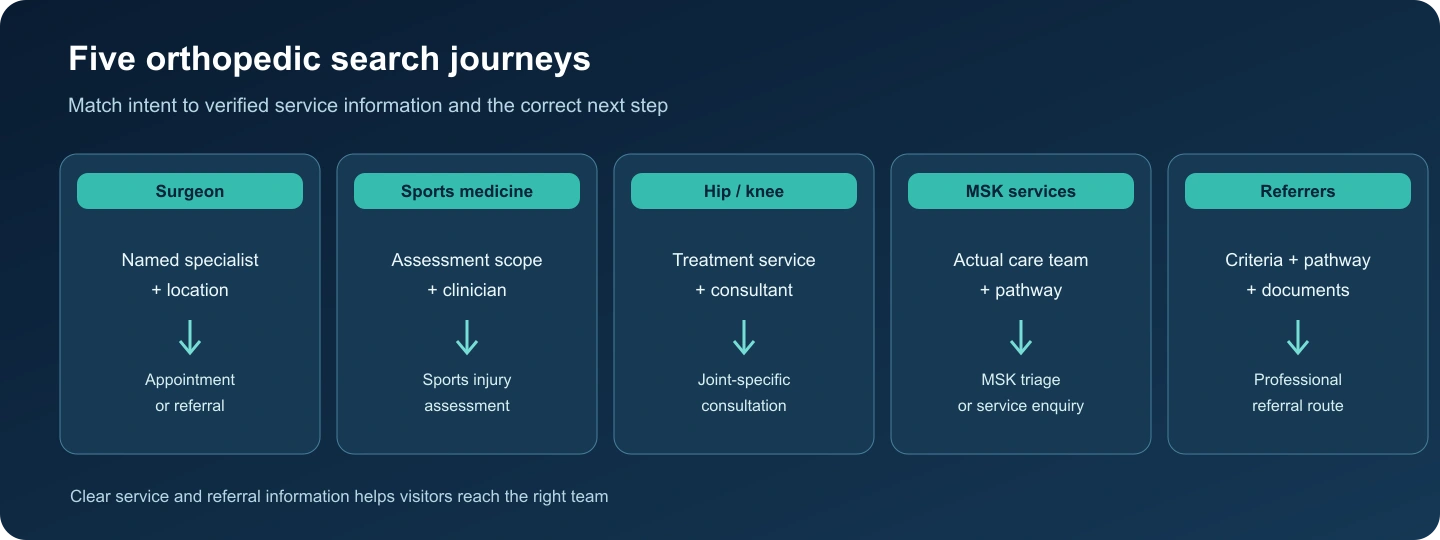
Orthopedic SEO connects commercially important searches with pages that answer a real decision. Instead of creating one page for every loosely related phrase, we map keywords to an intent, a service, a clinical owner and an appropriate next action. Our approach to SEO for orthopedic practices covers technical foundations, on-page structure, clinician and location profiles, medically reviewed content and measurement. It can also support practices looking for orthopedic SEO experts rather than a generalist agency.
Orthopedic SEO Strategy: Clinician, Condition, Service and Location
An orthopedic search architecture usually begins with the practice and its people, then branches to verified clinical services and relevant locations. A knee assessment service may deserve its own page; a hip replacement consultation page should exist only when that service is genuinely available. Informational explanations about symptoms or surgery decisions can support those pages but should not pretend to provide a diagnosis or treatment recommendation.
| Searcher intent | Page or information needed | Responsible conversion path |
|---|---|---|
| “orthopedic surgeon near me” / “orthopaedic consultant [city]” | Verified specialist profile, clinic address, scope and availability | Consultation enquiry or referral guidance |
| “sports medicine clinic” / “knee sports injury specialist” | Sports medicine team, assessment scope and services | Suitable assessment request, not a surgery promise |
| “hip replacement surgeon” / “knee replacement consultation” | Approved surgeon, procedure scope, hospital or clinic, expectations | Consultant assessment or established referral process |
| “orthopedic clinic [location]” | Actual branch services, accessibility and clinician schedule | Location-specific contact or appointment request |
| “MSK referral” / “orthopaedic referral” | Referral criteria, documents and routing instructions | Professional referral channel where available |
Each target page should answer the immediate question, identify the qualified provider and make the next step visible. Supporting content should link into the most relevant clinical service page, not compete with it for the same term. Our healthcare SEO services cover technical SEO, content architecture and on-page improvements across the broader healthcare site.
Technical and On-Page Improvements That Matter
We review crawlability and indexing settings; canonical URLs and redirects; mobile usability and performance; heading structure; metadata; accessible navigation; structured data accuracy; clinician-service-location connections; and internal links. For a website redesign, protecting established useful URLs and search signals matters as much as improving the new interface. We avoid thin “near me” pages, copied condition text and location pages that claim a surgeon attends clinics where they do not practise.
Orthopedic Marketing by Service Line
The most valuable orthopedic patient acquisition opportunities differ by subspecialty. This sample planning matrix helps practices evaluate where a dedicated service page, specialist profile or referral pathway adds genuine value. It describes possible marketing approaches, not clinical recommendations or unverified services.
| Practice or service line | Search and content emphasis | Suitable enquiry or referral route |
|---|---|---|
| Orthopedic surgeons | Named surgeon, subspecialty, credentials, consultation sites and verified expertise | Surgeon consultation or approved professional referral |
| Orthopedic clinics | Clinic specialty mix, clinician availability and actual service-by-location coverage | Location-specific appointment request |
| Sports medicine | Injury assessment services, non-operative management and clinician roles | Sports medicine assessment with rehabilitation or referral information where offered |
| Joint replacement | Hip/knee replacement assessment, surgeon profile and pre-consultation information | Specialist evaluation; never imply surgery is always necessary |
| Spine, shoulder, hand and other MSK services | Only confirmed clinical teams and specific assessment services | Appropriate service enquiry, not automatic inclusion of unoffered procedures |
| Orthopedic groups and hospitals | Cross-location provider discovery, consultant selection and referral information | Verified clinic, department or referrer intake |
Joint replacement marketing and sports medicine marketing need different consultation information, clinician profiles and enquiry routes. We tailor the plan to the practice’s actual surgical or non-surgical services.
Local SEO for Orthopedic Practices
Local visibility is often the first commercial touchpoint for clinic, surgeon and sports medicine searches. Local SEO for orthopedic surgeons and practices requires consistent practice identities, actual locations, eligible Google Business Profiles, relevant business categories, helpful reviews and location pages that reflect real-world operations. A surgeon who attends two locations and a clinic with several practitioners may require different profile and landing-page structures.
DigiTaTop can assess profile completeness, NAP consistency, clinician and branch relationships, services, appointment destinations, photos, reviews, local citations and conversion actions. Our healthcare local SEO approach is designed around genuine business presence, not fictitious branches, keyword-stuffed titles or duplicate practitioner profiles.
For US audiences, we use verified local phrases such as orthopedic clinic marketing and provider/location searches; for UK audiences, orthopaedic SEO and consultant/referral vocabulary may better describe the same discovery task. We validate local terminology against actual searches, not assumed search volume. The site should specify whether a patient can book directly or needs a referral; that differs by service, organization and pathway.
US and UK Orthopedic Marketing Differences
An orthopedic marketing strategy should reflect the organization’s market and care model. A US private practice and a UK private orthopaedic clinic can share SEO fundamentals while differing in search terminology, financing information, professional referrals and advertising responsibilities.
| Planning consideration | United States | United Kingdom |
|---|---|---|
| Search language | “Orthopedic”, surgeon, specialist and city/near-me queries | “Orthopaedic”, consultant, clinic and local/private-care queries |
| Appointment flow | Practice- and payer-specific referrals, insurance participation or self-pay details where confirmed | Private consultation, insurer arrangements or NHS referral information where applicable |
| Trust information | Verified physician identity, clinic location, service eligibility and insurance information if available | Verified consultant identity, clinic location, private access requirements and treatment information |
| Marketing review | Evaluate HIPAA applicability, analytics/PHI exposure, Google Ads policies and relevant professional rules | Evaluate applicable UK data protection, advertising standards, regulator guidance and patient-content approvals |
| Measurement | Qualified appointment enquiries and appropriate referring-professional contacts | Qualified private enquiries and appropriate referral contacts, separated by service and location |
For regulated US healthcare organizations, tracking architecture needs a privacy review before patient data is passed to vendors; HHS provides guidance about tracking technologies and protected health information, including a notice about the 2024 court order affecting part of that guidance. For UK clinician-facing marketing, the General Medical Council’s guidance emphasizes accurate, non-misleading communications. Requirements depend on the individual organization and its activities; agency content is not legal or clinical advice.
We adapt the website and campaigns to your actual service model, local terminology and consultation pathways in each target market.
Orthopedic Web Design and Consultation Conversion
A strong orthopedic website design helps prospective patients assess fit before they enquire. It should make the differences between sports injuries, joint replacement, surgical consultation and rehabilitation clear without presenting the website as a substitute for clinical assessment. Whether your project involves an orthopedic website redesign, a new clinic launch or a multi-location platform, we build the user journey around accurate care information.
An effective orthopedic site typically needs searchable clinician profiles, service-specific pages, precise locations, verified hospital affiliations where appropriate, clear appointment and referral instructions, accessible forms and mobile-friendly contact options. When selecting an orthopedic web design company, ask how it will retain useful URL equity, accommodate clinical review and connect each service to its booking or referral route. Cost, insurance, funding or self-pay information can be valuable when available and approved, but it must be localized and kept current.
What We Review Before Recommending a Redesign
- Site structure: can visitors move from condition or service information to the clinician and clinic actually providing the service?
- Enquiry friction: do appointment links, calls and forms reach the right team, and can referrers find a professional route?
- Content trust: are qualifications, clinical responsibilities, outcomes claims and review processes documented and approved?
- Technical risk: are existing high-value URLs, redirects, canonical signals, structured data and measurement preserved?
- Accessibility: are navigation, forms, contrast, images and mobile layouts usable without reliance on visual-only controls?
We scope healthcare website design and conversion optimization to the needs of the practice, rather than proposing a rebuild before diagnosing the existing site.
Different Orthopedic Patient Journeys

Orthopedics covers several distinct service lines. A generic “treatments we offer” page may conceal the very information patients and referrers need. Our content and conversion planning makes the distinctions explicit.
Sports Medicine and Injury Assessment
Sports medicine SEO supports searches about appropriate clinicians, assessment availability, recurring sports injuries and pathways into rehabilitation or specialist treatment. Content may cover a practice’s verified approach to knee, shoulder, ankle or overuse concerns, but must not imply that every sports injury needs imaging or surgery. A sports medicine physician is not necessarily an orthopedic surgeon; individual credentials and offered services should be explicit. Marketing can also address referring physiotherapists, coaches and other clinicians where an approved referral route exists.
Hip and Knee Replacement Consultations
Someone evaluating hip or knee replacement is often comparing clinicians, hospital locations, eligibility for assessment, practical preparation information and the process of deciding whether surgery is appropriate. Content should explain that treatment decisions are made through individual clinical assessment. A responsible service page should not assert that a particular procedure is always needed, always effective, painless or risk-free. Approved explanations can include who provides consultations, where procedures are undertaken, how referral or private booking works, and which follow-up resources are available.
Musculoskeletal, Spine, Shoulder and Specialist Services
Some orthopedic practices include spine, shoulder, hand, foot and ankle, trauma or pediatric services; others do not. We use only confirmed subspecialties, clinicians and locations to determine which pages deserve a place in the website. MSK services may include non-surgical assessment and multidisciplinary support, depending on the provider. A fracture or emergency pathway should never be represented as a routine marketing-booking form unless the provider explicitly operates that route.
Explore healthcare SEO and content planning for service-line education, specialist content planning and a controlled clinical review process.
Google Ads and PPC for Orthopedic Surgeons
Search campaigns can reach users looking for a named specialist, a verified clinic service or an available orthopedic consultation. Campaign planning should identify whether the landing-page offering is clinician-led, clinic-level, sports-medicine or surgical-assessment related. An orthopedic PPC agency should separate brand queries from service queries, identify eligible locations, align ad copy to the real appointment offering and audit conversion tracking before it claims lead performance. We prioritize eligible, high-intent campaigns over broad traffic acquisition.
Paid search for medical services requires extra controls. Google’s personalized advertising policy restricts certain targeting based on sensitive health interests, including some surgical and long-term-condition contexts; creative, targeting and landing pages need a market- and campaign-specific review. Campaigns aimed at patients and those aimed at referring professionals need separate audience and policy assessments. We do not propose condition-based remarketing or upload patient lists without a properly vetted lawful basis and platform eligibility.
Landing pages should state who delivers the service, which location is available, how to make an enquiry and whether a referral is required. Call tracking and analytics must be reviewed for privacy and consent; sensitive patient details should not be pushed into routine marketing platforms. See our healthcare PPC and Google Ads services.
Content Marketing, Professional Trust and AI Search
A credible orthopedic content strategy should be useful to patients and referring professionals. The strongest materials typically answer clear questions about care pathways, clinician roles and practical logistics, with medical review for clinical statements. Content marketing for an orthopedic practice may include surgeon profiles, appropriate treatment-service explanations, consultation preparation guidance, referrer information, and an editorial library that links back to the right commercial pages.
For Google, Bing and AI-powered search, the practice should be easy to identify as a consistent real-world entity. Clear, source-backed information helps people and search systems understand the practice. We connect practitioner names and verifiable qualifications with confirmed services, practice locations and source-backed facts. Pages should answer direct questions in plain language, explain restrictions or uncertainty and distinguish a general educational article from a bookable clinic service. Clear source attribution and consistent terminology make those relationships easier to understand.
Our healthcare AI search optimization and medical SEO approaches work together: crawlable content, structured navigation, clinical review, authority signals and accurate linked information across relevant channels.
Information That Helps Patients, Referrers and AI Systems
A high-value orthopedic page should quickly answer four questions: Who is qualified to provide this service? Where is it available? What happens before a consultation or referral? How does someone take the next appropriate step? To make those answers checkable, practices should attach approved clinician details, dated service information, real clinic addresses, relevant guidance and a responsible medical review process when the content contains clinical claims.
We can also assess whether site pages are referenced consistently in Google, Bing and AI-supported discovery, recording actual mentions and citations to inform future improvements. See our healthcare AI-search strategy for the wider approach.
Reputation, Reviews and Ethical Healthcare Advertising
A trusted orthopedic practice needs a consistent account of its team, services and patient experience. We can review how legitimate feedback is requested and responded to, whether site testimonials have adequate permission, and whether before-and-after or outcome narratives are balanced and approved. We support genuine feedback and clinically reviewed, permissioned practice information.
US practices should assess advertising and privacy obligations relevant to their organization; UK practices should assess applicable professional, advertising and data-protection rules. These are operational review requirements, not a claim that any one legal regime automatically applies to every clinic. Where patient data may enter forms, call systems or analytics, governance needs to precede implementation.
We align responsible healthcare marketing services and medical branding with the clinician’s real professional identity and the practice’s approved clinical messaging.
How to Choose an Orthopedic Marketing Agency
A practice evaluating an orthopaedic marketing agency or US orthopedic marketing partner should look beyond a broad list of channels. Ask potential agencies for an example of how they would distinguish surgery consultations from non-surgical sports medicine, preserve validated clinician information and avoid creating misleading procedure pages. Then assess whether the proposal explains:
- Clinical content governance: who verifies clinician roles, service availability, referral rules and clinically sensitive statements?
- Search ownership: which page owns each commercial query, and how are overlapping service/location pages consolidated?
- Marketing measurement: what defines a qualified enquiry versus a click, and which systems legitimately receive the data?
- Platform and privacy compliance: how are Google Ads policies, tracking permissions and location-specific requirements checked before launch?
- Delivery transparency: which deliverables, decision points, access permissions and approval responsibilities are documented?
- Asset ownership: who controls the domain, analytics properties, GBP access, page content, creative assets and ad accounts?
DigiTaTop’s approach is to make those questions part of the assessment rather than asking a practice to accept unsupported projections. Compare our healthcare marketing service options and review healthcare marketing packages to see how an agreed scope can be assembled.
Orthopedic Marketing Assessment and Deliverables
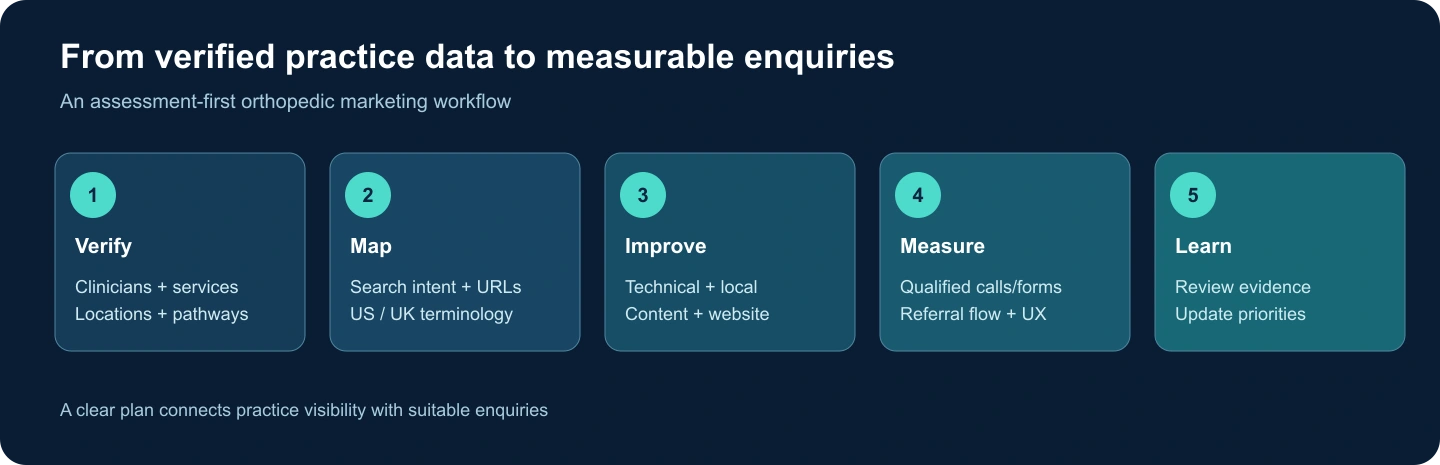
Request your orthopedic practice marketing assessment. Our first step is a discovery conversation to understand the services you provide, which US/UK locations you serve, the desired enquiry type and the data available for review. We then agree the assessment scope, what will be delivered, the required access, responsible reviewers, schedule and any fee before work begins. The purpose is to identify what stops a qualified visitor or referrer from finding, evaluating or contacting the right practice team, not to sell every channel by default.
| Workstream | What the assessment delivers | Decision it supports |
|---|---|---|
| Search and keyword architecture | Intent clusters, current URL mapping, content gaps and cannibalization risks | Which pages to retain, improve or create |
| Technical SEO and website | Crawl/index checks, mobile UX, tracking, internal links and critical fixes | Which blockers need attention first |
| Local and practitioner visibility | Real-location pages, eligible profiles, service/clinician mapping and review process | Where local visibility can improve responsibly |
| Enquiry and referral journeys | Form/call path assessment, referral flow and destination checks | How to reduce qualified-enquiry friction |
| Paid search feasibility | Policy screening, landing-page review, audience/intent plan and measurement requirements | Whether and where paid campaigns make sense |
| AI-search readiness and credibility | Direct-answer content, entity consistency, source/reviewer needs and structured data | How to make clinical information clearer and verifiable |
Your assessment can produce a prioritized findings summary, keyword-to-URL opportunity map, conversion-path recommendations, a 30/60/90-day action outline and a defined measurement plan, according to the agreed scope. The resulting priorities distinguish critical fixes, commercial quick wins and longer-term authority building. Each proposed task can be assigned an owner, dependency, approval status and measurement method. We can review an existing site or evaluate an upcoming clinic launch; the required scope depends on access, locations, available data and the practice’s service mix.
Request an orthopedic marketing assessment · View healthcare marketing packages and pricing
A Practical First 90 Days
Days 1-30, Understand and unblock. Confirm the actual service and provider inventory, US or UK market focus, referral and booking routes, analytics permissions and baseline. Resolve high-impact crawl, technical, local-profile and enquiry-routing problems that are supported by the audit.
Days 31-60, Improve high-intent pages. Refine the main practice and service pages, specialist profiles, site navigation, local information and relevant internal links. Prepare clinically reviewed content and, where eligible, carefully scoped paid-search tests. Prioritization is based on baseline evidence and available resources, with the delivery schedule confirmed in your proposal.
Days 61-90, Validate and iterate. Review qualified organic enquiries, form and call completion, local engagement, relevant rankings, search impressions and click-through rates where the data is available. Examine lead quality with the practice team and adjust copy, page architecture and campaigns accordingly. More extensive gains in search authority require continuing work beyond an initial quarter.
We measure progress through verified improvements to discovery and enquiry quality against your starting position.
Why Work With DigiTaTop Agency?
Our difference is a service-verification-first approach: the marketing plan begins with confirmed clinicians, real locations, clinical-service ownership, referral rules and appropriate conversion outcomes. Your proposal makes the planned work, approvals and measurement clear. DigiTaTop focuses on healthcare marketing decisions that require clinical accuracy and commercial clarity at the same time. For orthopedic practices, this means mapping named clinicians to offered services; respecting surgical and non-surgical distinctions; supporting referral and appointment routes; designing around mobile users; and separating credible practice information from claims that need clinical substantiation.
We bring together orthopedic digital marketing, SEO, local discovery, orthopedic website design, paid-search planning, content governance and AI-search readiness in one accountable roadmap. You retain control of clinical approvals, verified professional details and the decision to publish. We prioritize the channels that fit your particular service model rather than treating a sports medicine service, an individual surgeon and a hospital department as the same business.
Frequently Asked Questions
What does an orthopedic marketing agency do?
An orthopedic marketing agency helps eligible practices improve how prospective patients and referrers discover, understand and contact them. Typical work includes orthopedic SEO, clinician and service pages, local search, websites, content, paid-search planning and enquiry measurement. The scope should follow confirmed services, clinical review and the practice’s goals.
How is orthopedic SEO different from general healthcare SEO?
Orthopedic SEO needs specific connections between a surgeon or MSK clinician, the conditions or services they actually manage, locations and appointment or referral routes. It also differentiates sports medicine, joint replacement consultations and other subspecialties so visitors do not land on generic or clinically misleading pages.
Can you market both orthopedic surgeons and non-surgical sports medicine clinics?
Yes. We plan distinct paths for each provider type and only describe qualifications, procedures and services that the organization confirms. A non-surgical sports medicine assessment is not advertised as orthopedic surgery, and joint replacement is not promoted as appropriate for every person with knee or hip pain.
How much does orthopedic digital marketing cost in the USA or UK?
The cost depends on the practice’s locations, number of clinicians and service lines, current website condition, required content and clinical reviews, ad-management needs and the agreed scope. SEO, websites, local visibility and PPC can be scoped separately or together; paid-media spend is distinct from agency fees. We share a written scope before any paid engagement. Review DigiTaTop healthcare marketing packages or request an assessment for a practice-specific proposal.
Can orthopedic practices use Google Ads?
Often, but eligibility depends on the specific service, location, audience, creative and applicable platform policies. Sensitive health interests restrict certain personalized targeting methods. We review the campaign and landing-page approach before launch, and we do not guarantee ad approval or a specific cost per enquiry.
How does orthopedic marketing differ between the USA and UK?
We adapt spelling and search language, referral pathways, insurance or private-pay context, advertising review and data-governance requirements. UK NHS specialist referrals and private consultation journeys can differ, while US practice workflows depend on the provider and payer arrangements. The website must describe the real local process.
How long does orthopedic SEO take to show measurable progress?
Technical fixes, tracking and clearer enquiry pathways can sometimes be assessed within the first months, while organic rankings, competitive service-line visibility and sustained qualified enquiries may take considerably longer. There is no reliable universal timeline. We establish the starting position and check crawl/index signals, impressions, relevant rankings, enquiry quality and content performance over time; no fixed ranking or patient-volume outcome is guaranteed.
How do you measure orthopedic marketing performance?
We establish a baseline for relevant search visibility, qualified forms and calls, appropriate referral enquiries and page-level conversion performance where lawful and technically feasible. Reporting should separate total traffic from enquiries that the practice can genuinely serve; changes in rankings or AI citations are observed, not guaranteed.
Request an Orthopedic Marketing Assessment
Whether your priority is orthopedic practice growth, surgeon visibility, sports medicine appointments, joint replacement consultation enquiries or accurate referral discovery, start with your actual services. Share your website, target market, locations, highest-priority specialties and any known enquiry challenges. We will discuss whether a focused assessment, site improvements or a broader marketing engagement is an appropriate next step, and clarify the proposed scope before any work is commissioned.