
Hospital Digital Marketing Agency for Hospitals & Health Systems
DigiTaTop Agency, a healthcare-focused hospital marketing agency, provides hospital digital marketing services for independent hospitals, specialty hospitals and multi-site healthcare groups in the United States and United Kingdom. We help connect the hospital brand to its real departments, facilities, clinicians, referral processes and patient-access routes through medical SEO, healthcare PPC, hospital website design, AI-search optimization, content governance and measurable digital strategy.
Service-line strategy · Multi-campus architecture · Privacy-aware measurement · US/UK hospital pathways

Hospital Marketing Must Connect Visibility to Real Access to Care
Hospitals have many routes to care, but their websites and marketing often behave as though every visitor needs the same contact page. A patient may be trying to find the right hospital campus, a particular specialist, an outpatient appointment or verified information about a service. A referring clinician needs a different pathway. An executive needs to know whether marketing activity is improving the service lines the organization can actually support.
A hospital marketing agency should not treat website sessions, emergency enquiries, specialist referrals and booked elective consultations as interchangeable conversions. The first objective is to clarify who the organization serves, which care is offered at each site, how people enter the care pathway, and which teams own the next step. When that information is accurate, digital marketing can help people discover services and navigate the institution without making unsupported clinical promises.
Hospital marketing becomes especially complex when a system brand sits above several hospitals, specialist centers, outpatient clinics and diagnostic facilities. Each location may have different operating hours, services, consultants, insurance arrangements, referral rules, availability and contact routes. A campaign can create interest while an unsuitable destination page creates confusion. We therefore plan around service availability, location, clinician, eligibility, contact route and accountable owner before selecting channels.
Who We Support
| Hospital organization | Primary business need | Practical marketing focus |
|---|---|---|
| Independent and private hospitals | Clear brand and patient-access experience | Verified departments, consultants, appointment routes and local discovery |
| Specialty and surgical hospitals | Service-line understanding and enquiry relevance | Clinically reviewed treatment-service content and suitable referral pathways |
| Hospital groups and health systems | Coordinated network visibility | System/campus architecture, local listings, governance and reporting |
| Outpatient and ambulatory divisions | Appropriate qualified service enquiries | Site-specific clinic and procedure information, capacity-aware campaigns |
| Hospital marketing directors and executives | Accountable performance and delivery | Executive scorecards, prioritization, approvals and handover |
| Department and referral teams | Easier professional and patient navigation | Specialty pages, referral criteria, contact ownership and service-line visibility |
DigiTaTop can be engaged for one high-priority service line or a clearly defined multi-facility program. A central hospital team should not have to outsource every function to solve one digital bottleneck.
Hospital Marketing by Service Line: Different Patients, Different Access Routes
Hospital service-line marketing works best when the hospital starts with verified offerings, available capacity, the right referral requirements and a page that answers the visitor’s immediate question. A health system marketing program should not send every department to the same general enquiry form. The examples below describe an illustrative institution, not DigiTaTop client outcomes or a claim that every hospital offers these services.
| Hospital service line | Typical search decision | Required proof on the destination page | Next step to verify |
|---|---|---|---|
| Cardiology | Where can I see a cardiac consultant? | Verified consultant, outpatient service and campus | Referral rule and booked-consultation route |
| Orthopedics | Is an appropriate assessment or elective procedure available? | Exact service scope, location, clinician and eligibility | Referral, assessment and capacity confirmation |
| Diagnostic imaging | Which campus offers a particular scan? | Verified modality, preparation, hours and facility | Referral or self-pay booking rules where applicable |
| Women's health and maternity | What gynecology or maternity services are available? | Approved scope, clinician profiles and care setting | Appropriate maternity or outpatient access pathway |
| Gastroenterology | How do I access GI consultation or endoscopy? | Verified endoscopy offer, clinical review and location | Referral/eligibility and scheduling route |
A hospital advertising agency or SEO partner should use this matrix to reject unsuitable campaign destinations, not merely to build more landing pages. For a private hospital marketing program, commercial priorities also need to account for the care patients can actually book and the payment pathway they are authorized to use.
A Hospital Growth Framework Built Around Service Lines, Campuses and Patient Access
Consistent identity and governance
Hospital campus A
Departments and clinicians
Service information and eligibility
Approved referral and enquiry route
Hospital campus B
Outpatient services and clinical teams
Current roster and availability
Approved booking and access route
Illustrative campus and service architecture.
The same hospital may want to strengthen cardiology outpatient enquiries, improve elective orthopedics visibility, correct local discovery for diagnostic imaging, and support clinician referrals. Those are separate objectives with different stakeholders. The operating model needs to be clear enough for a board-level discussion and precise enough for web, clinical and scheduling teams to implement.
1. Verify the Service and Capacity
Before promoting a service, confirm that the hospital actually offers it at the proposed location; that appointment or referral access is appropriate; and that the responsible clinical team has reviewed the public description. Eligibility and clinical outcomes are never inferred from competitor pages. Where capacity is constrained, it may be better to improve information, referral handling or another service line than increase advertising demand.
2. Map Patients, Referrers and Other Audiences Separately
A person searching for an outpatient consultation needs clinician and booking details. A referring clinician may need criteria, forms, fax or secure contact channels, and named department information. People seeking visiting hours or emergency guidance need factual operational information rather than a marketing funnel. Recruitment and charitable giving are distinct initiatives and should not be counted as new-patient acquisition.
3. Connect the Hospital Brand to Specific Locations
A system-level page establishes institutional identity; a campus page establishes a physical location; a specialty page describes verified services; a clinician profile establishes professional information; and an access page explains the legitimate next step. Avoid publishing dozens of thin city or department copies. Each URL should do a useful job.
4. Align Channel Choices with the Actual Objective
Search optimization may suit long-term discoverability. PPC may be useful for suitable, eligible local services with available capacity. Website and UX work may be more urgent when search demand exists but referrals or booking links are broken. Brand communications can support reputation but should not be disguised as a direct-appointment campaign. A hospital marketing plan prioritizes the bottleneck, not the channel with the most attractive dashboard.
5. Report Marketing Activity and Hospital-Confirmed Outcomes
Use a measurement framework that distinguishes observable website actions from qualified enquiries, accepted referrals, scheduled visits and attended encounters. The latter usually depend on approved hospital systems and governance. Do not imply that a click, form submission or ad-platform conversion equals a new patient or collected revenue.
Hospital SEO Services: Make Departments and Locations Discoverable
Hospital SEO requires more than optimizing a homepage for hospital near me. Hospital buyers search for institutions, departments, specialists, service lines and care pathways. A useful search structure supports those different intents while preserving one clear source of truth for services, physicians and locations.
DigiTaTop’s healthcare SEO services can address technical crawlability, canonical URLs, internal linking, specialty information architecture, campus pages, content quality and local-search accuracy. For a complex health system, we begin with an inventory of the existing pages, services and facilities.
Hospital Website Architecture and Technical SEO
A practical hierarchy can connect a health system overview to real hospital campuses, outpatient centers, verified specialties, clinician directories and appointment/referral information. It can also cover accessibility, mobile navigation, site migrations, multilingual requirements where appropriate, indexation, page performance, duplicates and the governance of legacy URLs. Each location must be represented accurately without inventing facilities or practitioner profiles.
Service-Line SEO and Specialist Pages
Different specialties require different service explanations. A cardiology department may emphasize outpatient consultations and referral guidance; an orthopedic service may need verified procedures and service eligibility; gastroenterology may require clear endoscopy or consultation pathways; diagnostic centers need modality- and site-specific facts. The service-line plan reflects the hospital’s actual departments and access arrangements.
Where relevant, link department content to the hospital’s own clinicians and locations. On DigiTaTop, these planning disciplines connect to our cardiology marketing, orthopedic marketing, ophthalmology marketing and medical laboratory marketing expertise.
Local SEO for Hospitals and Legitimate Departments
Hospital local SEO should begin with real campuses: official name, accurate address, phone, main URL, verified categories, operating hours and appropriate patient entry points. Separate Google Business Profiles for departments and practitioners are conditional on Google’s eligibility rules; not every department or service deserves an additional listing. Review legitimate differences in public access and staffing before proposing separate profiles.
Hospital SEO deliverables can include: an indexability and technical findings register, approved site architecture, service/URL ownership matrix, refreshed location information, medically reviewed content briefs, internal-link map, local profile remediation plan and practical measurement definitions. The exact scope is agreed before work begins.
Hospital Website Design and the Digital Front Door
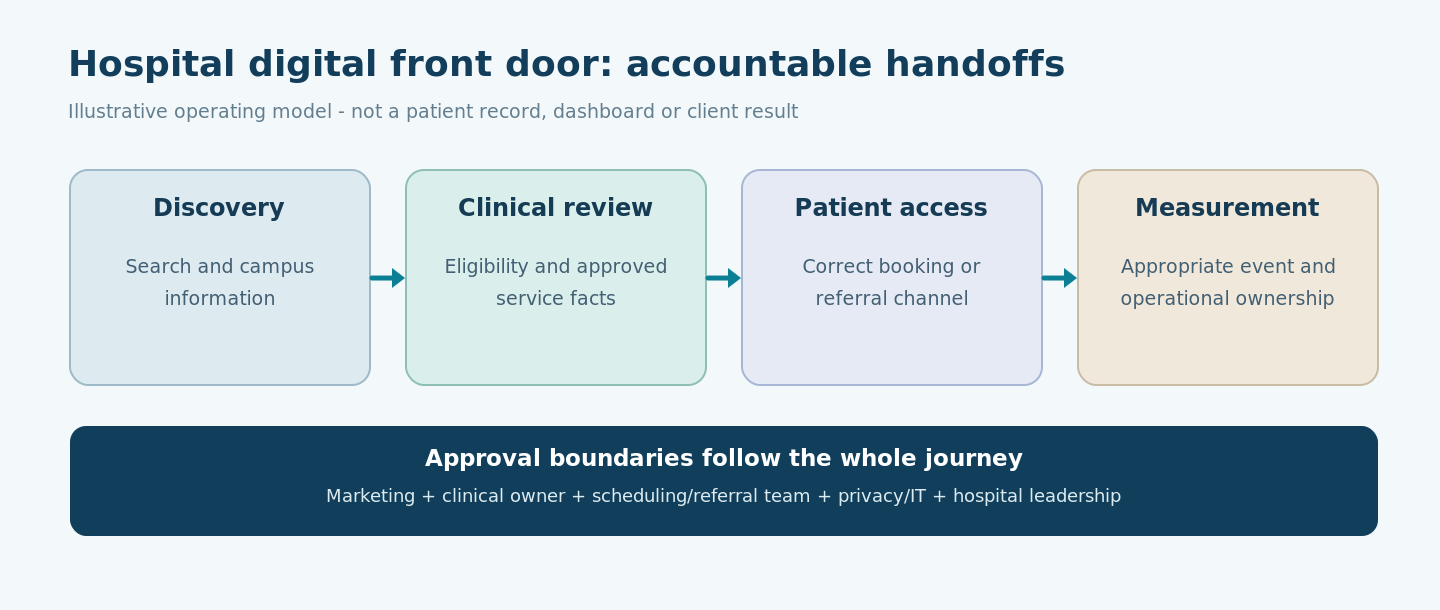
Discovery
Search and campus information
Clinical review
Eligibility and approved service facts
Patient access
Correct booking or referral channel
Measurement
Appropriate event and operational ownership
The hospital website is often the first accessible explanation of where care happens and how to contact the right team. A polished interface alone is not sufficient when a visitor cannot find a consultant, reach the right campus or understand what an appointment entails. Healthcare website design should connect content design to operating reality.
A useful hospital digital front door includes clear navigation by service, location and clinician, accessible mobile layouts, accurate wayfinding, suitable appointment and referral options, timely content governance, and distinct pathways for general information, elective care, urgent instructions and professional referrals. Patient portals and medical-record transactions remain within approved clinical systems; marketing sites should not independently create unsafe intake or tracking pathways.
A Practical Page Brief: Outpatient Cardiology at Campus B
Consider an illustrative two-campus hospital group. Campus A operates a broader acute hospital site. Campus B offers scheduled outpatient cardiology appointments. A visitor searching for a cardiologist arrives at a generic system page with a central phone number and no campus distinction. The solution is not immediately to buy more PPC traffic.
| Page component | What must be verified | Implementation decision |
|---|---|---|
| Service scope | Approved outpatient cardiology services | Describe only services truly offered |
| Campus | Campus B address and hours | Link directly to the correct site |
| Clinicians | Current roster, qualifications and locations | Use verified profiles and service associations |
| Access | Referral rules, booking method and eligibility | Show the approved pathway and contact destination |
| Patient information | Parking, accessibility, preparation where appropriate | Provide operational details, reviewed by the hospital |
| Measurement | Suitable enquiry types and booking confirmation method | Separate website actions from confirmed appointments |
The resulting web journey is search or referral → clinically approved service explanation → actual campus and clinician → eligible contact route → hospital-confirmed outcome. This is an illustrative model, not a DigiTaTop hospital client result.
Hospital PPC and Paid Media: Capacity-Aware Campaigns
Healthcare PPC may support eligible hospital services when the campaign’s message, geography, location, service availability and destination page are aligned. Useful search intent can be service-led or location-led. Campaigns should exclude irrelevant or unsuitable demand and respect advertising platform restrictions, sensitive health policies and hospital-specific approval processes.
A sample hospital PPC review can specify ad groups by approved service line, relevant campus, verified eligibility, negative-keyword considerations, approved ad copy, landing-page acceptance tests and an operational reporting owner. The hospital should decide which services can accept enquiries; the agency should not optimize toward capacity that does not exist. Patient-list remarketing, inferred health conditions and unapproved sensitive information transfers must not be assumed as standard tactics.
The better PPC question: Can the hospital safely receive, qualify and act on the enquiries this campaign is intended to generate? If not, improve the pathway first.
Hospital Brand Strategy, Reputation, Content and AI Search
Hospital brands must be recognizable across facilities while remaining specific about real local services. Healthcare branding can help align institutional messaging, campus presentation and design standards; healthcare social media can support approved education and community communication. Neither should rely on invented patient stories, unsubstantiated awards or implied treatment guarantees.
Clinical Review and the Editorial Approval Chain
Every material service claim should have a clinical owner who can verify what is offered, where, to whom and under what conditions. Hospital content governance can establish author/reviewer roles, review dates, source records, approval thresholds, accessibility checks and a procedure for removing outdated details. DigiTaTop’s medical editorial standards provide the public-facing starting point for this approach.
Hospital AI Visibility Assessment: What Can Search and AI Systems Verify?
An effective hospital AI visibility assessment starts with a dated list of real patient and referrer questions, then checks the public facts an AI answer could legitimately draw on. The aim is accurate discoverability and consistent public information.
| Example question to test | Evidence to inspect | Acceptance criterion |
|---|---|---|
| Which campus offers outpatient cardiology? | Campus page, service page, current public directory | Correct campus and available service are stated consistently |
| How do I find an orthopedic consultant? | Consultant directory, credentials, hospital location | Current clinician relationship and approved contact route are discoverable |
| Can I book a diagnostic scan at this facility? | Service inventory, referral requirements, campus booking information | Eligibility and facility details are not guessed |
| How does a clinician refer a patient? | Referral information, verified contact channels | A current professional route is available without exposing patient records |
| What evidence supports this hospital's stated expertise? | Clinician profiles, sources, editorial review, third-party corroboration | Claims can be traced to attributable public information |
For every question, record the test date, target geography, AI/search surface, exact prompt, visible answer, cited sources, official hospital truth source, discrepancy severity, owner and retest date. A failed or absent citation is recorded as an observation, not presented as definitive proof of poor ranking. Results can change between sessions and platforms. The findings register makes it easier to assign corrections and check them again.
GEO and AI-Search Readiness for Health Systems
Search engines and AI-enabled discovery systems may use hospital websites, professional profiles, local listings and third-party references to answer questions about care. Healthcare AI search optimization should focus on accessible and consistent facts: hospital identity, campuses, services, clinicians, author or reviewer signals, publishing history and clear referral/appointment instructions.
We focus on understandable, attributable information about the hospital, its services and its access routes. Where AI-visibility testing is undertaken, record the prompt set, sources, observation dates, limitations and changes in public information without presenting invented citation counts as results.
A Practical Hospital Marketing Measurement Framework
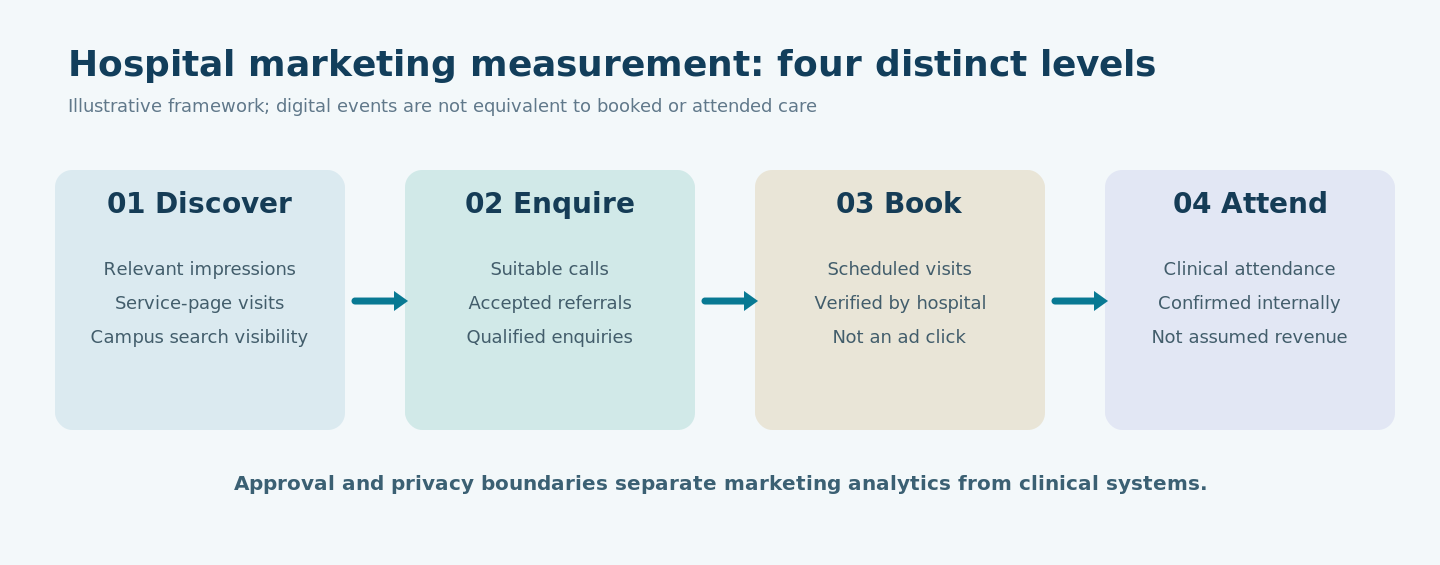
| Stage | Useful indicator | Evidence owner | Interpretation limit |
|---|---|---|---|
| Discovery | Relevant impressions, non-branded clicks and campus visibility | SEO / analytics | Visibility does not establish appointment demand |
| Engagement | Service-line visits and usable referral/booking interactions | Web / analytics | A click is not a completed referral |
| Suitable enquiries | Qualified calls or accepted digital enquiries where measured lawfully | Access operations | Requires agreed eligibility criteria |
| Booking | Hospital-confirmed scheduled visits or accepted referrals | Hospital systems | Separate scheduling from marketing attribution |
| Service access | Attendance, cancellations and capacity by approved aggregate | Hospital operations | Do not export patient records to ad tools |
| Governance | Clinical approvals, accessibility and data-flow checks | Compliance / clinical teams | Compliance needs qualified organizational review |
The dashboard should let leadership compare campuses and service lines without exposing identifiable patient information to marketing vendors. Some hospital systems can measure only public website actions at first. That limitation should be clearly documented rather than concealed behind an assumed patient-acquisition number.
Hospital Marketing in the USA and UK
| Area | United States | United Kingdom |
|---|---|---|
| Common organizational language | Health systems, hospitals, physician groups, outpatient centers | NHS trusts, independent/private hospitals, consultants, outpatient services |
| Access information | Insurance and network participation where applicable, referrals, provider availability | NHS/private pathways, consultant referrals, self-pay or insurance where applicable |
| Digital local discovery | Hospital campuses, eligible departments and public-facing practitioners | Facility and service information, local searches, consultant and referral details |
| Privacy review | HIPAA applicability, PHI data flows, marketing permissions and vendor relationships | UK GDPR, special-category health data and applicable PECR requirements |
| Advertising | Platform healthcare policies, claim substantiation, local eligibility | CAP/ASA advertising requirements, clinical claims, platform policy and privacy |
No hospital should imply that its pathways are identical to another institution’s. The marketing program must be adapted to the hospital’s actual jurisdiction, public/private service arrangement, available clinical services and internal approval process.
US Hospital and Health System Marketing Example
For an illustrative US health system, a person researching an orthopedic specialist may need the hospital campus, an eligible clinician, relevant insurer/network details where published, a referral requirement and a working scheduling route. The marketing team can improve discoverability, but the hospital verifies physician availability and the operational definition of an accepted appointment. Campaign measurement should never pass identifiable clinical information into advertising platforms without appropriate legal and technical review.
UK NHS and Private Hospital Marketing Example
In the UK, a private hospital marketing campaign may need to distinguish self-pay, private insurance and consultant-led referral routes for an elective service. An NHS organization’s public information may instead prioritize the correct service access, locations and referral explanation without optimizing for self-pay conversion. Treatment eligibility, claims and waiting-time statements require the relevant organization’s approval. This distinction matters more than changing American spellings to British ones.
Privacy, Sensitive Data and Trust
Marketing measurement should use information appropriate to the hospital’s approved data flows. Patient diagnoses, medical records and identifiable care information belong in approved hospital systems. The hospital’s legal, privacy and IT teams review the proposed tracking and vendor arrangements before implementation.
Urgent and emergency service instructions must be accurate, prominent where needed and owned by the hospital’s clinical operations; not replaced by an appointment marketing funnel.
The DigiTaTop Hospital Growth Assessment: A Defined Decision Framework
Hospitals rarely need another generic traffic report. They need evidence that helps a marketing director, service-line leader or executive committee decide which campuses and services to prioritize, whether enquiries are appropriate and whether the digital access path is fit for purpose. DigiTaTop’s Hospital Growth Assessment focuses the review on that decision.
The engagement begins by identifying the decision owner and approved review scope. Work may start with one service line, one campus or a defined set of facilities. The following are illustrative deliverable categories, not items automatically included in every paid or introductory engagement:
| Assessment output | What the hospital receives if included in scope | Sign-off or acceptance check |
|---|---|---|
| Campus × service-line register | Locations, offered services, operational owners, links and access routes | Hospital confirms each entry against actual operations |
| Search and AI visibility evidence sheet | Queries, question set, publicly observable citations and dated discrepancies | Reproducible findings with source URLs and limitations |
| Digital front-door review | Key patient/referrer journey, accessibility and contact-route blockers | Correct destination, appropriate intake and owner confirmed |
| Marketing risk and governance register | Claims needing review, privacy/tracking questions and responsible approvers | Legal/clinical/IT owner accepts or rejects each item |
| Prioritized opportunity plan | Recommended work by business impact, evidence confidence, effort and dependency | Hospital approves priorities and decision owners |
| Measurement specification | Definitions for interactions, suitable enquiries, referrals and confirmed bookings | Marketing and hospital operations agree what can be measured |
Example review sequence: a scoping discussion → a verified document and public-site inventory → evidence collection against agreed questions → a working findings review with hospital stakeholders → a prioritized action register. The statement of work identifies the pages and systems reviewed, access needed, excluded activities, deliverables, acceptance criteria and timing. DigiTaTop may implement later, but recommendations can also be delivered to a hospital’s existing team or another agency; any implementation is separately agreed.
Hospital Procurement and Clinical Stakeholder Readiness
A hospital marketing proposal should specify who signs off clinical claims, department/service availability, privacy and security arrangements, accessibility, procurement requirements, brand review, IT access and call/appointment routing. Procurement teams may also require a data-processing agreement, supplier onboarding and insurance or security review where applicable. Those are hospital-specific dependencies; the proposal identifies the responsible reviewers and required approvals.
A useful acceptance test: a service-line page can be signed off by an authorized clinical owner, points to the correct campus and access route, and has a documented measurement limitation. A high impression count alone is not an accepted hospital marketing deliverable.
First 90 Days: From Evidence to Controlled Improvement
A marketing director may start with confusing outpatient service pages; a health system may need a campus-to-service inventory before a migration. The responsible hospital teams validate the diagnostic findings and agree the 30/60/90-day priorities before implementation.
| Phase | Working activities | Acceptance criteria |
|---|---|---|
| Days 1-30 | Verify locations, departments, services, access routes and analytics boundaries | Signed-off service/campus registry, agreed goals and risk register |
| Days 31-60 | Improve priority service pages, internal links, listings and approved campaigns | Reviewed pages, verified contact paths, documented QA and ownership |
| Days 61-90 | Evaluate suitable enquiries and governance, refine next priorities | Clear before/after observations, reporting limitations and next-quarter plan |
This sequence is an example framework, not a promise that every hospital will have an integrated campaign live within 90 days. Approvals, technology access, clinical review and the number of facilities determine the schedule.
Hospital Marketing Pricing and Working Arrangement
Hospital marketing engagements are scoped according to the number of campuses, priority service lines, website complexity, channels, content-review owners, analytics boundaries, procurement requirements and reporting responsibilities. Our healthcare marketing pricing and packages provide general reference points; a hospital-wide or multi-campus statement of work needs a tailored proposal with clear exclusions.
A hospital can request a focused assessment or discuss a defined service-line project before considering a larger engagement. Share your hospital marketing priorities and the public website; please do not send patient records or detailed medical histories through a general enquiry form.
Hospital Marketing Assessment: The Right First Conversation
Request a Hospital Growth Assessment if you need to decide which campus, service-line or patient-access problem should be addressed first. Share your hospital’s website and objectives so DigiTaTop can discuss a focused review versus a broader health system marketing engagement.
Tell us your organization, role, official website, country, campus count, priority service lines and current digital challenges so we can prepare a relevant follow-up. Do not submit patient details, diagnoses, referral documents or medical records through this general marketing form.
What Happens After an Enquiry?
DigiTaTop reviews the organizational context and clarifies the decision the hospital needs to make. The parties then agree whether there is a suitable scoped assessment, which information can be reviewed, who approves clinical and operational facts, and whether the project requires a written proposal. The proposal confirms the assessment scope, timing, deliverables and commercial terms.
Why Choose DigiTaTop for Hospital Marketing
DigiTaTop’s proposition is a healthcare-focused, scope-led approach: clarify services and locations, remove digital access friction, prioritize channels around hospital decisions and document what can be measured responsibly. We recommend a defined scope around your priorities, agreed deliverables and practical reporting.
You can explore our services, process, healthcare audiences, medical specialties and editorial standards to assess whether the approach fits your organization. Explore our documented process, editorial standards and example deliverables to understand how an engagement can work. Illustrations are not client case studies. Discuss your priorities and the evidence you need with our team before choosing an engagement.
Frequently Asked Questions About Hospital Digital Marketing
What does a hospital digital marketing agency do?
It helps hospitals and health systems organize and improve public-facing search visibility, local listings, websites, service-line content, eligible paid campaigns and measurement. The work should be scoped to actual facilities, clinical services, patient/referral pathways and accountable hospital teams; not simply increased traffic.
Can DigiTaTop work with a multi-hospital healthcare group?
Yes. The service can be scoped around several campuses and departments, with a system-to-campus architecture, service inventory, prioritized workstreams, reporting framework and named approval owners. Delivery depends on the agreed facilities, access, governance and scope.
How is hospital SEO different from marketing an individual doctor?
Hospital SEO must connect an institution to multiple real locations, departments, clinician profiles, eligibility rules and varied appointment or referral routes. Doctor marketing usually focuses on a narrower, verified provider-service-location relationship.
Should every hospital department have its own Google Business Profile?
No. Google permits separate profiles for certain genuinely distinct, publicly facing departments and eligible practitioners, but not every internal department or keyword variation qualifies. Each proposed listing should be checked against Google’s current requirements and the hospital’s actual operations.
Can you run Google Ads for hospital procedures and specialist services?
Eligible services can be considered for paid-search campaigns after verifying the offered care, geographic and referral suitability, available capacity, clinical claims, landing-page information, platform policy and privacy constraints. An agency cannot guarantee ad approval or patient outcomes.
How would you improve a hospital website without harming existing SEO?
Start with an inventory of current URLs, traffic, indexation, service ownership and referral paths; map destination pages and redirects; preserve legitimate canonical relationships; test technical and accessibility changes; and verify search and conversion behavior after release. A staged rollout is preferable to an unreviewed rewrite.
What results should hospital marketing teams measure?
Track appropriate visibility and web interactions alongside qualified enquiries, accepted referrals and scheduled visits where hospital systems can lawfully and reliably supply that information. Never equate website form submissions with attended patients or revenue without a verified measurement link.
How much does hospital digital marketing cost, and when do we pay?
Pricing depends on campus count, service lines, channels, content and technical scope, review requirements and reporting. DigiTaTop publishes general healthcare service prices, while larger hospital engagements require a tailored proposal. Agency fees are billed after completed one-time work or each completed recurring service period; third-party charges and contract-specific terms are separate.
Build a Hospital Marketing Plan Around Care People Can Actually Access
Whether you lead an independent hospital, specialty hospital, marketing department or multi-campus healthcare group, the most valuable first step is to identify the hospital services and patient/referral journeys worth improving. DigiTaTop can help turn that decision into an approved, measurable marketing scope.