
Digital Marketing for Dermatologists & Cosmetic Dermatology Clinics
DigiTaTop is a dermatology marketing agency helping individual dermatologists, skin clinics and multi-location practices improve search visibility, websites and consultation enquiries. We plan around the different needs of medical skin consultations, elective cosmetic services and referring clinicians.
Connect the right practitioner, service, clinic location and enquiry route with a focused strategy for the United States, United Kingdom or your agreed target market.

Dermatology Marketing Services for Doctors & Skin Clinics
The word dermatology describes a clinical specialty, not a single business model. An independent dermatologist’s professional reputation and referrals may be central to discovery. A multi-specialty skin clinic must explain which clinician offers which consultation or service. A group with several branches must also distinguish availability, booking routes and clinician schedules across locations.
For medical dermatology marketing, the audience may be comparing care for acne, eczema, psoriasis or persistent skin concerns, or seeking a qualified clinician to assess a changing lesion. These searches call for carefully reviewed educational information and a clear consultation route for professional assessment. For cosmetic services, people may be evaluating an elective consultation, the treating professional, suitability, limitations, risks and expected costs. A referring clinician needs a different page explaining referral requirements, specialist scope and professional contact details. These visitors should not be pushed into the same generic conversion funnel.
| Practice model | Main information challenge | Marketing priority to assess |
|---|---|---|
| Individual dermatologist or consultant | Verified name, qualifications, areas of practice and consultation locations | Professional profile, local search, useful condition and consultation information |
| Medical dermatology clinic | Multiple services and practitioner availability | Clear service-to-clinician paths, medical review and appointment requests |
| Cosmetic dermatology clinic | Elective decision-making, suitability and claims | Qualified-practitioner information, risk-aware explanations and enquiry screening |
| Multi-location dermatology group | Which services and clinicians are available at each branch | Location-specific pages, local business information and enquiry routing |
A dermatologist-led medical practice and an aesthetics-led business may have different operator credentials, professional responsibilities, treatment offerings and patient journeys. A medical-spa business is not automatically the same as a dermatologist-led clinic. Medical spa SEO and med-spa marketing can involve different service scopes, operators and regulatory requirements. We would assess the actual provider and its claims before deciding whether they belong within a dermatology project.
Dermatology SEO & Local Search for Dermatologists
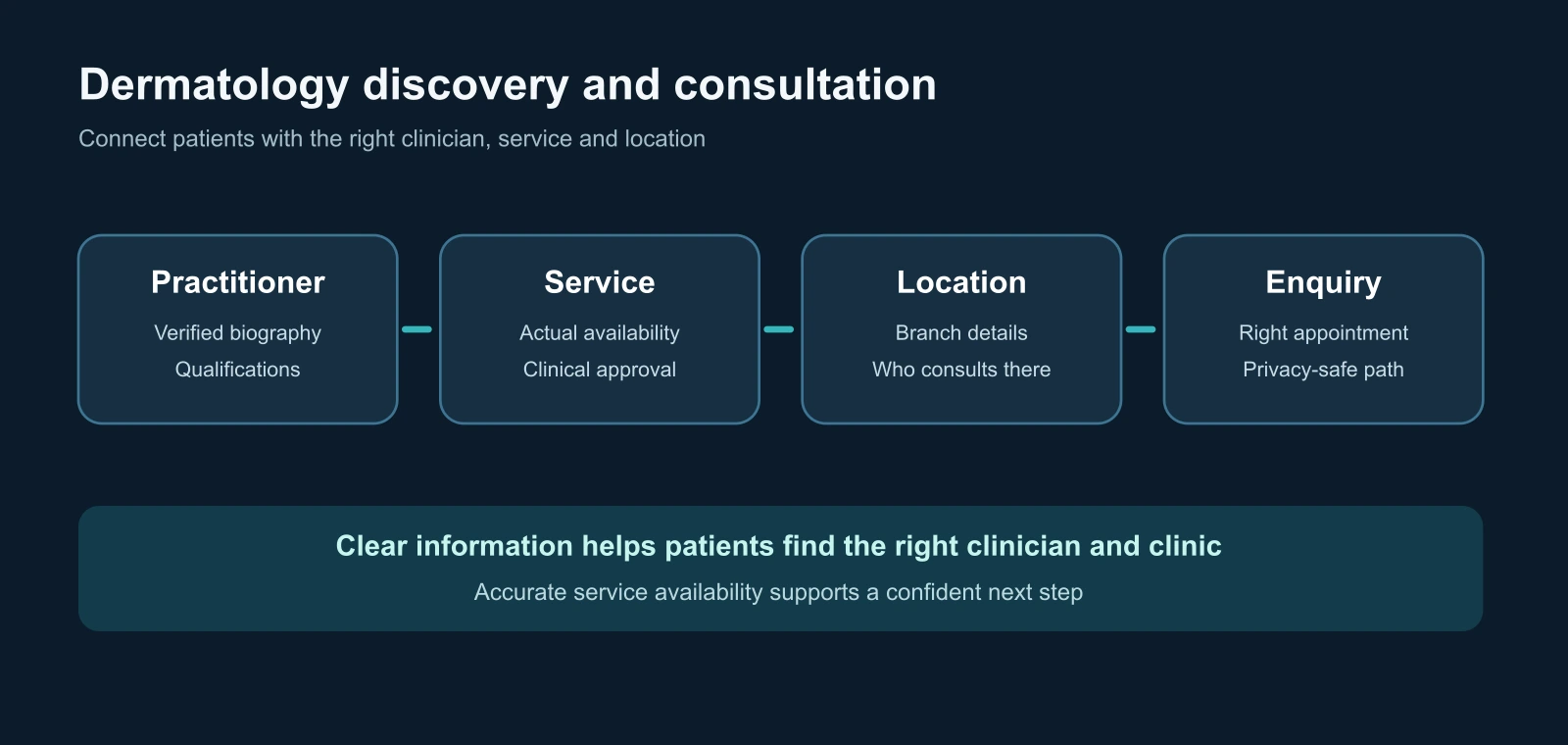
Dermatology search engine optimization, including skin clinic SEO, is not simply creating a page for every condition or treatment keyword. It starts with verifying the services actually available, distinguishing educational questions from requests for a consultation, and helping visitors find the appropriate professional or location. A useful plan covers crawlability, content structure, practitioner identity, internal links, local signals and genuine enquiry paths.
A patient searching for a named dermatologist may need a concise professional biography, affiliations, consultation hours and directions. Someone researching a medical skin concern usually needs medically reviewed information explaining when professional assessment may be appropriate. An elective-treatment researcher may need a responsible description of consultation, suitability assessment, alternatives, limitations and practical next steps.
For a dermatology practice, we connect marketing for doctors and medical specialists with clear clinic-level information, so visitors can understand who provides each consultation and where. Site structure should clarify which pages represent the clinician, the practice, a location, an approved service and a general education topic.
Local SEO for Dermatologists & Skin Clinics
Local SEO for dermatologists should accurately reflect real practice addresses, public-facing clinicians, service categories and appointment availability. We assess the relationship between the clinic’s Google Business Profile and any eligible practitioner profiles rather than automatically creating listings for every staff member. A practitioner profile needs to satisfy Google’s own public-facing eligibility rules.
Multi-location clinics benefit from distinct location pages that confirm the services and clinicians at each site. Each location page helps a visitor identify the actual branch, clinician, approved information, directions and contact method that applies to their query.
Dermatology Website Design, UX & Consultation Conversion
Dermatology website design should make the next step easy without disguising medical uncertainty. The website needs to work on mobile, demonstrate practitioner accountability, keep medical and elective services distinct, and clearly explain how to request a consultation. Design decisions should support the patient’s information needs, not just the visual style.
A useful dermatologist website can include a verifiable team directory, clinician bios, relevant service pages, locations and hours, privacy-aware enquiry forms, accessibility-conscious navigation, and a managed process for keeping medical content current. US practices may need clearly presented insurance participation and self-pay arrangements where applicable; UK private practices may need referral and consultant-appointment information. These details should be checked with the provider rather than inferred from competitors. Dermatology web design should also address fast-loading images, appropriate alt text, usable text contrast and reliable appointment routes.
| Page element | What a visitor should learn | Conversion or trust role |
|---|---|---|
| Practitioner biography | Who the clinician is, verifiable qualifications and where they consult | Professional credibility and correct clinician selection |
| Medical dermatology consultation page | Scope of consultation, what to expect and how to seek assessment | Reduces uncertainty without implying a diagnosis |
| Cosmetic dermatology consultation page | Assessment process, limitations and responsible next steps | Supports informed enquiry rather than unrealistic promises |
| Location page | Real hours, access details, clinicians and services at that site | Sends the visitor to the correct branch |
| Enquiry route | Which information to share and how to request contact | Supports qualified requests without gathering unnecessary health data |
For a major redesign, our healthcare website development service can be scoped around existing search visibility, URL mapping and content migrations. We preserve useful practitioner and service information so visitors can continue to find answers to specific questions.
Medical vs Cosmetic Dermatology Marketing
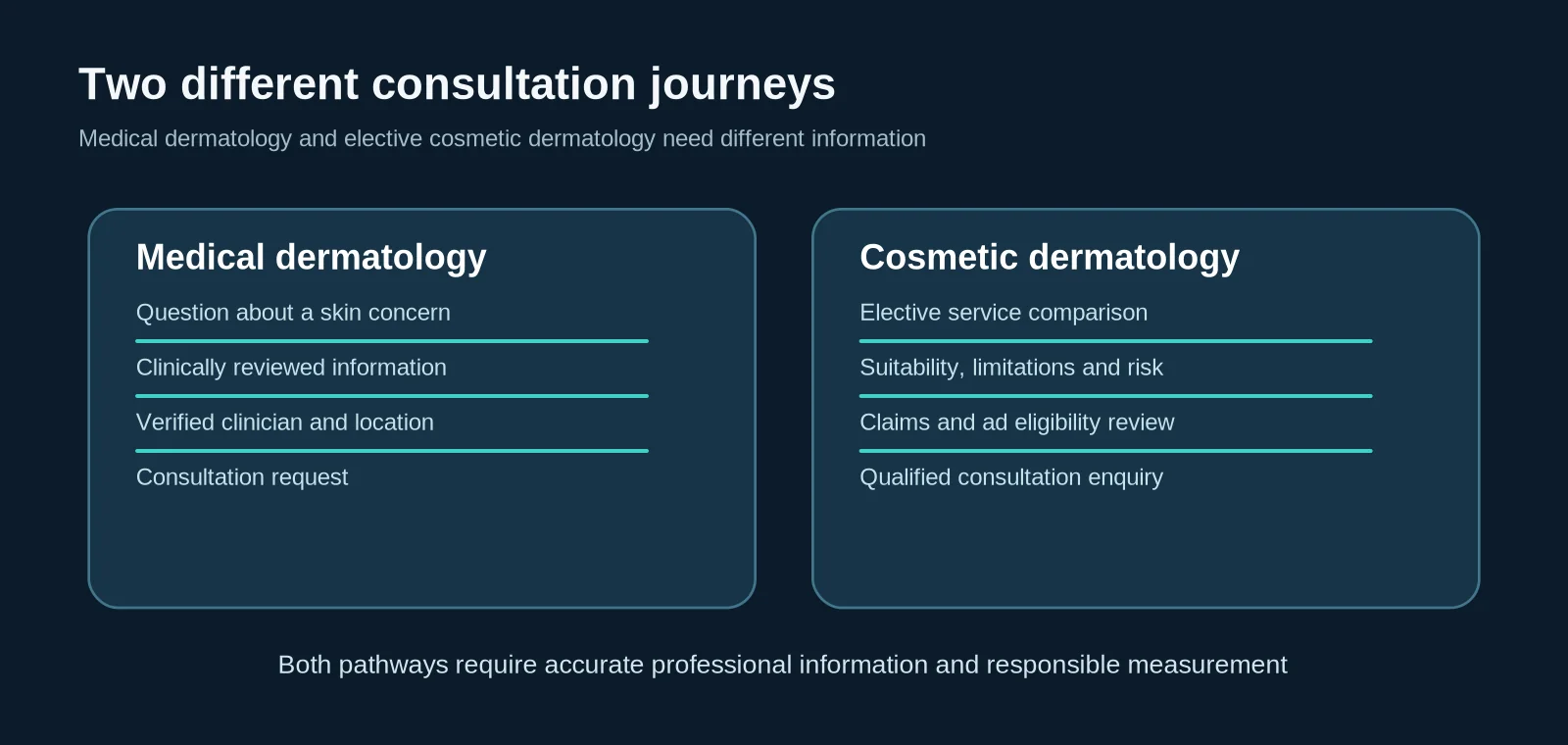
Cosmetic dermatology marketing requires a distinct tone and approval workflow because many visitors are considering elective interventions. A medical dermatology pathway may start with symptom-related educational content and progress toward a qualified consultation. An elective pathway may start with service comparison and proceed to a suitability discussion. A professional-referral pathway may begin with the specialist’s expertise and referral criteria. None of these is interchangeable with a sales-only landing page. Information about suitability, benefits, possible risks, alternatives and realistic expectations should not be reduced to a discount-led message or a promise of an outcome. The responsible practitioner or appropriate clinical reviewer must approve medically substantive content.
A dermatology clinic might offer medical consultations and a separate elective service line. Those audiences can share the same brand and site, but not always the same advertisements, consent requirements, or booking qualification. Service-page language should be proportionate to what the organization is licensed, qualified and actually equipped to offer.
Medical aesthetics marketing may be relevant to certain dermatology practices, but it is not interchangeable with a general medical dermatology service. Likewise, med spa marketing agency searches can reflect different buyers and provider credentials. DigiTaTop’s proposed engagement would first establish who operates the service and which claims can be made in the target market.
Responsible UK Cosmetic Advertising
For UK-facing campaigns, the advertising rules require particular attention to cosmetic interventions and prescription-only medicines. Public advertising of prescription-only botulinum toxin products is restricted; even website and social-media wording can constitute promotional advertising. The UK CAP Code guidance also prohibits cosmetic-intervention advertisements from being directed at under-18s through audience targeting or media context. Campaigns therefore need service-specific legal and clinical review instead of assuming any cosmetic treatment may be promoted freely.
Professional titles, claimed expertise, patient images, testimonials and before-and-after material also require substantiation and appropriate permissions. Promotional content must not minimize treatment risks, pressure vulnerable people or imply guaranteed results. The same clinical and advertising claims should be reviewed when creating website copy, social posts or paid landing pages.
Google Ads for Dermatologists: Campaign Eligibility Before Spending
Google Ads for dermatologists can be considered where the service, geography, ad content and audience targeting are eligible. Google treats health-related interests as sensitive for personalized advertising and restricts certain targeting methods. An eligible search campaign still needs a relevant landing page, suitable claims, appropriate privacy controls and a clinic ready to handle real enquiries.
A useful paid-search readiness review asks: Is the advertised consultation actually offered by the provider? Is the practitioner and location clear? Could the ad be interpreted as promising treatment eligibility or results? Does the landing page help users make a responsible decision? Can meaningful business enquiries be measured without transmitting sensitive medical data to ordinary advertising tools?
Paid clicks, form submissions, qualified appointment requests and attended consultations are different outcomes. Reports should label them separately. Read more about our healthcare PPC management approach.
Dermatology Content Marketing, Reputation & AI Search Visibility
Dermatologists often need to explain the difference between medical information and an individual diagnosis. Practical, medically approved educational content can answer common questions about the consultation process, professional assessment, referral needs and what information to prepare. It should not pretend that a website can diagnose a visitor or establish an individual’s suitability for a procedure.
For social media, the clinic may prioritize practitioner introductions, general education, service-access updates or responsibly reviewed non-promotional information. Consent and disclosure requirements matter for images of identifiable patients. Our healthcare social media management can be scoped around the clinic’s actual approvals and content capacity.
Dermatology Reputation Management & Legitimate Patient Feedback
Dermatology reputation management is an accuracy and service-communication responsibility, not a promise to remove unfavorable reviews. For a skin clinic, a practical review process can verify public clinic information, identify unanswered service questions, and guide staff on respectful responses that do not disclose patient information. Google’s review policy prohibits paid or incentivized reviews, review gating and selectively asking only satisfied people for positive ratings. Practices can invite genuine feedback without pressuring patients or sharing clinical details.
Dermatology social media marketing should serve clear patient-information goals, such as practitioner introductions, appointment logistics and clinically reviewed education. Before-and-after images, testimonials and cosmetic claims require appropriate consent, evidence and applicable advertising approval. Their availability in a content library does not mean they are suitable for every campaign.
AI Search and Verified Practitioner Information
AI-assisted discovery introduces another reason to keep entity relationships consistent. Dermatology web marketing should make it clear who the clinician is, which clinic they work with, what consultations are available and where. Healthcare GEO and AI-search optimization can assess how those facts are represented and referenced, but no provider can guarantee placement in third-party AI answers.
Dermatology Marketing in the United States and United Kingdom
Dermatology marketing needs locally accurate information, even when the practice serves similar patient needs in both countries. A US visitor may want to know the practice’s accepted insurance plans, self-pay options, appointment access and whether a particular board-certified practitioner consults at that site. A UK private patient may need to understand whether a GP referral is required, which consultant delivers the service, private consultation arrangements, and location-specific access. Claims about insurance participation, board certification, GMC registration, referrals or fees must be verified for the actual provider before publication.
For US campaigns, health-related advertising claims and endorsements require substantiation; privacy and state-specific professional rules may also affect patient stories and marketing data. For UK campaigns, relevant GMC, ASA/CAP and privacy requirements shape how qualifications, cosmetic interventions, testimonials and promotional content are presented. DigiTaTop plans the marketing material and review workflow, while the practice’s appropriate professionals and advisers remain responsible for medical accuracy and applicable compliance decisions.
What a Dermatology Marketing Assessment Can Deliver
A decision-ready assessment should answer which clinical information, search visibility or appointment-path issue deserves attention first. The deliverables below illustrate a possible scoped dermatology marketing assessment; the exact pages, practice locations, meeting time, report format, timeline and revisions are specified in the individual proposal, with the included work clearly confirmed.
| Proposed deliverable | What the practice can review | Decision supported |
|---|---|---|
| Practitioner, service and location inventory | Selected clinician profiles, stated services, actual consulting sites and mismatches | Correct inaccurate public information before promotion |
| Dermatology SEO and local search findings | Prioritized page/content issues and location-profile observations within agreed scope | Select high-intent information and technical fixes |
| Medical-versus-cosmetic journey map | Two distinct consultation information paths, including risk and qualification boundaries | Separate educational, elective and referral enquiries |
| Website and appointment-path review | Mobile, navigation, accessibility, form and contact-route findings | Reduce uncertainty and failed appointment requests |
| Paid media and reputation-readiness notes | Eligibility questions, landing-page risks, privacy boundaries and legitimate review practices | Decide if promotion should begin or be deferred |
| Written priority roadmap | Suggested actions, owners, dependencies and sequence | Define the next commercial engagement and approvals |
Illustrative prioritization: A skin clinic advertises consultations in two cities, but one location page names a dermatologist who no longer consults there. Correcting the clinician’s availability and appointment route may have a higher priority than increasing advertising. This hypothetical example shows how we prioritize improvements.
A discovery conversation should also identify the client’s main goal, ownership of website and advertising accounts, the person authorized to approve clinical copy, available non-sensitive reporting data and the budget boundary. Any audit depth beyond the signed scope is separately agreed. Compare our healthcare marketing packages or request a defined dermatology proposal.
Starting With a New Practice or Improving an Established Clinic
Launching a Dermatology Practice
New dermatologist-led practices often need their professional identity, website, correct location information, consultation services and enquiry handling established before paid promotion. An initial conversation can review the intended audience, practitioner credentials, approved services, target city and whether the appointment route is ready for visitors.
If you are launching, mention your specialty, proposed practice locations, website status and target consultation services when you contact us.
Growing an Established Dermatology Clinic
Existing practices may need to reconcile several clinicians and branches, update medical content, improve local visibility, identify gaps in web design or evaluate campaign efficiency. Clinics with medical and cosmetic services should map those journeys separately and agree who approves claims and patient-facing material.
For an established clinic, share your website, actual offered services, existing practice locations and the main enquiry challenge, without submitting patient information.
Multi-location Dermatology Groups
Groups need more than a repeated local SEO template. They need verified service-clinician-location relationships, consistency across business profiles, meaningful branch pages, correct referral and enquiry routing, and reporting that distinguishes branches and services where appropriate.
For a group, identify the number of locations and whether your challenge is service availability, practitioner relationships, cross-branch routing or reporting.
How Engagements Are Scoped and Measured
A practical scope starts with a discovery discussion, review of available website and search data, selection of responsible medical approvers, agreed service and location priorities, and deliverables suitable for the organization’s size. Ongoing execution may involve SEO, content improvement, design, eligible PPC or other services, depending on the proposal.
A staged 90-day plan might first verify clinic facts and the existing enquiry experience, then address the highest-priority page and location problems, and finally evaluate visibility and lead quality. Your proposal confirms the delivery schedule and work included at each stage. Pricing depends on the actual scope; compare DigiTaTop healthcare marketing packages or request a defined proposal.
Measurement should distinguish organic visibility, location actions, approved paid activity, contacted enquiries and confirmed appointments where reliable business-level reporting is available. Medical-record information and unnecessary health details should not be collected through normal marketing forms or sent to ad platforms. Your proposal sets expected milestones and reporting definitions, with clinical and platform approvals built into the plan.
Why Work With DigiTaTop on Dermatology Marketing?
DigiTaTop’s healthcare-focused offer links practitioner accuracy, search discovery and qualified enquiries. A dermatologist’s name, clinical role, actual service and consultation location should agree across the website, business listings, landing pages and advertising. The assessment framework above shows how a project can distinguish urgent information errors from lower-priority promotional changes.
Each proposal explains the questions the work will address, responsible owners, deliverables, approvals and measurement. Prospective clients can ask to review permissioned examples of relevant work where available. Patient data, project outcomes and practitioner credentials are never presented as evidence without authorization and verification.
Learn more about DigiTaTop, review our Medical Editorial Standards, or tell us about your dermatology marketing goals.
Frequently Asked Questions
Does DigiTaTop provide digital marketing for individual dermatologists and clinics?
Yes. DigiTaTop’s services can be scoped for an individual dermatologist, a specialist skin clinic or a multi-location practice. The site and campaigns should reflect the verified clinicians, services, locations and actual enquiry process of each organization.
What is the difference between medical dermatology SEO and cosmetic dermatology marketing?
Medical dermatology SEO often focuses on accurate condition and consultation information, practitioner identity and local discovery. Cosmetic dermatology marketing also needs clear suitability explanations, responsible elective-service claims and careful consideration of advertising restrictions. The two may share a website but require distinct content and enquiry paths.
Can you improve a dermatologist's local Google visibility?
A local review can assess clinic and practitioner Business Profile eligibility, correct business details, service-location accuracy and useful landing pages. Recommendations follow Google’s eligibility rules and focus on accurate, helpful local discovery.
Do you design dermatology clinic websites?
Yes. Dermatology website design can include mobile-ready practitioner pages, approved service and consultation information, location details, conversion paths, accessibility considerations and SEO-safe migration planning, according to the agreed project scope.
Can dermatology clinics advertise cosmetic services using Google Ads?
Some services and ad formats may be eligible, but eligibility depends on treatment, jurisdiction, Google policies and targeting. Sensitive health interest targeting is restricted, and UK public advertising rules limit prescription-only medicine promotion. Every proposed campaign requires its own eligibility and claims review.
How should we present before-and-after photographs or patient stories?
Patient images and stories require suitable permissions, contextual accuracy, privacy review and applicable advertising-rule checks. Reviews should be genuine and never incentivized or selectively solicited only from satisfied patients. Images and testimonials should not imply guaranteed or typical outcomes without evidence. Some treatment categories have additional restrictions; professionally reviewed educational alternatives may be more appropriate.
What does a dermatology marketing assessment include?
The exact assessment scope is established in the proposal. It may cover practitioner and service information, selected SEO and local-search findings, clinic website experience, paid-media eligibility questions and a prioritized next-step plan. The number of pages, locations, meetings and deliverables is agreed in advance.
Can DigiTaTop support clinics in the United States and United Kingdom?
Yes. DigiTaTop supports practices targeting the USA and UK as well as other agreed markets. Regional differences include US insurance and self-pay information, UK private-consultant referrals and appointment details, practitioner rules, cosmetic advertising restrictions, privacy obligations and clinical review arrangements. The practice’s clinical and legal advisers confirm the requirements that apply to its services and marketing.
Discuss Dermatology Marketing for Your Practice
Whether you are establishing a dermatologist’s professional website, improving a medical skin clinic or coordinating a larger cosmetic dermatology group, the useful first step is to identify the people, services, locations and consultations that need accurate visibility. DigiTaTop can discuss an appropriate marketing scope and the decisions required to make it workable.